AAWSAP DIRD, Ultracapacitors as Energy and Power Storage Devices, November 2010
DOW-UAP-D147 · page 24 of 34
Text
This text came with the file. It may have mistakes. When the text and the image disagree, the image is right.
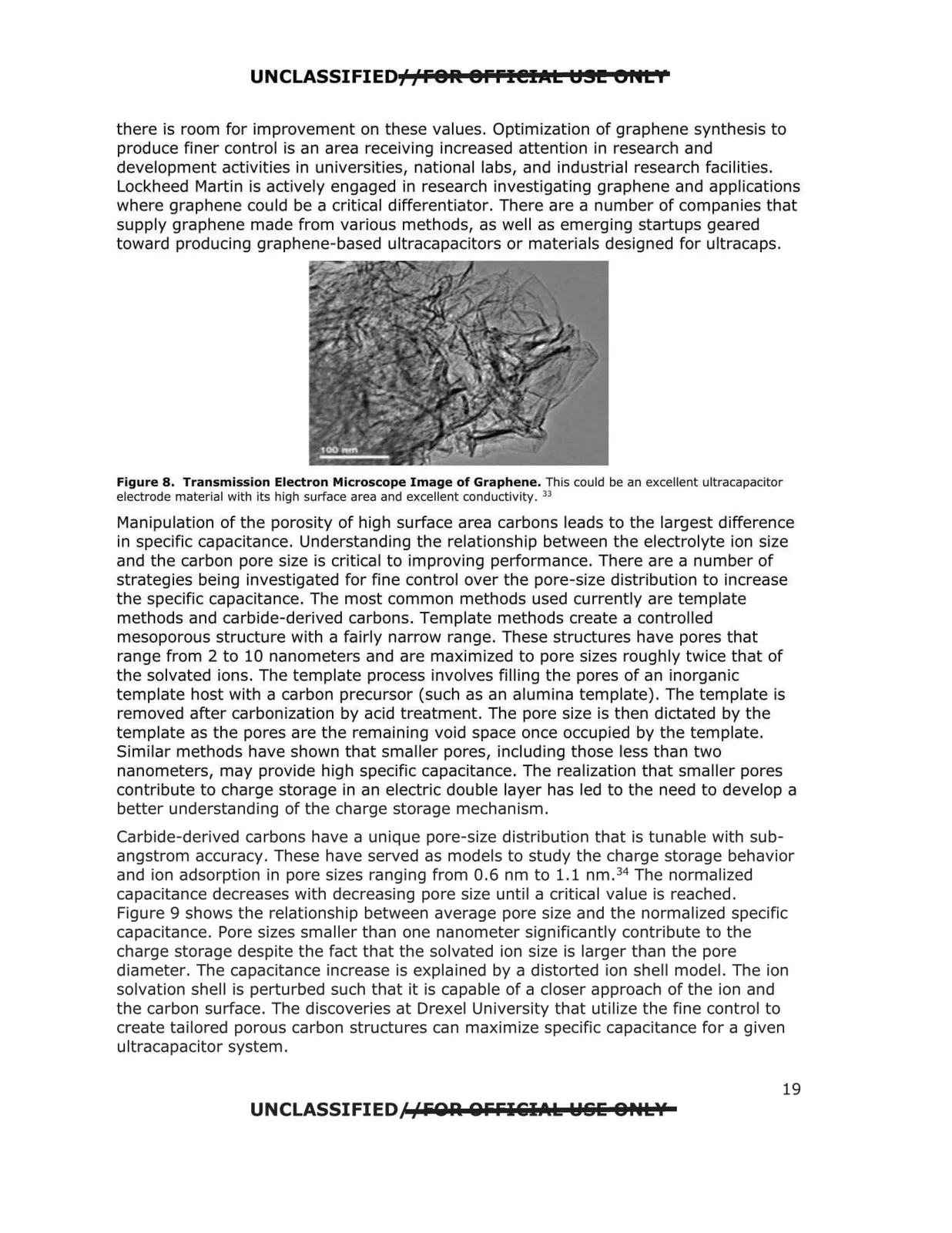
UNCLASSIFIED1/FOR 8ffl@IAL tt91! e"t I there is room for improvement on these values. Optimization of graphene synthesis to produce finer control is an area receiving increased attention in research and development activities in universities, national labs, and industrial research facilities. Lockheed Martin is actively engaged in research investigating graphene and applications where graphene could be a critical differentiator. There are a number of companies that supply graphene made from various methods, as well as emerging startups geared toward producing graphene-based ultracapacitors or materials designed for ultracaps. Figure 8. Transmission Electron Microscope Image of Graphene. This could be an excellent ultracapacitor electrode material with its high surface area and excellent conductivity. 33 Manipulation of the porosity of high surface area carbons leads to the largest difference in specific capacitance. Understanding the relationship between the electrolyte ion size and the carbon pore size is critical to improving performance. There are a number of strategies being investigated for fine control over the pore-size distribution to increase the specific capacitance. The most common methods used currently are template methods and carbide-derived carbons. Template methods create a controlled mesoporous structure with a fairly narrow range. These structures have pores that range from 2 to 10 nanometers and are maximized to pore sizes roughly twice that of the solvated ions. The template process involves filling the pores of an inorganic template host with a carbon precursor (such as an alumina template). The template is removed after carbonization by acid treatment. The pore size is then dictated by the template as the pores are the remaining void space once occupied by the template. Similar methods have shown that smaller pores, including those less than two nanometers, may provide high specific capacitance. The realization that smaller pores contribute to charge storage in an electric double layer has led to the need to develop a better understanding of the charge storage mechanism. Carbide-derived carbons have a unique pore-size distribution that is tunable with sub angstrom accuracy. These have served as models to study the charge storage behavior and ion adsorption in pore sizes ranging from 0.6 nm to 1.1 nm. 34 The normalized capacitance decreases with decreasing pore size until a critical value is reached. Figure 9 shows the relationship between average pore size and the normalized specific capacitance. Pore sizes smaller than one nanometer significantly contribute to the charge storage despite the fact that the solvated ion size is larger than the pore diameter. The capacitance increase is explained by a distorted ion shell model. The ion salvation shell is perturbed such that it is capable of a closer approach of the ion and the carbon surface. The discoveries at Drexel University that utilize the fine control to create tailored porous carbon structures can maximize specific capacitance for a given ultracapacitor system. UNCLASSIFIEO/fFOA OFFI&I:.l.b YS& ONLY 19