AAWSAP DIRD, Ultracapacitors as Energy and Power Storage Devices, November 2010
DOW-UAP-D147 · page 5 of 34
Text
This text came with the file. It may have mistakes. When the text and the image disagree, the image is right.
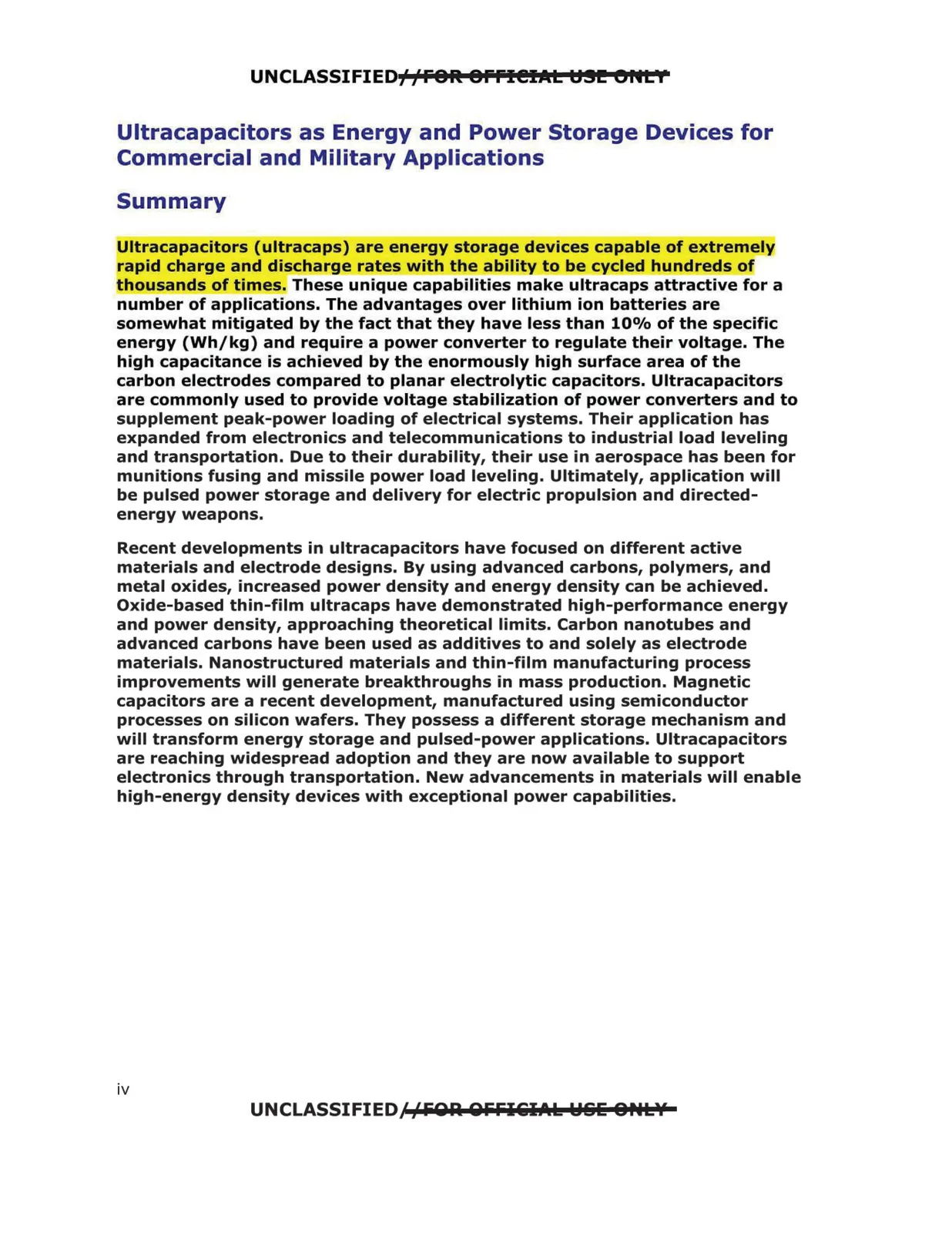
UNCLASSIFIED1fFOR 8ffl@IAL tt9! e"t I Ultracapacitors as Energy and Power Storage Devices for Commercial and Military Applications Summary Ultracapacitors (ultracaps) are energy storage devices capable of extremely rapid charge and discharge rates with the ability to be cycled hundreds of thousands of times. These unique capabilities make ultracaps attractive for a number of applications. The advantages over lithium ion batteries are somewhat mitigated by the fact that they have less than 10% of the specific energy (Wh/kg) and require a power converter to regulate their voltage. The high capacitance is achieved by the enormously high surface area of the carbon electrodes compared to planar electrolytic capacitors. Ultracapacitors are commonly used to provide voltage stabilization of power converters and to supplement peak-power loading of electrical systems. Their application has expanded from electronics and telecommunications to industrial load leveling and transportation. Due to their durability, their use in aerospace has been for munitions fusing and missile power load leveling. Ultimately, application will be pulsed power storage and delivery for electric propulsion and directed energy weapons. Recent developments in ultracapacitors have focused on different active materials and electrode designs. By using advanced carbons, polymers, and metal oxides, increased power density and energy density can be achieved. Oxide-based thin-film ultracaps have demonstrated high-performance energy and power density, approaching theoretical limits. Carbon nanotubes and advanced carbons have been used as additives to and solely as electrode materials. Nanostructured materials and thin-film manufacturing process improvements will generate breakthroughs in mass production. Magnetic capacitors are a recent development, manufactured using semiconductor processes on silicon wafers. They possess a different storage mechanism and will transform energy storage and pulsed-power applications. Ultracapacitors are reaching widespread adoption and they are now available to support electronics through transportation. New advancements in materials will enable high-energy density devices with exceptional power capabilities. UNCLASSIFIEO/fFOA OFFI&I:.l.b YS& ONLY iv