AAWSAP DIRD, Ultracapacitors as Energy and Power Storage Devices, November 2010
DOW-UAP-D147 · page 6 of 34
Text
This text came with the file. It may have mistakes. When the text and the image disagree, the image is right.
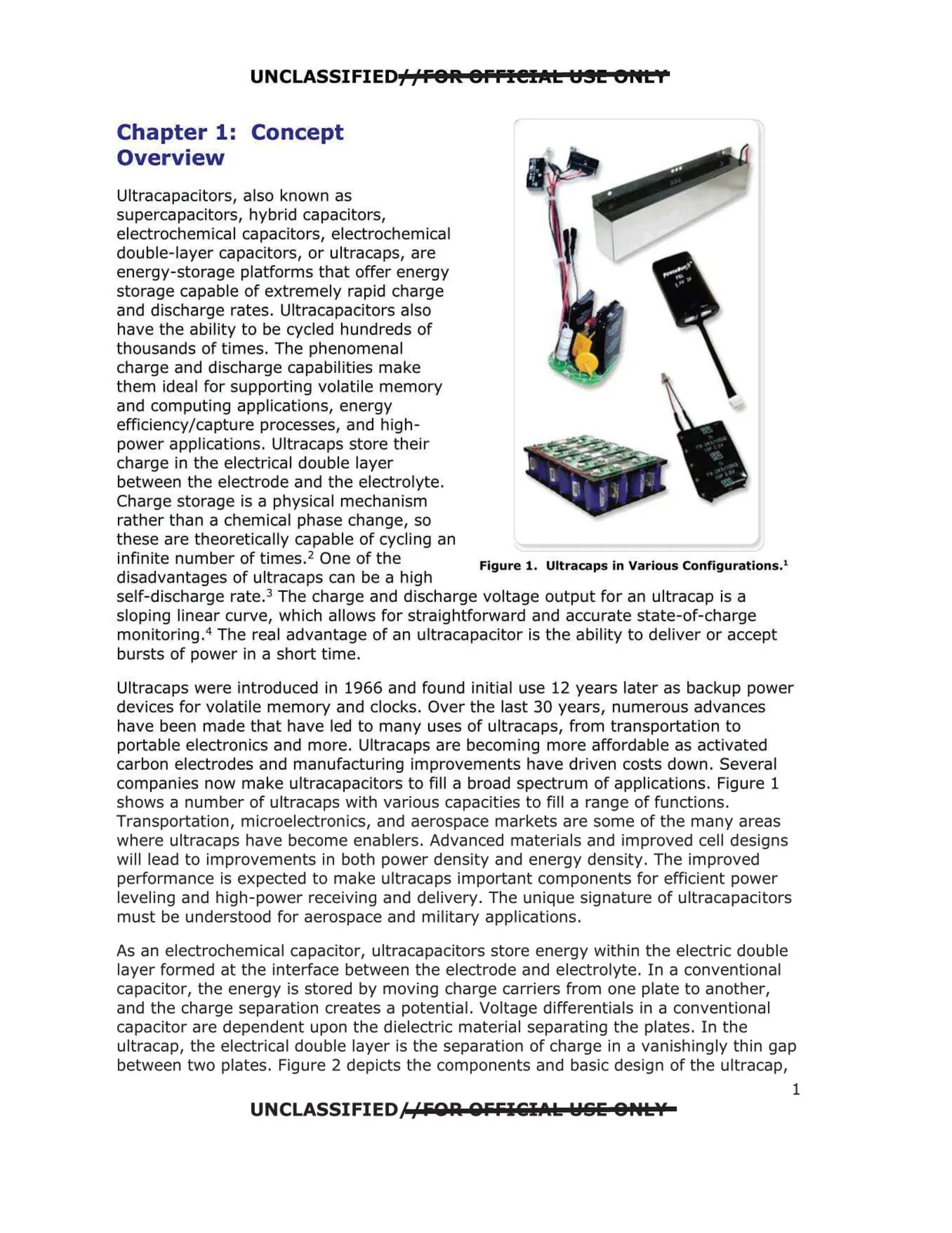
UNCLASSIFIED1/FOR 8ffl@IAL tt91! e"t I Chapter 1: Concept Overview Ultracapacitors, also known as supercapacitors, hybrid capacitors, electrochemical capacitors, electrochemical double-layer capacitors, or ultracaps, are energy-storage platforms that offer energy storage capable of extremely rapid charge and discharge rates. Ultracapacitors also have the ability to be cycled hundreds of thousands of times. The phenomenal charge and discharge capabilities make them ideal for supporting volatile memory and computing applications, energy efficiency/capture processes, and high power applications. Ultracaps store their charge in the electrical double layer between the electrode and the electrolyte. Charge storage is a physical mechanism rather than a chemical phase change, so these are theoretically capable of cycling an infinite number of times. 2 One of the Figure 1. Ultracaps in Various Configurations.' disadvantages of ultracaps can be a high self-discharge rate. 3 The charge and discharge voltage output for an ultracap is a sloping linear curve, which allows for straightforward and accurate state-of-charge monitoring.4 The real advantage of an ultracapacitor is the ability to deliver or accept bursts of power in a short time. Ultracaps were introduced in 1966 and found initial use 12 years later as backup power devices for volatile memory and clocks. Over the last 30 years, numerous advances have been made that have led to many uses of ultracaps, from transportation to portable electronics and more. Ultracaps are becoming more affordable as activated carbon electrodes and manufacturing improvements have driven costs down. Several companies now make ultracapacitors to fill a broad spectrum of applications. Figure 1 shows a number of ultracaps with various capacities to fill a range of functions. Transportation, microelectronics, and aerospace markets are some of the many areas where ultracaps have become enablers. Advanced materials and improved cell designs will lead to improvements in both power density and energy density. The improved performance is expected to make ultracaps important components for efficient power leveling and high-power receiving and delivery. The unique signature of ultracapacitors must be understood for aerospace and military applications. As an electrochemical capacitor, ultracapacitors store energy within the electric double layer formed at the interface between the electrode and electrolyte. In a conventional capacitor, the energy is stored by moving charge carriers from one plate to another, and the charge separation creates a potential. Voltage differentials in a conventional capacitor are dependent upon the dielectric material separating the plates. In the ultracap, the electrical double layer is the separation of charge in a vanishingly thin gap between two plates. Figure 2 depicts the components and basic design of the ultracap, UNCLASSIFIEO/fFOA OFFI&I:.l.b YS& ONLY 1