AAWSAP DIRD, Detection and High-Resolution Tracking of Vehicles at Hypersonic Velocities, November 2010
DOW-UAP-D148 · page 10 of 46
Text
This text came with the file. It may have mistakes. When the text and the image disagree, the image is right.
UNCLASSIFIED/fFOR. QFFIEl.t.L: Uii QD:I! X
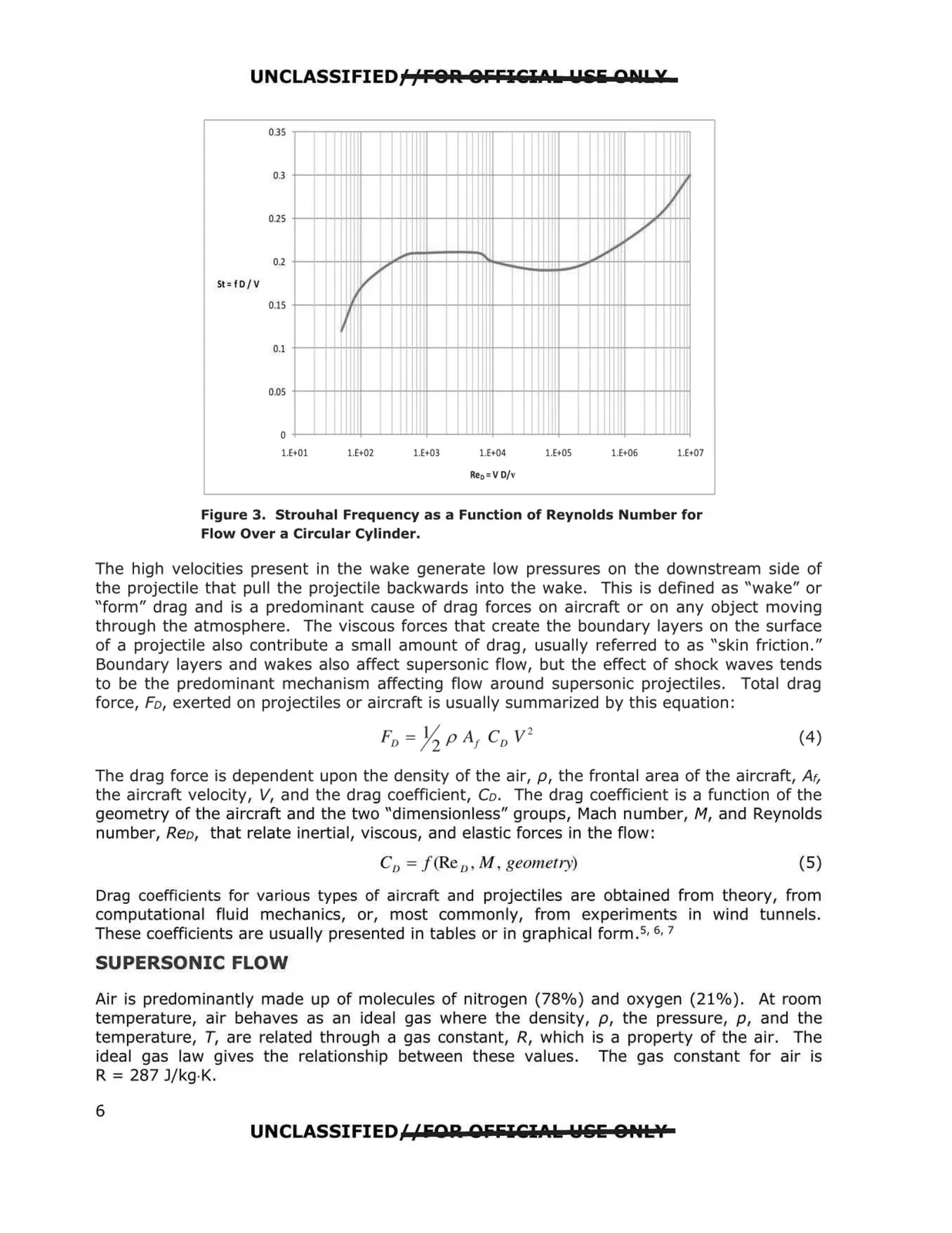
St= 10/V
0 -~~----+--~............f--~~-~f--..........-~~-+---~~......
1.E+0l
1.E+02
1.E+03
1.E+04
1.E+05
1.E+06
1.H07
Re 0 =VD/v
Figure 3. Strouhal Frequency as a Function of Reynolds Number for
Flow Over a Circular Cylinder.
The high velocities present in the wake generate low pressures on the downstream side of
the projectile that pull the projectile backwards into the wake. This is defined as "wake" or
"form" drag and is a predominant cause of drag forces on aircraft or on any object moving
through the atmosphere. The viscous forces that create the boundary layers on the surface
of a projectile also contribute a small amount of drag, usually referred to as "skin friction."
Boundary layers and wakes also affect supersonic flow, but the effect of shock waves tends
to be the predominant mechanism affecting flow around supersonic projectiles. Total drag
force, Fo, exerted on projectiles or aircraft is usually summarized by this equation:
(4)
The drag force is dependent upon the density of the air, p, the frontal area of the aircraft, Ar,
the aircraft velocity, V, and the drag coefficient, Co. The drag coefficient is a function of the
geometry of the aircraft and the two "dimensionless" groups, Mach number, M, and Reynolds
number, Reo, that relate inertial, viscous, and elastic forces in the flow:
C0 =f (Re 0 , M , geoniet ry)
(5)
Drag coefficients for various types of aircraft and projectiles are obtained from theory, from
computational fluid mechanics, or, most commonly, from experiments in wind tunnels.
These coefficients are usually presented in tables or in graphical form. 5, 6, 7
SUPERSONIC FLOW
Air is predominantly made up of molecules of nitrogen (78%) and oxygen (21%). At room
temperature, air behaves as an ideal gas where the density, p, the pressure, p, and the
temperature, T, are related through a gas constant, R, which is a property of the air. The
ideal gas law gives the relationship between these values.
The gas constant for air is
R = 287 J/kg-K.
UNCLASSIFIED//FOR QlililEl.t.L: W&li ONL'l
6