AAWSAP DIRD, Detection and High-Resolution Tracking of Vehicles at Hypersonic Velocities, November 2010
DOW-UAP-D148 · page 18 of 46
Text
This text came with the file. It may have mistakes. When the text and the image disagree, the image is right.
UNCLASSIFIED/fFOR. QFFIEIA.L: Ulii Qt!! X
RADAR systems are widely used for aircraft surveillance and can detect the distance to
objects and the position of an object (through triangulation); with Doppler RADAR, the
velocity can be directly measured.
RADAR does have limitations.
While low-frequency
RADAR systems are capable of following the curvature of the earth, the long wavelength of
this energy makes it difficult to resolve small objects. Higher frequency RADAR tends to be
more "line of sight."
Since it depends upon reflected energy, several problems are
highlighted by the RADAR Equation:
p . = P,,·ansmilld GA a F 4
(15)
rece,ved
( 4 1r)2 R/ R,2
In this equation, Ptransmitted represents the transmitted power, Preceived the received power, G
the transmitting antenna gain, A the aperture area of the receiving antenna, a the RADAR
cross section, F the pattern propagation factor, and Rt and Rr are the distance from the
transmitter to the target and the target to the receiver, respectively.
If the RADAR
transmitter and receiver are in the same unit, the power returned as a reflection from a
target decreases as R4 . This means that energy received in reflected energy decreases by
94% every time the distance to the target is doubled.
RADAR depends upon the reflection of electromagnetic waves off of a target's surface,
thereby making objects with a small RADAR cross section difficult to detect (e.g., stealth
aircraft).
Atmospheric phenomenon, including inversions and turbulence, can lead to
interference with RADAR reflections. Even with these limitations, RADAR is widely used to
monitor high-speed aircraft, meteors, and man-made objects reentering the atmosphere
from Earth orbit.
Velocity Vector
Radar Dish
Hypersonic Vehicle
Radial direction
I
Rotat
Pedei
Reflected Energy
Transmitted Energy
R= radial distance
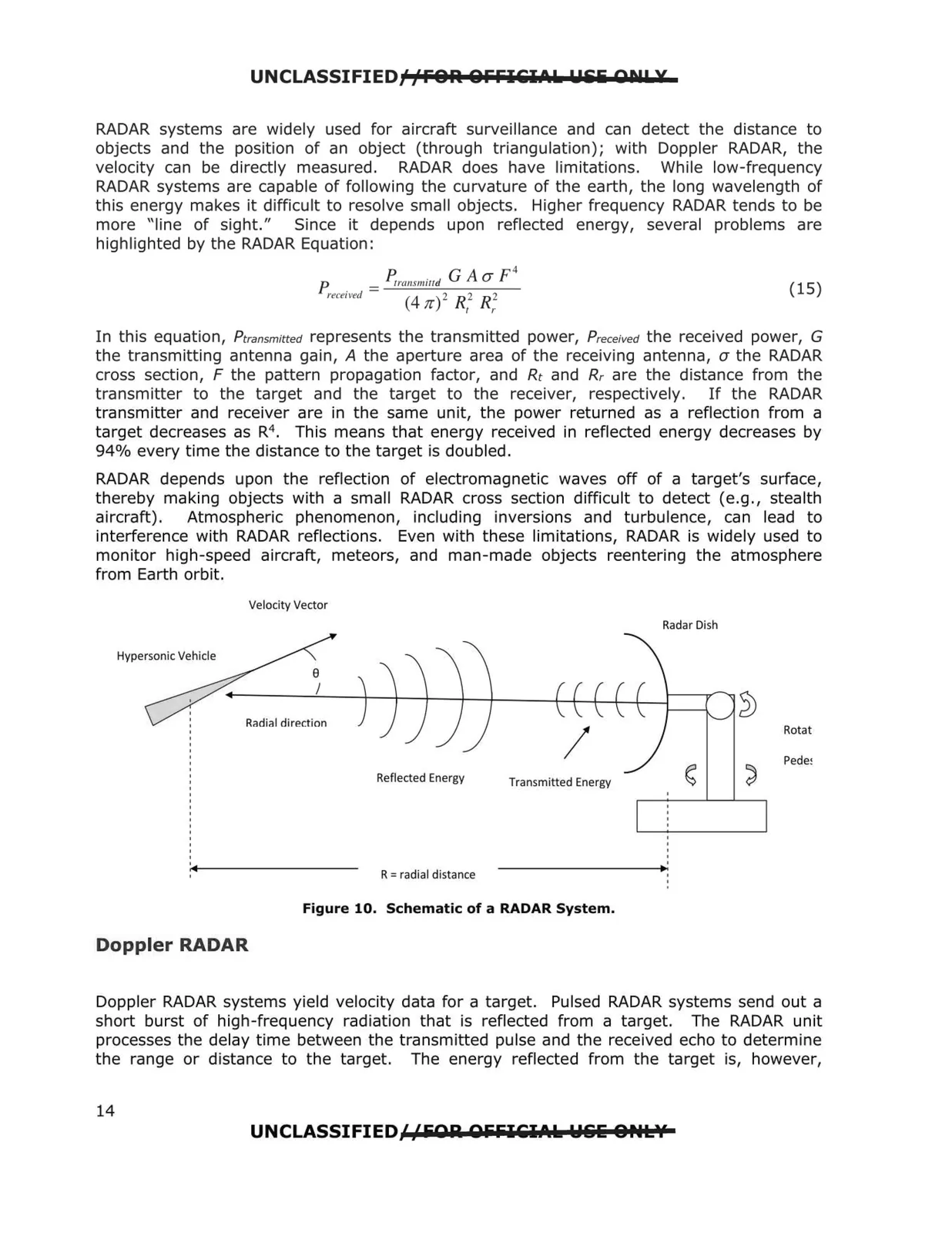
Figure 10. Schematic of a RADAR System.
Doppler RADAR
Doppler RADAR systems yield velocity data for a target. Pulsed RADAR systems send out a
short burst of high-frequency radiation that is reflected from a target.
The RADAR unit
processes the delay time between the transmitted pulse and the received echo to determine
the range or distance to the target.
The energy reflected from the target is, however,
14
UNCLASSIFIED//FQR QfifilEIA.k W&lii O,.L\f