AAWSAP DIRD, Detection and High-Resolution Tracking of Vehicles at Hypersonic Velocities, November 2010
DOW-UAP-D148 · page 17 of 46
Text
This text came with the file. It may have mistakes. When the text and the image disagree, the image is right.
UNCLASSIFIED/fFOR. QFFIEl.t.L: Uii QD:I! X
Electromagnetic Spectrum
Wavelength
Type of
Radiation
1nm
x-rays
10nm
100nm
Ultraviolet (UV)
lµm
Visible Light {0.4 to 0.7 µm)
l0µm
Near Infrared
lOOµm
Thermal Infrared
1mm
Far Infrared
10mm
Microwaves
100mm
Radar
lm
Rad io Waves
10m
100m
AM Radio
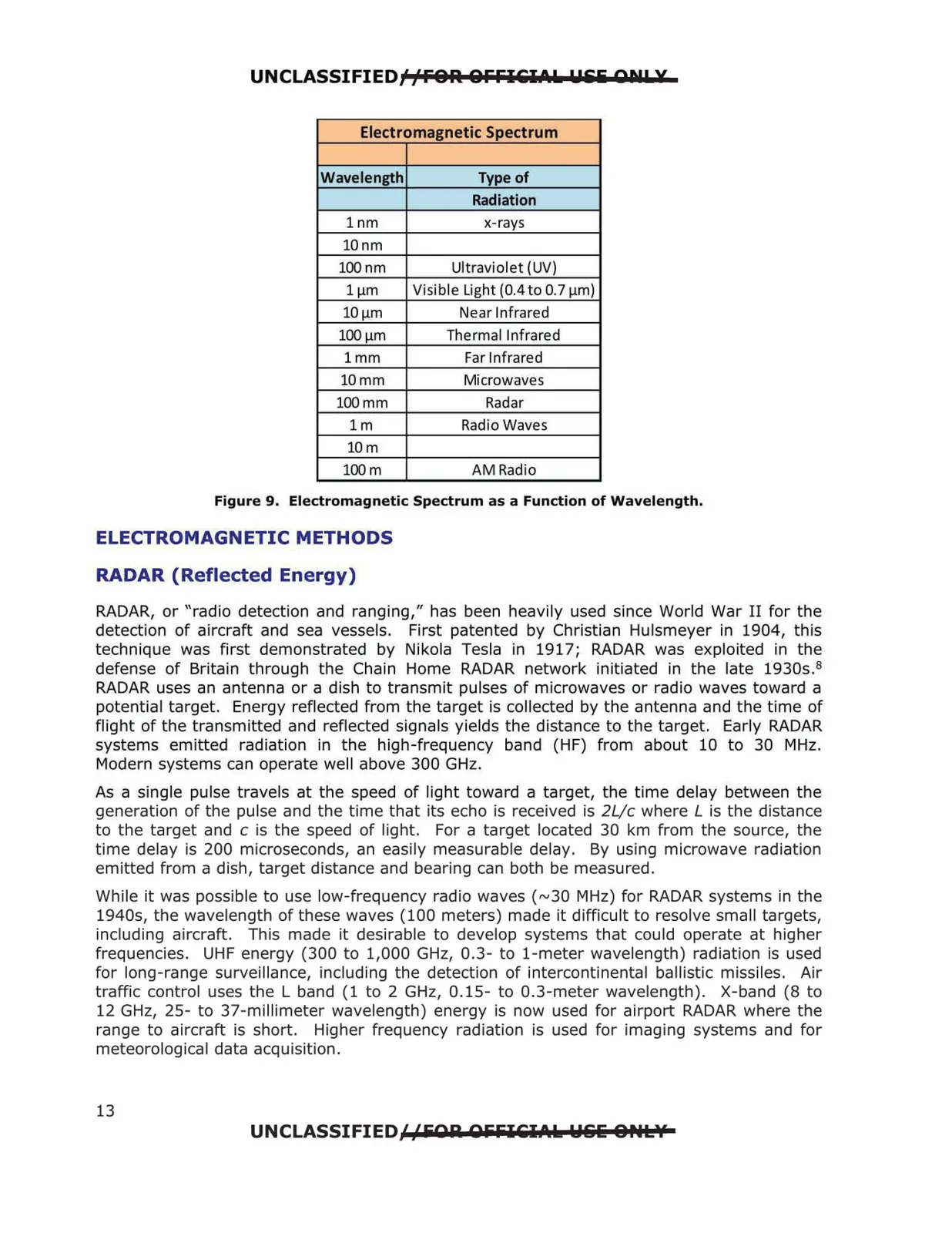
Figure 9. Electromagnetic Spectrum as a Function of Wavelength.
ELECTROMAGNETIC METHODS
RADAR (Reflected Energy)
RADAR, or "radio detection and ranging," has been heavily used since World War II for the
detection of aircraft and sea vessels.
First patented by Christian Hulsmeyer in 1904, this
technique was first demonstrated by Nikola Tesla in 1917; RADAR was exploited in the
defense of Britain through the Chain Home RADAR network initiated in the late 1930s.8
RADAR uses an antenna or a dish to transmit pulses of microwaves or radio waves toward a
potential target. Energy reflected from the target is collected by the antenna and the time of
flight of the transmitted and reflected signals yields the distance to the target. Early RADAR
systems emitted radiation in the high-frequency band (HF) from about 10 to 30 MHz.
Modern systems can operate well above 300 GHz.
As a single pulse travels at the speed of light toward a target, the time delay between the
generation of the pulse and the time that its echo is received is 2L/c where L is the distance
to the target and c is the speed of light. For a target located 30 km from the source, the
time delay is 200 microseconds, an easily measurable delay. By using microwave radiation
emitted from a dish, target distance and bearing can both be measured.
While it was possible to use low-frequency radio waves (~30 MHz) for RADAR systems in the
1940s, the wavelength of these waves (100 meters) made it difficult to resolve small targets,
including aircraft. This made it desirable to develop systems that could operate at higher
frequencies. UHF energy (300 to 1,000 GHz, 0.3- to 1-meter wavelength) radiation is used
for long-range surveillance, including the detection of intercontinental ballistic missiles. Air
traffic control uses the L band (1 to 2 GHz, 0.15- to 0.3-meter wavelength). X-band (8 to
12 GHz, 25- to 37-millimeter wavelength) energy is now used for airport RADAR where the
range to aircraft is short. Higher frequency radiation is used for imaging systems and for
meteorological data acquisition.
UNCLASSIFIED//EQA: QlililEl.t.L: W&&: O,.L'l
13