AAWSAP DIRD, Detection and High-Resolution Tracking of Vehicles at Hypersonic Velocities, November 2010
DOW-UAP-D148 · page 8 of 46
Text
This text came with the file. It may have mistakes. When the text and the image disagree, the image is right.
UNCLASSIFIED/fFOR. QFFIEIA.L: Ulii Qt!! X
Re = viscous forces= VD
(3)
inertial forces
v
In this expression, V is the velocity of the projectile, D is its effective diameter, and v is the
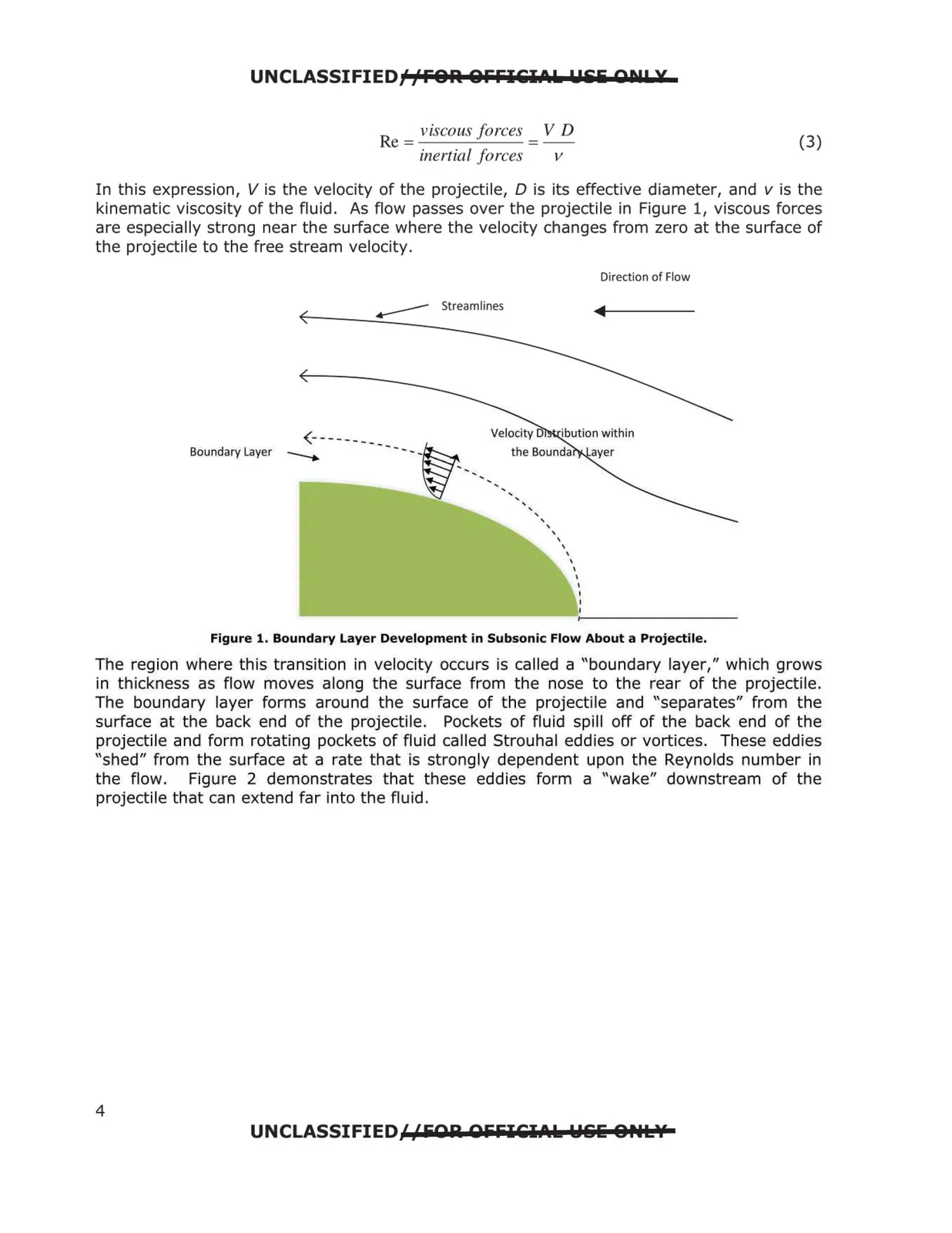
kinematic viscosity of the fluid. As flow passes over the projectile in Figure 1, viscous forces
are especially strong near the surface where the velocity changes from zero at the surface of
the projectile to the free stream velocity.
Direction of Flow
.----
Streamlines
<- ________
Velocity D
ibution within
Boundary Layer --
- - - - -
the Bounda
ayer
-------,,,
' ' ' '
\
\
\
\
I
I
Figure 1. Boundary Layer Development in Subsonic Flow About a Projectile.
The region where this transition in velocity occurs is called a "boundary layer," which grows
in thickness as flow moves along the surface from the nose to the rear of the projectile.
The boundary layer forms around the surface of the projectile and "separates" from the
surface at the back end of the projectile. Pockets of fluid spill off of the back end of the
projectile and form rotating pockets of fluid called Strauhal eddies or vortices. These eddies
"shed" from the surface at a rate that is strongly dependent upon the Reynolds number in
the flow.
Figure 2 demonstrates that these eddies form a "wake" downstream of the
projectile that can extend far into the fluid.
UNCLASSIFIED//EQA: QlililEl.t.L: W&&: O,.L'l
4