AAWSAP DIRD, MHD Air Breathing Propulsion and Power for Aerospace Applications, November 2010
DOW-UAP-D149 · page 27 of 32
Text
This text came with the file. It may have mistakes. When the text and the image disagree, the image is right.
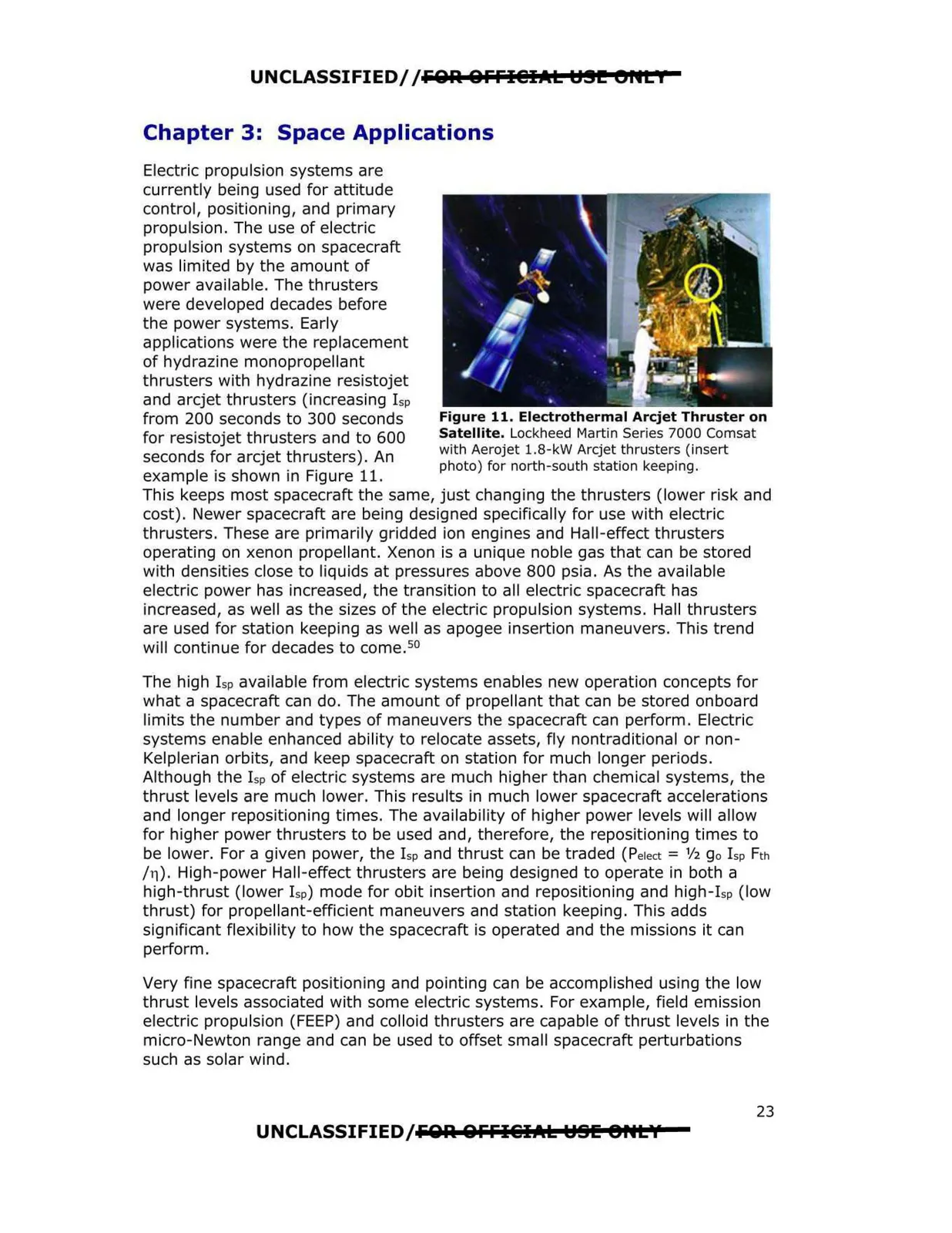
UNCLASSIFIED//FOA QFFI@IAL tt91!! Brit I Chapter 3: Space Applications Electric propulsion systems are currently being used for attitude control, positioning, and primary propulsion. The use of electric propulsion systems on spacecraft was limited by the amount of power available. The thrusters were developed decades before the power systems. Early applications were the replacement of hydrazine monopropellant thrusters with hydrazine resistojet and arcjet thrusters (increasing lsp from 200 seconds to 300 seconds for resistojet thrusters and to 600 seconds for arcjet thrusters). An example is shown in Figure 11. This keeps most spacecraft the same, just changing the thrusters (lower risk and cost). Newer spacecraft are being designed specifically for use with electric thrusters. These are primarily gridded ion engines and Hall-effect thrusters operating on xenon propellant. Xenon is a unique noble gas that can be stored with densities close to liquids at pressures above 800 psia. As the available electric power has increased, the transition to alt electric spacecraft has increased, as well as the sizes of the electric propulsion systems. Hall thrusters are used for station keeping as well as apogee insertion maneuvers. This trend will continue for decades to come. 50 The high lsp available from electric systems enables new operation concepts for what a spacecraft can do. The amount of propellant that can be stored onboard limits the number and types of maneuvers the spacecraft can perform. Electric systems enable enhanced ability to relocate assets, fly nontraditional or non Kelplerian orbits, and keep spacecraft on station for much longer periods. Although the l sp of electric systems are much higher than chemical systems, the thrust levels are much lower. This results in much lower spacecraft accelerations and longer repositioning times. The availability of higher power levels will allow for higher power thrusters to be used and, therefore, the repositioning times to be lower. For a given power, the lsp and thrust can be traded (Pe1ect = ½ go lsp Fth /17). High-power Hall-effect thrusters are being designed to operate in both a high-thrust (lower l sp) mode for obit insertion and repositioning and high-lsp (tow thrust) for propellant-efficient maneuvers and station keeping. This adds significant flexibility to how the spacecraft is operated and the missions it can perform . Very fine spacecraft positioning and pointing can be accomplished using the low thrust levels associated with some electric systems. For example, field emission electric propulsion (FEEP) and colloid thrusters are capable of thrust levels in the micro-Newton range and can be used to offset small spacecraft perturbations such as solar wind. UNCLASSIFIED/FQA OFFl&lsld:. ~9E 8HLY Figure 11. Electrothermal Arcjet Thruster on Satellite. Lockheed Martin Series 7000 Comsat with Aerojet 1.8-kW Arcjet thrusters (insert photo) for north-south station keeping. 23