AAWSAP DIRD, MHD Air Breathing Propulsion and Power for Aerospace Applications, November 2010
DOW-UAP-D149 · page 28 of 32
Text
This text came with the file. It may have mistakes. When the text and the image disagree, the image is right.
UNCLASSIFIED//EAR QFFl&IAk l!ISl!!! er•t I
Another operational option enabled with
electric systems is to fly at much lower obits
where drag forces would normally cause the
spacecraft to reenter in a short period of
time. An air-breathing electric thruster can
be used for drag make-up without the need
for additional propellant. 51
Nuclear fission power systems coupled with
electric thrusters enable new capabilities.
Nuclear space reactors have been flown in
space (SNAP-10A by the United States and
TOPAZ reactors by the former Soviet
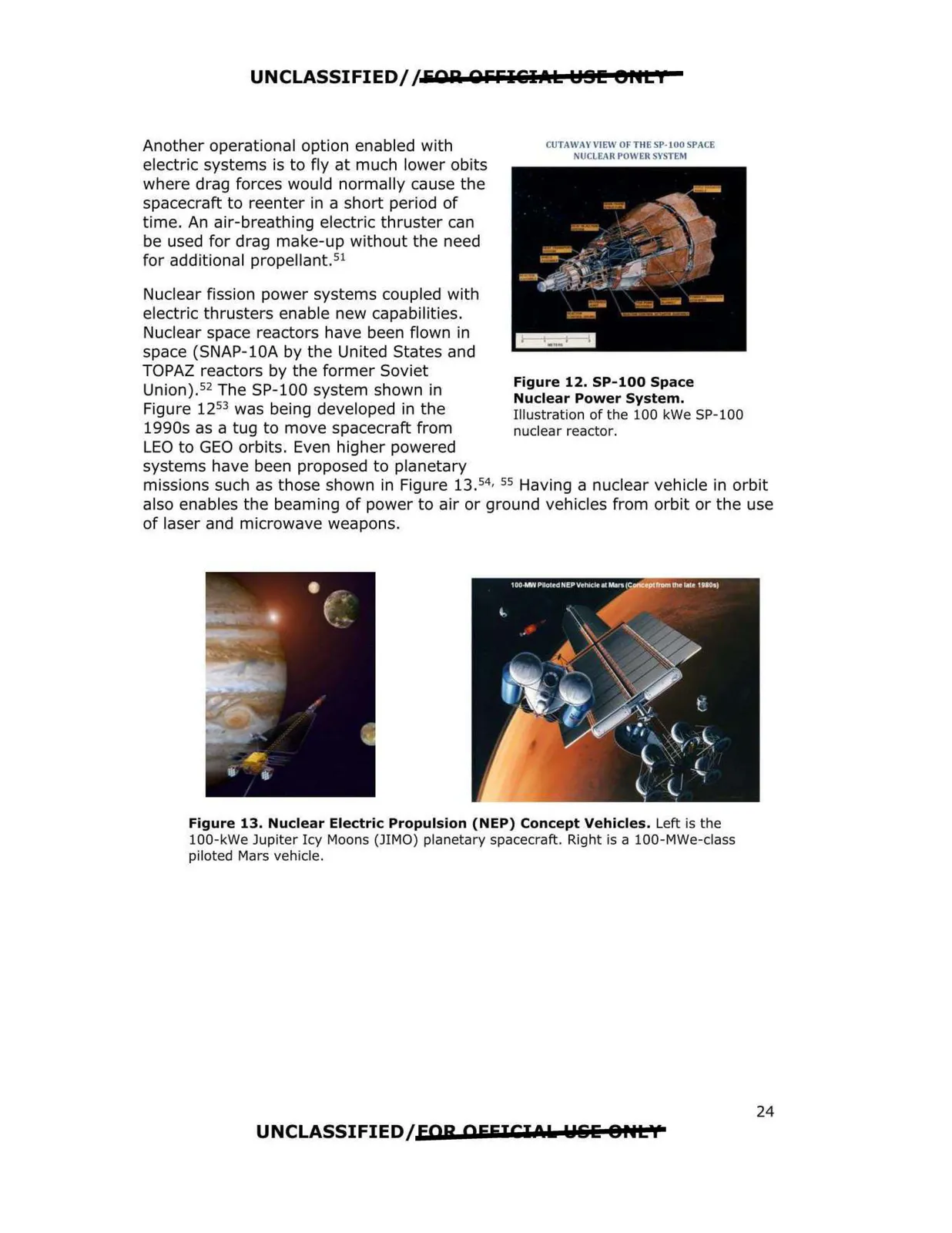
Union).52 The SP-100 system shown in
Figure 1253 was being developed in the
1990s as a tug to move spacecraft from
LEO to GEO orbits. Even higher powered
systems have been proposed to planetary
CUTAWAY VIEW OFTHESP-IOOSPACE
NUCLEAR POWER SYSTEM
Figure 12. SP-100 Space
Nuclear Power System.
Illustration of the 100 kWe SP-100
nuclear reactor.
missions such as those shown in Figure 13. 54• 55 Having a nuclear vehicle in orbit
also enables the beaming of power to air or ground vehicles from orbit or the use
of laser and microwave weapons.
Figure 13. Nuclear Electric Propulsion (NEP) Concept Vehicles. Left is the
100-kWe Jupiter Icy Moons (JIMO) planetary spacecraft. Right is a 100-MWe-class
piloted Mars vehicle.
UNCLASSIFIED/FOR OEFICllk W61i 8HLY
24