AAWSAP DIRD, Quantum Computing and Utilizing Organic Molecules in Automation Technology, December 2010
DOW-UAP-D150 · page 16 of 54
Text
This text came with the file. It may have mistakes. When the text and the image disagree, the image is right.
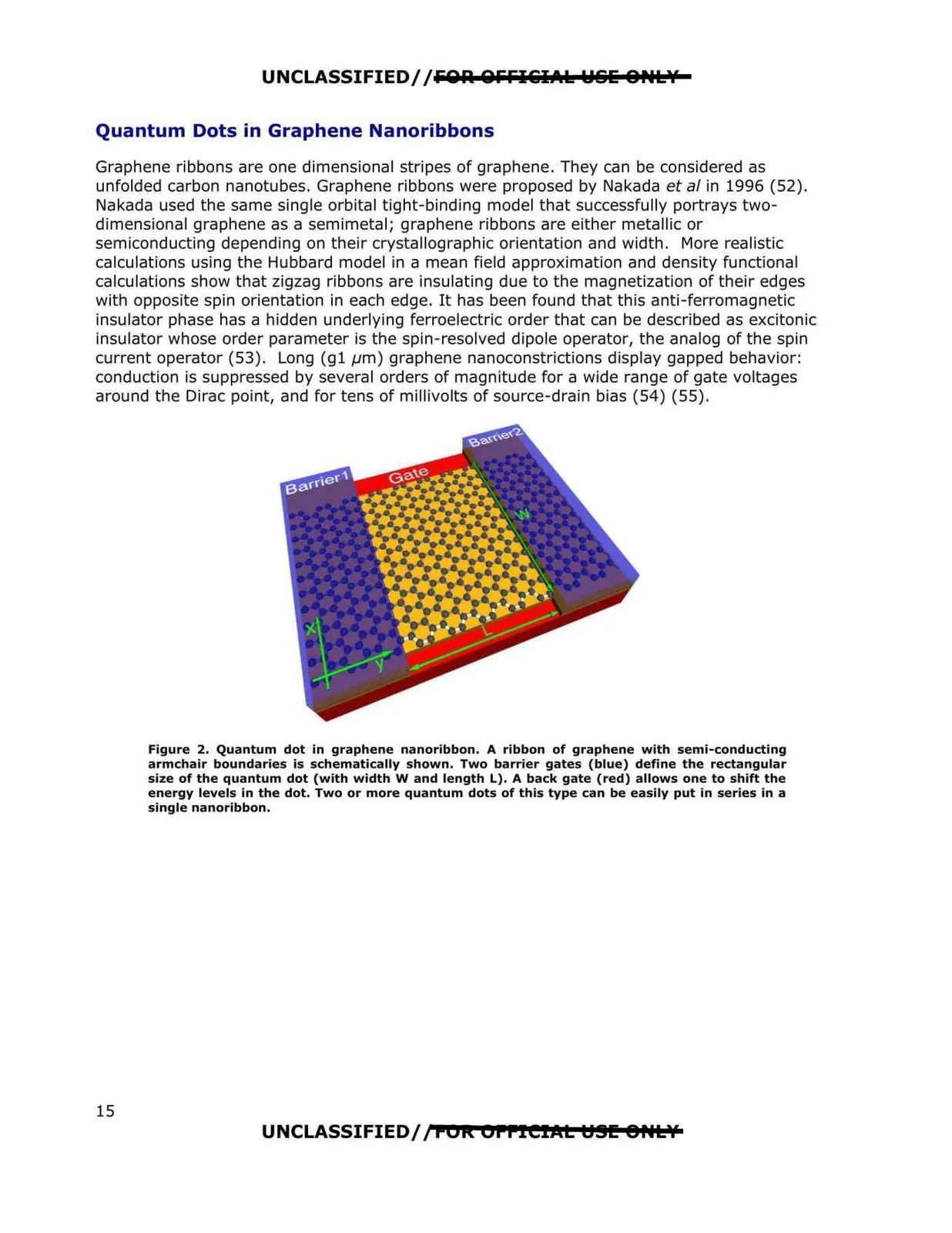
UNCLASSIFIED//FOA 8FFl&I.t.k WSli 8,.k\f Quantum Dots in Graphene Nanoribbons Graphene ribbons are one dimensional stripes of graphene. They can be considered as unfolded carbon nanotubes. Graphene ribbons were proposed by Nakada et al in 1996 (52). Nakada used the same single orbital tight-binding model that successfully portrays two dimensional graphene as a semimetal; graphene ribbons are either metallic or semiconducting depending on their crystallographic orientation and width. More realistic calculations using the Hubbard model in a mean field approximation and density functional calculations show that zigzag ribbons are insulating due to the magnetization of their edges with opposite spin orientation in each edge. It has been found that this anti-ferromagnetic insulator phase has a hidden underlying ferroelectric order that can be described as excitonic insulator whose order parameter is the spin-resolved dipole operator, the analog of the spin current operator (53). Long (gl µm) graphene nanoconstrictions display gapped behavior: conduction is suppressed by several orders of magnitude for a wide range of gate voltages around the Dirac point, and for tens of millivolts of source-drain bias (54) (55). Figure 2. Quantum dot in graphene nanoribbon. A ribbon of graphene with semi-conducting armchair boundaries is schematically shown. Two barrier gates (blue) define the rectangular size of the quantum dot (with width W and length L). A back gate (red) allows one to shift the energy levels in the dot. Two or more quantum dots of this type can be easily put in series in a single nanoribbon. UNCLASSIFIED// FOR OPPICIJ!tt U:!I!! 8HL\S 15