AAWSAP DIRD, Quantum Computing and Utilizing Organic Molecules in Automation Technology, December 2010
DOW-UAP-D150 · page 17 of 54
Text
This text came with the file. It may have mistakes. When the text and the image disagree, the image is right.
UNCLASSIFIED//FOR. 8FFI@IAL l::181: 8HL'I
E
C
11 IUo
2Ll
u
<l
-........,
V
I
I
II
I
10
11
loll
-R 0 R
r
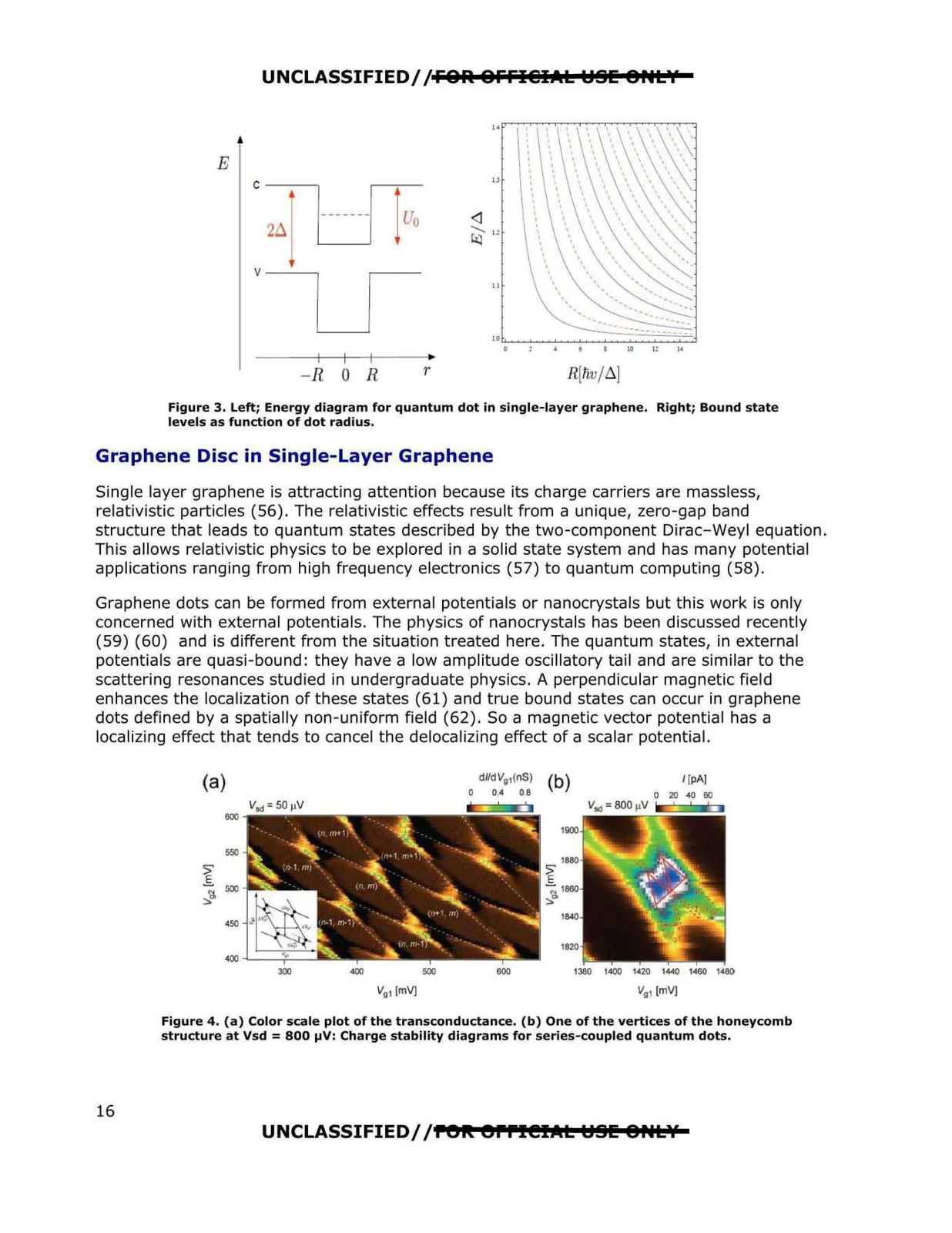
Figure 3. Left; Energy diagram for quantum dot in single-layer graphene. Right; Bound state
levels as function of dot radius.
Graphene Disc in Single-Layer Graphene
Single layer graphene is attracting attention because its charge carriers are massless,
relativistic particles (56). The relativistic effects result from a unique, zero-gap band
structure that leads to quantum states described by the two-component Dirac-Weyl equation.
This allows relativistic physics to be explored in a solid state system and has many potential
applications ranging from high frequency electronics (57) to quantum computing (58).
Graphene dots can be formed from external potentials or nanocrystals but this work is only
concerned with external potentials. The physics of nanocrystals has been discussed recently
(59) (60) and is different from the situation treated here. The quantum states, in external
potentials are quasi-bound: they have a low amplitude oscillatory tail and are similar to the
scattering resonances studied in undergraduate physics. A perpendicular magnetic field
enhances the localization of these states (61) and true bound states can occur in graphene
dots defined by a spatially non-uniform field (62). So a magnetic vector potential has a
localizing effect that tends to cancel the delocalizing effect of a scalar potential.
(a)
800
5'
E
-
-::.";l,
550
500
450
400
dl/dVg1(nS)
/[pA]
(b)
0
0 ,◄
0.8
1900
1880
>
E
-
1860
>~
1&40
1820
300
400
500
600
1380
1400
1420
1440
1460
1480
V91 [mV]
V91 [mV]
Figure 4. (a) Color scale plot of the transconductance. (b) One of the vertices of the honeycomb
structure at Vsd = 800 1,1V: Charge stability diagrams for series-coupled quantum dots.
UNCLASSIFIED//POft. orr1e1s11t l::181: 8,.LY
16