AAWSAP DIRD, Quantum Computing and Utilizing Organic Molecules in Automation Technology, December 2010
DOW-UAP-D150 · page 20 of 54
Text
This text came with the file. It may have mistakes. When the text and the image disagree, the image is right.
UNCLASSIFIED//FOA QFFIEJIAL YSI!!! 9Ht'I"
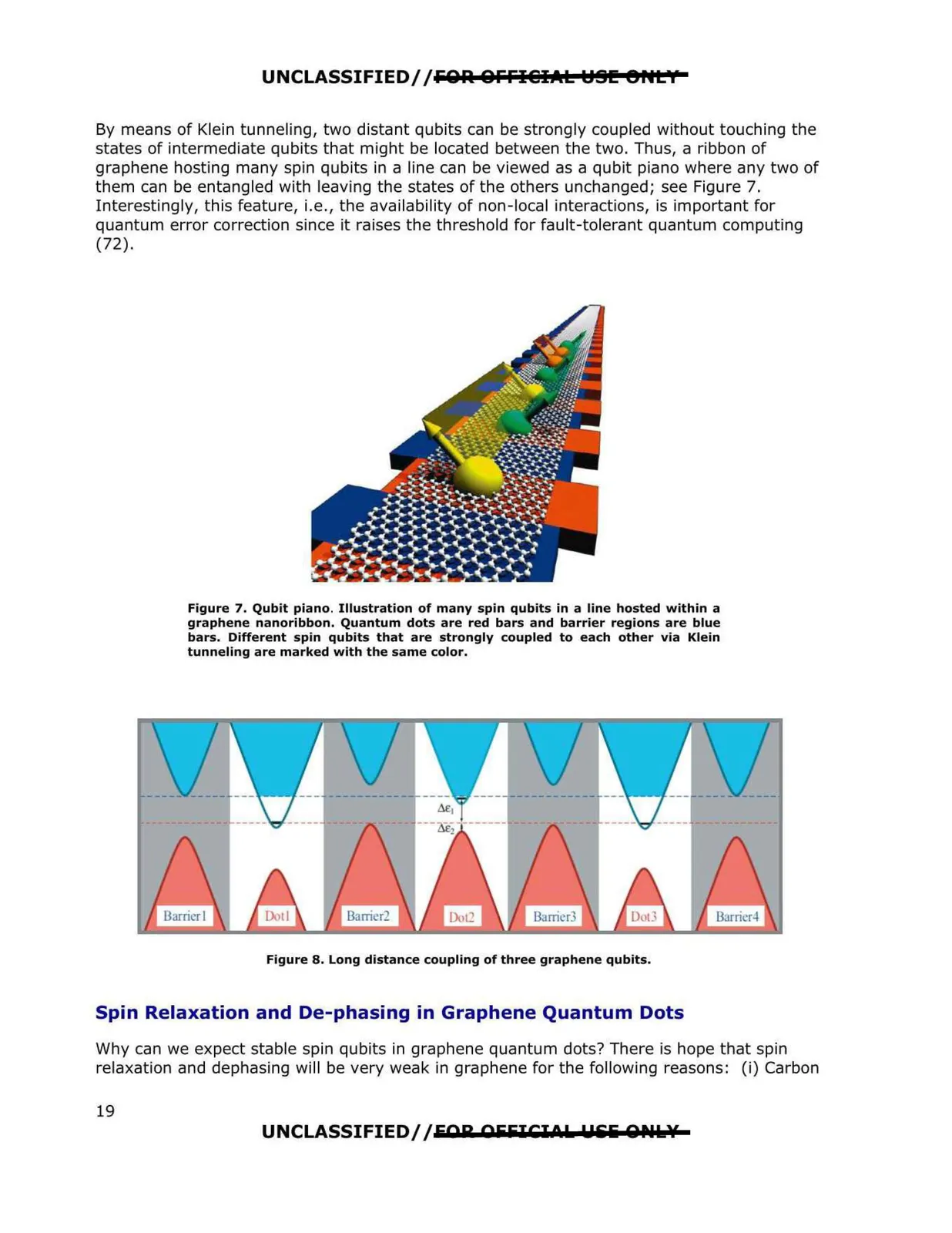
By means of Klein tunneling, two distant qubits can be strongly coupled without touching the
states of intermediate qubits that might be located between the two. Thus, a ribbon of
graphene hosting many spin qubits in a line can be viewed as a qubit piano where any two of
them can be entangled with leaving the states of the others unchanged; see Figure 7.
Interestingly, this feature, i.e., the availability of non-local interactions, is important for
quantum error correction since it raises the threshold for fault-tolerant quantum computing
(72).
Figure 7. Qubit piano. Illustration of many spin qubits in a line hosted within a
graphene nanoribbon. Quantum dots are red bars and barrier regions are blue
bars. Different spin qubits that are strongly coupled to each other via Klein
tunneling are marked with the same color.
Figure 8. Long distance coupling of three graphene qubits.
Spin Relaxation and De-phasing in Graphene Quantum Dots
Why can we expect stable spin qubits in graphene quantum dots? There is hope that spin
relaxation and dephasing will be very weak in graphene for the following reasons: (i) Carbon
UNCLASSIFIED//EAR OFFICIO I. flii 0Plk¥
19