AAWSAP DIRD, Quantum Computing and Utilizing Organic Molecules in Automation Technology, December 2010
DOW-UAP-D150 · page 19 of 54
Text
This text came with the file. It may have mistakes. When the text and the image disagree, the image is right.
UNCLASSIFIED//FOR OFFICIAL USE ONLY
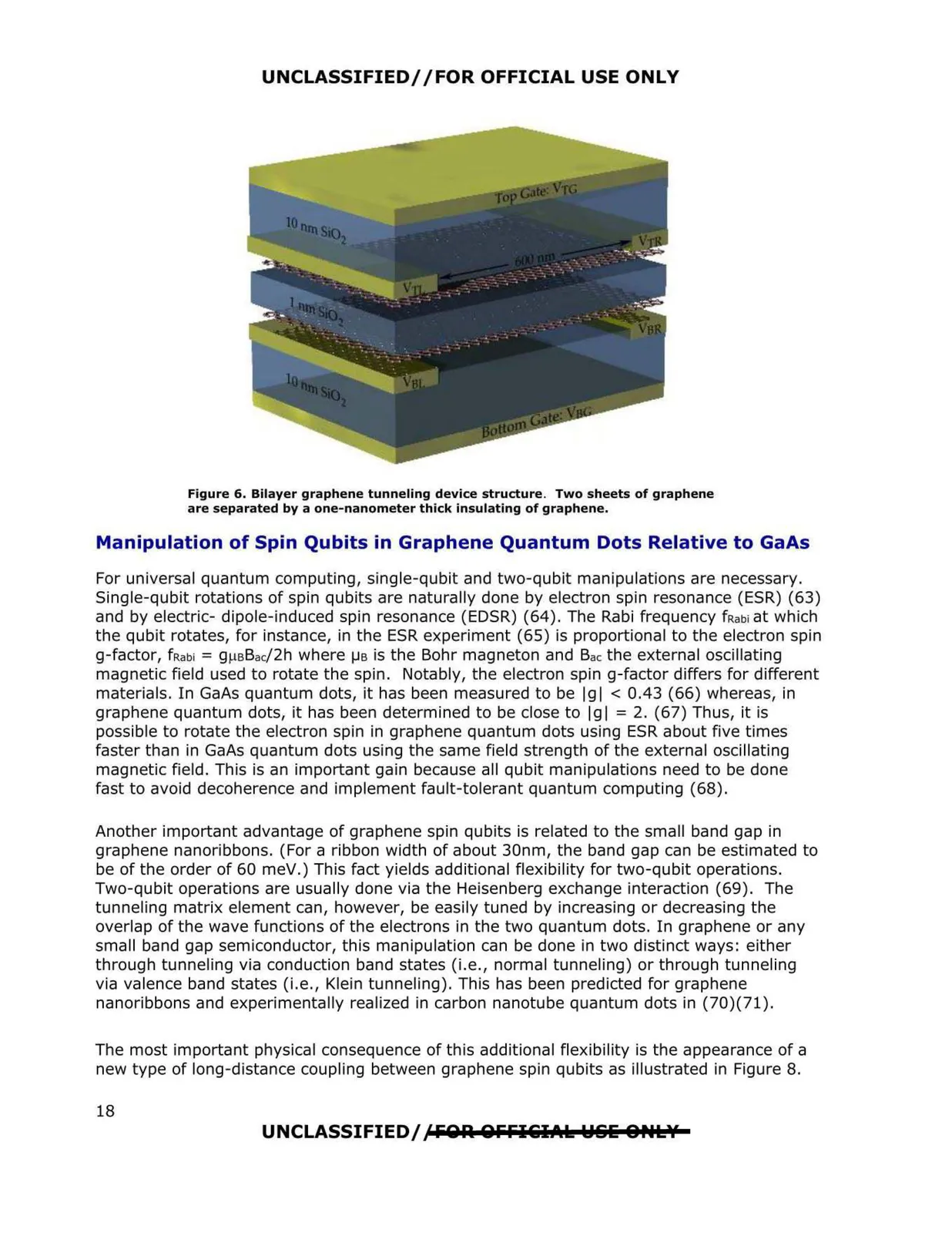
Figure 6. Bilayer graphene tunneling device structure. Two sheets of graphene
are separated by a one-nanometer thick insulating of graphene.
Manipulation of Spin Qubits in Graphene Quantum Dots Relative to GaAs
For universal quantum computing, single-qubit and two-qubit manipulations are necessary.
Single-qubit rotations of spin qubits are naturally done by electron spin resonance (ESR) (63)
and by electric- dipole-induced spin resonance (EDSR) (64). The Rabi frequency faabl at which
the qubit rotates, for instance, in the ESR experiment (65) is proportional to the electron spin
g-factor, faabi = gµsBac/2h where µs is the Bohr magneton and Bae the external oscillating
magnetic field used to rotate the spin. Notably, the electron spin g-factor differs for different
materials. In GaAs quantum dots, it has been measured to be lg I < 0.43 (66) whereas, in
graphene quantum dots, it has been determined to be close to lg I = 2. (67) Thus, it is
possible to rotate the electron spin in graphene quantum dots using ESR about five times
faster than in GaAs quantum dots using the same field strength of the external oscillating
magnetic field. This is an important gain because all qubit manipulations need to be done
fast to avoid decoherence and implement fault-tolerant quantum computing (68).
Another important advantage of graphene spin qubits is related to the small band gap in
graphene nanoribbons. (For a ribbon width of about 30nm, the band gap can be estimated to
be of the order of 60 meV.) This fact yields additional flexibility for two-qubit operations.
Two-qubit operations are usually done via the Heisenberg exchange interaction (69). The
tunneling matrix element can, however, be easily tuned by increasing or decreasing the
overlap of the wave functions of the electrons in the two quantum dots. In graphene or any
small band gap semiconductor, this manipulation can be done in two distinct ways: either
through tunneling via conduction band states (i.e., normal tunneling) or through tunneling
via valence band states (i.e., Klein tunneling). This has been predicted for graphene
nanoribbons and experimentally realized in carbon nanotube quantum dots in (70)(71).
The most important physical consequence of this additional flexibility is the appearance of a
new type of long-distance coupling between graphene spin qubits as illustrated in Figure 8.
UNCLASSIFIED/,'FOA OFFI&il.t.L W&li 8,.LY
18