AAWSAP DIRD, Quantum Computing and Utilizing Organic Molecules in Automation Technology, December 2010
DOW-UAP-D150 · page 26 of 54
Text
This text came with the file. It may have mistakes. When the text and the image disagree, the image is right.
UNCLASSIFIED//FOR OFFICIAL 09~ l>flti
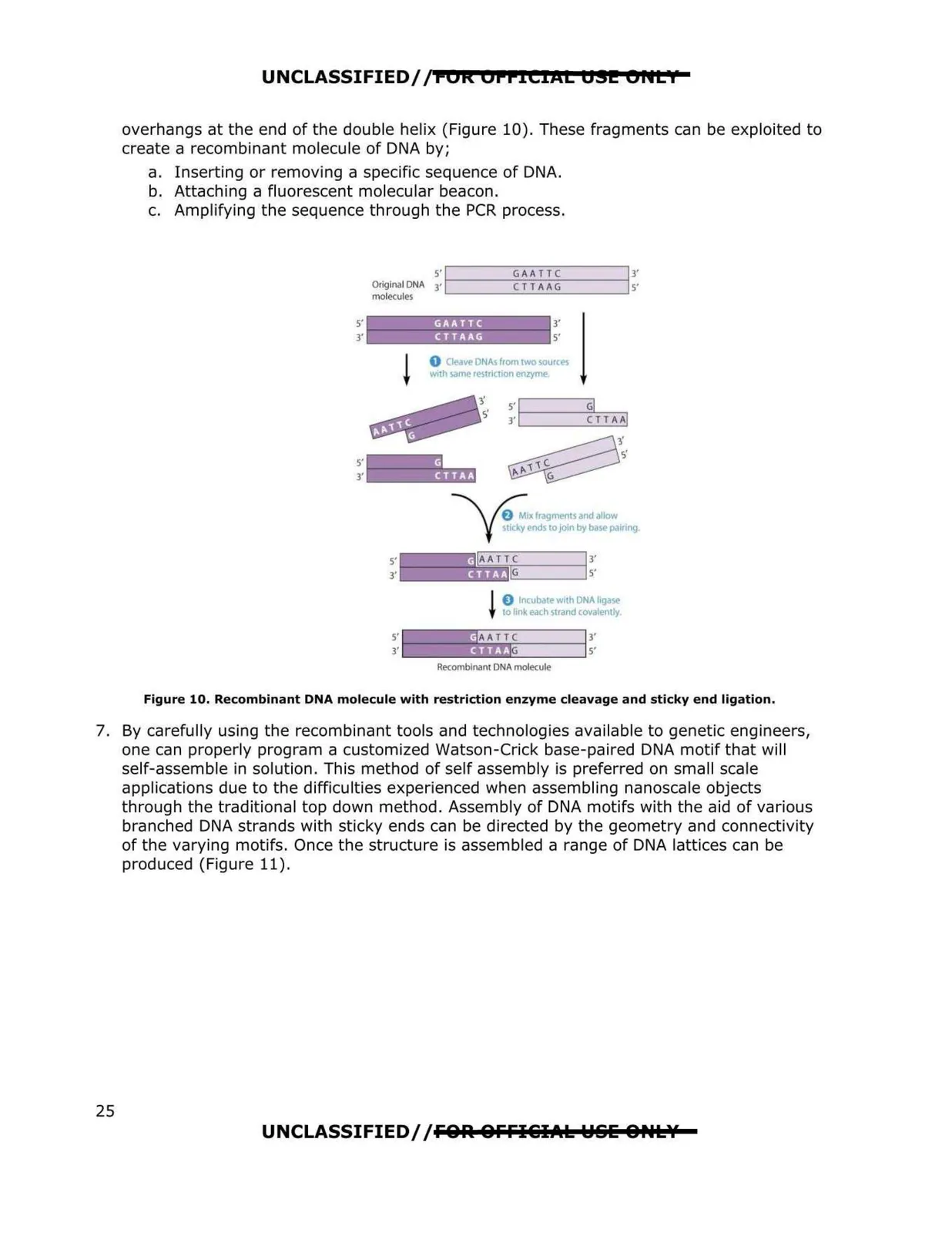
overhangs at the end of the double helix (Figure 10). These fragments can be exploited to
create a recombinant molecule of DNA by;
a. Inserting or removing a specific sequence of DNA.
b. Attaching a fluorescent molecular beacon.
c. Amplifying the sequence through the PCR process.
5,• ~----GA_A_T_T_C___--<1 3s•'
3
Original DNA
_
CT TA A G
_
molecules
5'
GAATTC
3'
CTTAAG
5'
3• l
ve DNAI from IWO, urc
s3: ~---=GI_~
.
C TTAAI
O o
vVtth s.arru'!' ·~trh t1on enzyme
~ £ ,fragmemsand~llow
¥ 7ic~y-end, to Join by base patnng
I E) Incubate w,th DNA log.1se
+10 t,nk each wand covo! ntly
Recombinant DNA molecule
Figure 10. Recombinant DNA molecule with restriction enzyme cleavage and sticky end ligation.
7. By carefully using the recombinant tools and technologies available to genetic engineers,
one can properly program a customized Watson-Crick base-paired DNA motif that will
self-assemble in solution. This method of self assembly is preferred on small scale
applications due to the difficulties experienced when assembling nanoscale objects
through the traditional top down method. Assembly of DNA motifs with the aid of various
branched DNA strands with sticky ends can be directed by the geometry and connectivity
of the varying motifs. Once the structure is assembled a range of DNA lattices can be
produced (Figure 11).
UNCLASSIFIED//FOR OFFI&I.t.k W&E 8Nk\f
25