AAWSAP DIRD, Quantum Computing and Utilizing Organic Molecules in Automation Technology, December 2010
DOW-UAP-D150 · page 29 of 54
Text
This text came with the file. It may have mistakes. When the text and the image disagree, the image is right.
UNCLASSIFIED//FOR. OFFI@IAL l!ISI!!! er~t I
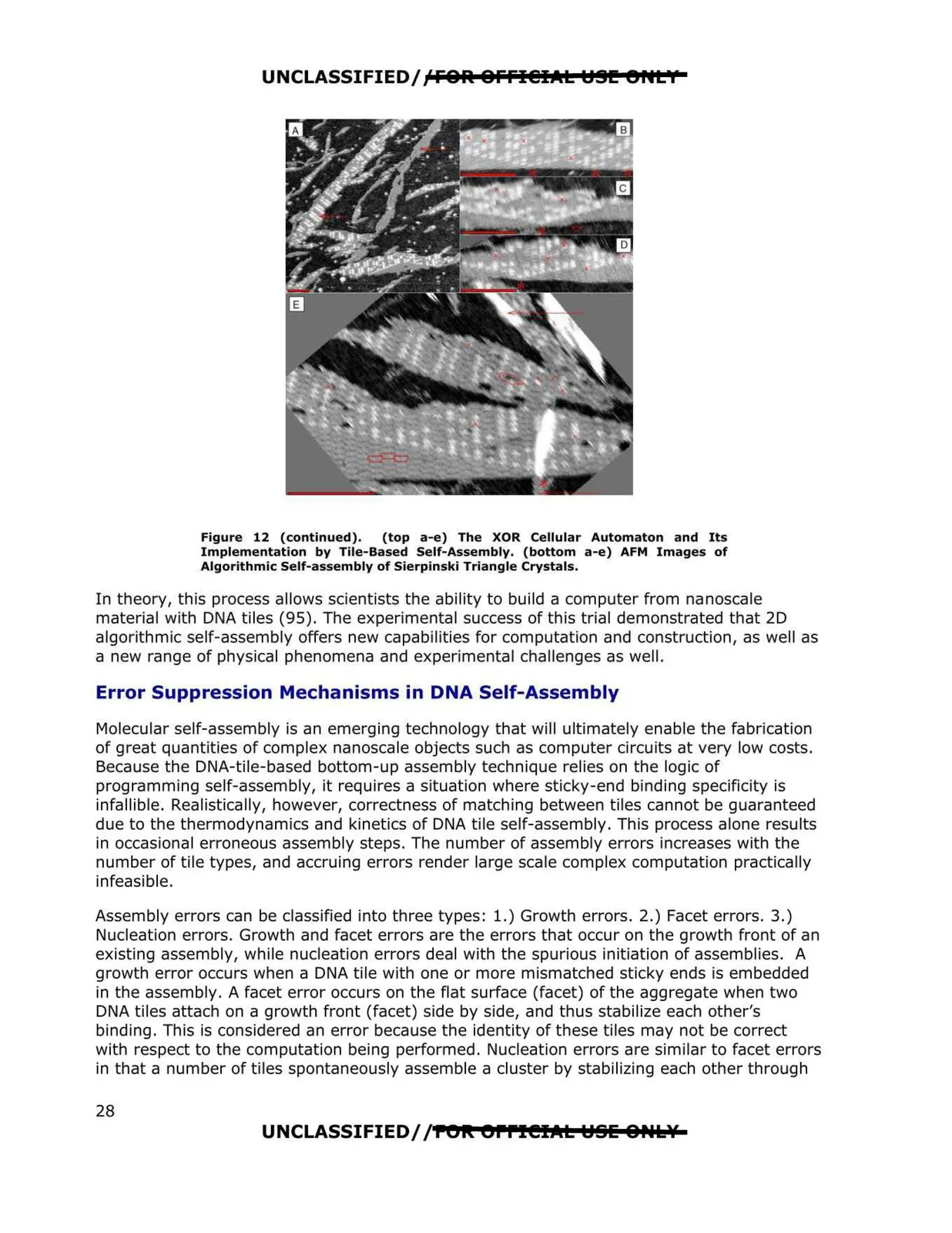
Figure 12 (continued).
(top a-e) The XOR Cellular Automaton and Its
Implementation by Tile-Based Self-Assembly. (bottom a-e) AFM Images of
Algorithmic Self-assembly of Sierpinski Triangle Crystals.
In theory, this process allows scientists the ability to build a computer from nanoscale
material with DNA tiles (95). The experimental success of this trial demonstrated that 2D
algorithmic self-assembly offers new capabilities for computation and construction, as well as
a new range of physical phenomena and experimental challenges as well.
Error Suppression Mechanisms in DNA Self-Assembly
Molecular self-assembly is an emerging technology that will ultimately enable the fabrication
of great quantities of complex nanoscale objects such as computer circuits at very low costs.
Because the DNA-tile-based bottom-up assembly technique relies on the logic of
programming self-assembly, it requires a situation where sticky-end binding specificity is
infallible. Realistically, however, correctness of matching between tiles cannot be guaranteed
due to the thermodynamics and kinetics of DNA tile self-assembly. This process alone results
in occasional erroneous assembly steps. The number of assembly errors increases with the
number of tile types, and accruing errors render large scale complex computation practically
infeasible.
Assembly errors can be classified into three types: 1.) Growth errors. 2.) Facet errors. 3.)
Nucleation errors. Growth and facet errors are the errors that occur on the growth front of an
existing assembly, while nucleation errors deal with the spurious initiation of assemblies. A
growth error occurs when a DNA tile with one or more mismatched sticky ends is embedded
in the assembly. A facet error occurs on the flat surface (facet) of the aggregate when two
DNA tiles attach on a growth front (facet) side by side, and thus stabilize each other's
binding . This is considered an error because the identity of these tiles may not be correct
with respect to the computation being performed. Nucleation errors are similar to facet errors
in that a number of tiles spontaneously assemble a cluster by stabilizing each other through
UNCLASSIFIED//POI'.. orr1e1At l!ISE Qptkl{
28