AAWSAP DIRD, Quantum Computing and Utilizing Organic Molecules in Automation Technology, December 2010
DOW-UAP-D150 · page 28 of 54
Text
This text came with the file. It may have mistakes. When the text and the image disagree, the image is right.
UNCLASSIFIED//FOR OFFICIAL 031! BHLY
the complementary binding of the Watson-Crick base pairs that correspond to each sticky
end. In this way, a lattice structure can be built upon the base structure by synthesizing
additional DX motifs to construct what is known as a "DNA tile." These tiles can be further
utilized as a scaffold for additional molecular structures.
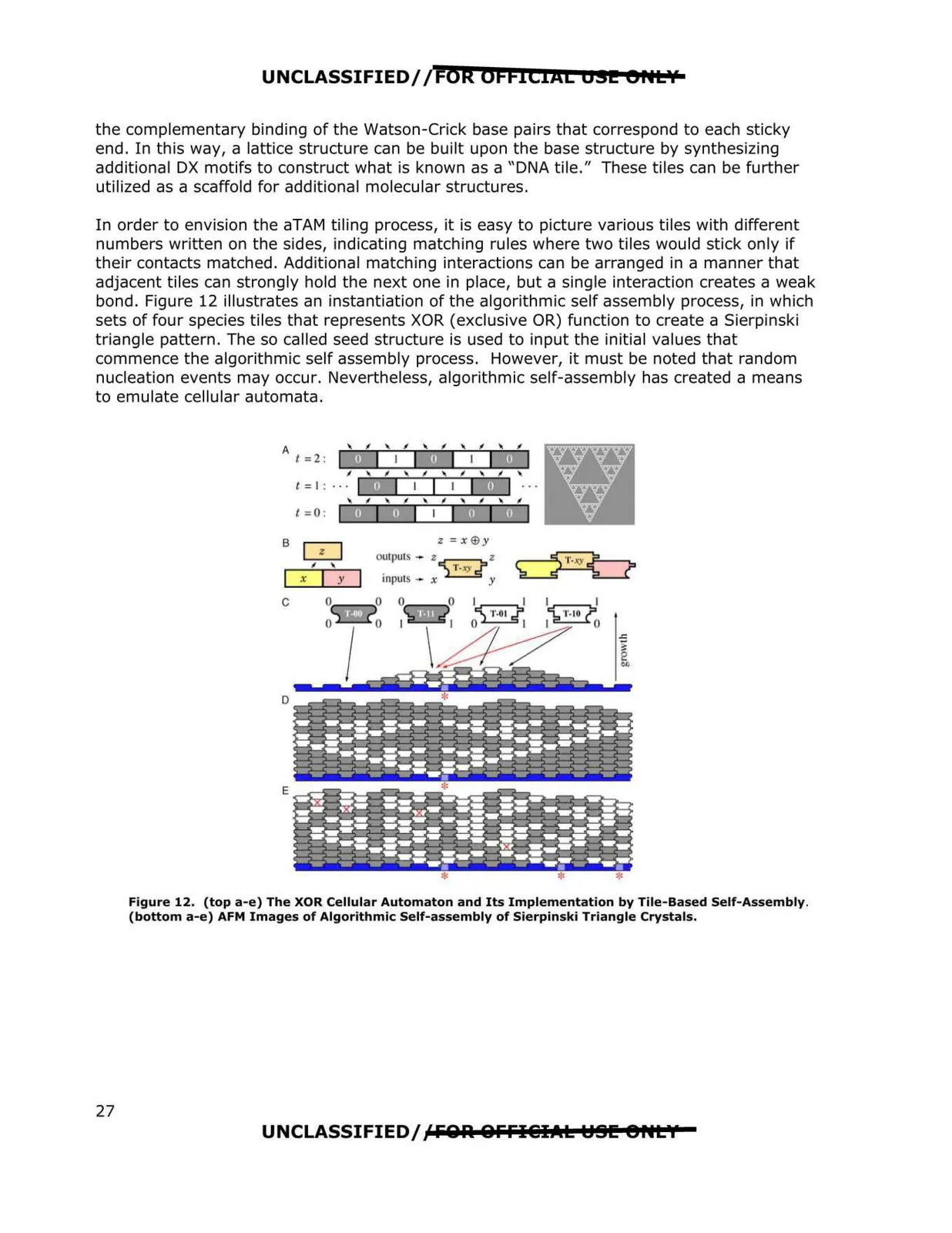
In order to envision the aTAM tiling process, it is easy to picture various tiles with different
numbers written on the sides, indicating matching rules where two tiles would stick only if
their contacts matched. Additional matching interactions can be arranged in a manner that
adjacent tiles can strongly hold the next one in place, but a single interaction creates a weak
bond. Figure 12 illustrates an instantiation of the algorithmic self assembly process, in which
sets of four species tiles that represents XOR ( exclusive OR) function to create a Sierpinski
triangle pattern. The so called seed structure is used to input the initial values that
commence the algorithmic self assembly process. However, it must be noted that random
nucleation events may occur. Nevertheless, algorithmic self-assembly has created a means
to emulate cellular automata.
A l = 2 :
I = 0 :
z = xEBy
output -
z
z ~
~ ~
inputs -
x
y
D
*
E
-
-
-
y
....
.....
........ ~-~ ---
--·--
-
Figure 12. (top a-e) The XOR Cellular Automaton and Its Implementation by Tile-Based Self-Assembly.
(bottom a-e) AFM Images of Algorithmic Self-assembly of Sierpinski Triangle Crystals.
UNCLASSIFIED//FOA QFFl&IAL Y!H! 8Ht,
27