AAWSAP DIRD, Quantum Computing and Utilizing Organic Molecules in Automation Technology, December 2010
DOW-UAP-D150 · page 32 of 54
Text
This text came with the file. It may have mistakes. When the text and the image disagree, the image is right.
UNCLASSIFIED//P91t 9PPl@IAL l:ISIE 8HLY
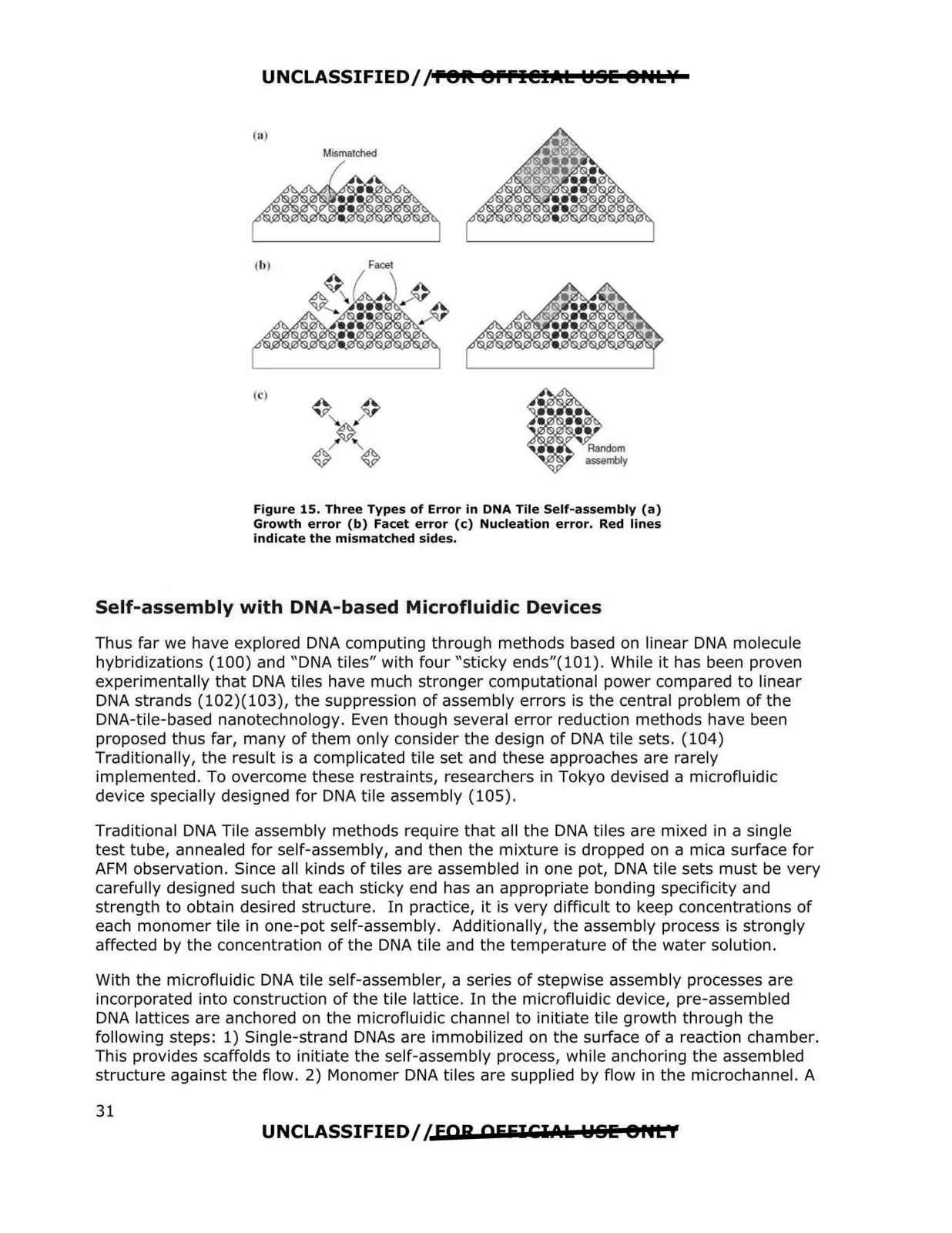
(a)
Mismatched
~
Facet
c)
~OOm
~'::eRW1y
Figure 15. Three Types of Error in DNA Tile Self-assembly (a)
Growth error (b) Facet error (c) Nucleation error. Red lines
indicate the mismatched sides.
Self-assembly with DNA-based Microfluidic Devices
Thus far we have explored DNA computing through methods based on linear DNA molecule
hybridizations (100) and "DNA tiles" with four "sticky ends"(101) . While it has been proven
experimentally that DNA tiles have much stronger computational power compared to linear
DNA strands (102)(103), the suppression of assembly errors is the central problem of the
DNA-tile-based nanotechnology. Even though several error reduction methods have been
proposed thus far, many of them only consider the design of DNA tile sets. (104)
Traditionally, the result is a complicated tile set and these approaches are rarely
implemented. To overcome these restraints, researchers in Tokyo devised a microfluidic
device specially designed for DNA tile assembly ( 105).
Traditional DNA Tile assembly methods require that all the DNA tiles are mixed in a single
test tube, annealed for self-assembly, and then the mixture is dropped on a mica surface for
AFM observation. Since all kinds of tiles are assembled in one pot, DNA tile sets must be very
carefully designed such that each sticky end has an appropriate bonding specificity and
strength to obtain desired structure. In practice, it is very difficult to keep concentrations of
each monomer tile in one-pot self-assembly. Additionally, the assembly process is strongly
affected by the concentration of the DNA tile and the temperature of the water solution.
With the microfluidic DNA tile self-assembler, a series of stepwise assembly processes are
incorporated into construction of the tile lattice. In the microfluidic device, pre-assembled
DNA lattices are anchored on the microfluidic channel to initiate tile growth through the
following steps: 1) Single-strand DNAs are immobilized on the surface of a reaction chamber.
This provides scaffolds to initiate the self-assembly process, while anchoring the assembled
structure against the flow. 2) Monomer DNA tiles are supplied by flow in the microchannel. A
UNCLASSIFIED/lfQR OEEICIAk WSIE 9Htt
31