AAWSAP DIRD, Quantum Computing and Utilizing Organic Molecules in Automation Technology, December 2010
DOW-UAP-D150 · page 33 of 54
Text
This text came with the file. It may have mistakes. When the text and the image disagree, the image is right.
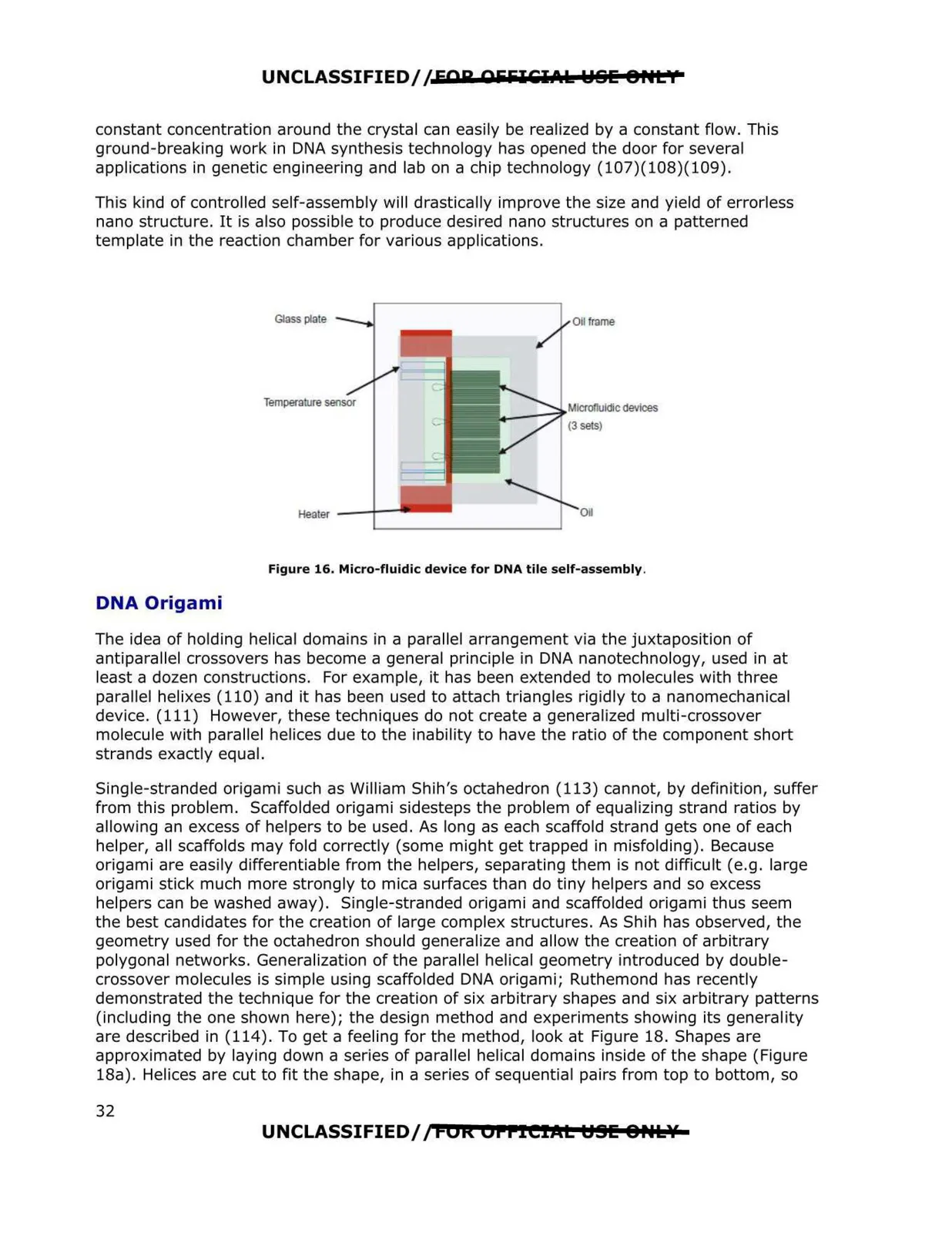
UNCLASSIFIED//FOR OSSICIAl WSE 8Ht'I" constant concentration around the crystal can easily be realized by a constant flow. This ground-breaking work in DNA synthesis technology has opened the door for several applications in genetic engineering and lab on a chip technology (107)(108)(109). This kind of controlled self-assembly will drastically improve the size and yield of errorless nano structure. It is also possible to produce desired nano structures on a patterned template in the reaction chamber for various applications. Glass plate 011 Figure 16. Micro-fluidic device for DNA tile self-assembly. DNA Origami The idea of holding helical domains in a parallel arrangement via the juxtaposition of antiparallel crossovers has become a general principle in DNA nanotechnology, used in at least a dozen constructions. For example, it has been extended to molecules with three parallel helixes (110) and it has been used to attach triangles rigidly to a nanomechanical device. (111) However, these techniques do not create a generalized multi-crossover molecule with parallel helices due to the inability to have the ratio of the component short strands exactly equal. Single-stranded origami such as William Shih's octahedron (113) cannot, by definition, suffer from this problem. Scaffolded origami sidesteps the problem of equalizing strand ratios by allowing an excess of helpers to be used. As long as each scaffold strand gets one of each helper, all scaffolds may fold correctly (some might get trapped in misfolding). Because origami are easily differentiable from the helpers, separating them is not difficult (e.g. large origami stick much more strongly to mica surfaces than do tiny helpers and so excess helpers can be washed away). Single-stranded origami and scaffolded origami thus seem the best candidates for the creation of large complex structures. As Shih has observed, the geometry used for the octahedron should generalize and allow the creation of arbitrary polygonal networks. Generalization of the parallel helical geometry introduced by double crossover molecules is simple using scaffolded DNA origami; Ruthemond has recently demonstrated the technique for the creation of six arbitrary shapes and six arbitrary patterns (including the one shown here); the design method and experiments showing its generality are described in (114). To get a feeling for the method, look at Figure 18. Shapes are approximated by laying down a series of parallel helical domains inside of the shape (Figure 18a). Helices are cut to fit the shape, in a series of sequential pairs from top to bottom, so UNCLASSIFIED// FOR OPPICIJ!tt tJ!JE 8Hllf 32