AAWSAP DIRD, Quantum Computing and Utilizing Organic Molecules in Automation Technology, December 2010
DOW-UAP-D150 · page 34 of 54
Text
This text came with the file. It may have mistakes. When the text and the image disagree, the image is right.
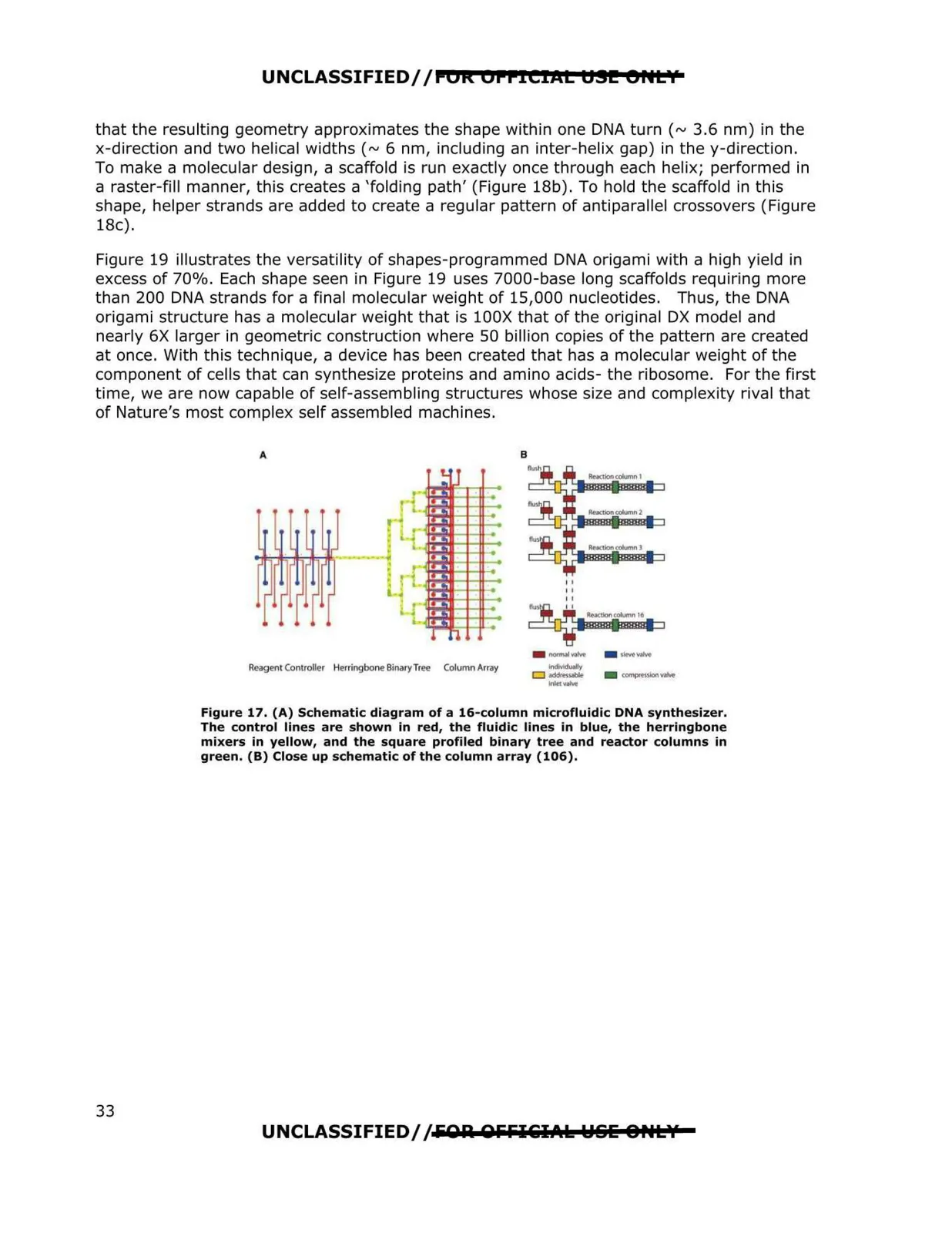
UNCLASSIFIED//FOR OFFICIAL U.!I! 8Ht¥ that the resulting geometry approximates the shape within one DNA turn ( ~ 3.6 nm) in the x-direction and two helical widths(~ 6 nm, including an inter-helix gap) in they-direction. To make a molecular design, a scaffold is run exactly once through each helix; performed in a raster-fill manner, this creates a 'folding path' (Figure 18b). To hold the scaffold in this shape, helper strands are added to create a regular pattern of antiparallel crossovers (Figure 18c). Figure 19 illustrates the versatility of shapes-programmed DNA origami with a high yield in excess of 70%. Each shape seen in Figure 19 uses 7000-base long scaffolds requiring more than 200 DNA strands for a final molecular weight of 15,000 nucleotides. Thus, the DNA origami structure has a molecular weight that is l00X that of the original DX model and nearly 6X larger in geometric construction where 50 billion copies of the pattern are created at once. With this technique, a device has been created that has a molecular weight of the component of cells that can synthesize proteins and amino acids- the ribosome. For the first time, we are now capable of self-assembling structures whose size and complexity rival that of Nature's most complex self assembled machines. A B 1 1 11 1 1 ~ - ~'t'fl\tt - JfflV,Jw Reagen! Controller Herringbone Binary Tree Column Array "'d!Yld..ily □ lnldvAM •""'"'"""' - - Figure 17. (A) Schematic diagram of a 16-column microfluidic DNA synthesizer. The control lines are shown in red, the fluidic lines in blue, the herringbone mixers in yellow, and the square profiled binary tree and reactor columns in green. (8) Close up schematic of the column array (106). UNCLASSIFIED//FOA OFFICil.t.k W&E 8HL1/ 33