AAWSAP DIRD, Quantum Computing and Utilizing Organic Molecules in Automation Technology, December 2010
DOW-UAP-D150 · page 40 of 54
Text
This text came with the file. It may have mistakes. When the text and the image disagree, the image is right.
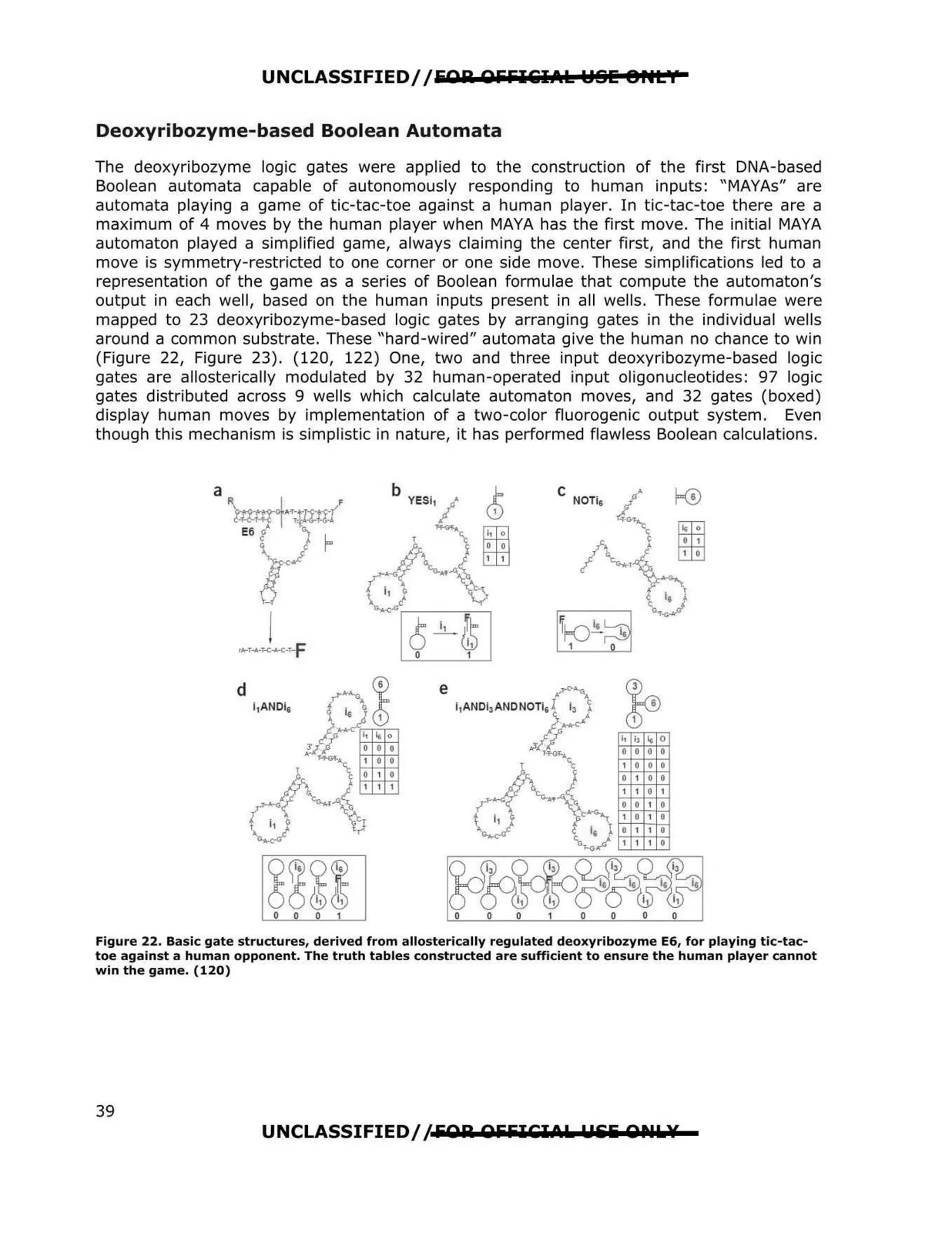
UNCLASSIFIED//FAA: QFFI&il.t.k YSIE 8HtY Deoxyribozyme-based Boolean Automata The deoxyribozyme logic gates were applied to the construction of the first DNA-based Boolean automata capable of autonomously responding to human inputs: "MAYAs" are automata playing a game of tic-tac-toe against a human player. In tic-tac-toe there are a maximum of 4 moves by the human player when MAYA has the first move. The initial MAYA automaton played a simplified game, always claiming the center first, and the first human move is symmetry-restricted to one corner or one side move. These simplifications led to a representation of the game as a series of Boolean formulae that compute the automaton's output in each well, based on the human inputs present in all wells. These formulae were mapped to 23 deoxyribozyme-based logic gates by arranging gates in the individual wells around a common substrate. These "hard-wired" automata give the human no chance to win (Figure 22, Figure 23). (120, 122) One, two and three input deoxyribozyme-based logic gates are allosterically modulated by 32 human-operated input oligonucleotides: 97 logic gates distributed across 9 wells which calculate automaton moves, and 32 gates (boxed) display human moves by implementation of a two-color fluorogenic output system. Even though this mechanism is simplistic in nature, it has performed flawless Boolean calculations. rA-T--A-"f-C.--A-C-t:--F d It i:, ;, 0 0 0 0 0 1 0 0 0 0 , 0 0 , , 0 I 0 0 1 0 1 0 1 0 0 I 1 0 1 1 1 0 Figure 22. Basic gate structures, derived from allosterically regulated deoxyribozyme E6, for playing tic-tac toe against a human opponent. The truth tables constructed are sufficient to ensure the human player cannot win the game. (120) UNCLASSIFIED//EAA: QFFiliCiliOI. l'ii QPII.¥ 39