AAWSAP DIRD, Quantum Computing and Utilizing Organic Molecules in Automation Technology, December 2010
DOW-UAP-D150 · page 43 of 54
Text
This text came with the file. It may have mistakes. When the text and the image disagree, the image is right.
----
UNCLASSIFIED//EOR OFFl&IJ..L ttSI!! BHLI
enzymes, e.g., deoxyribozymes, and performed either solution phase conformational
changes, or were proposed to move autonomously along a linear track over up to four steps.
(127)
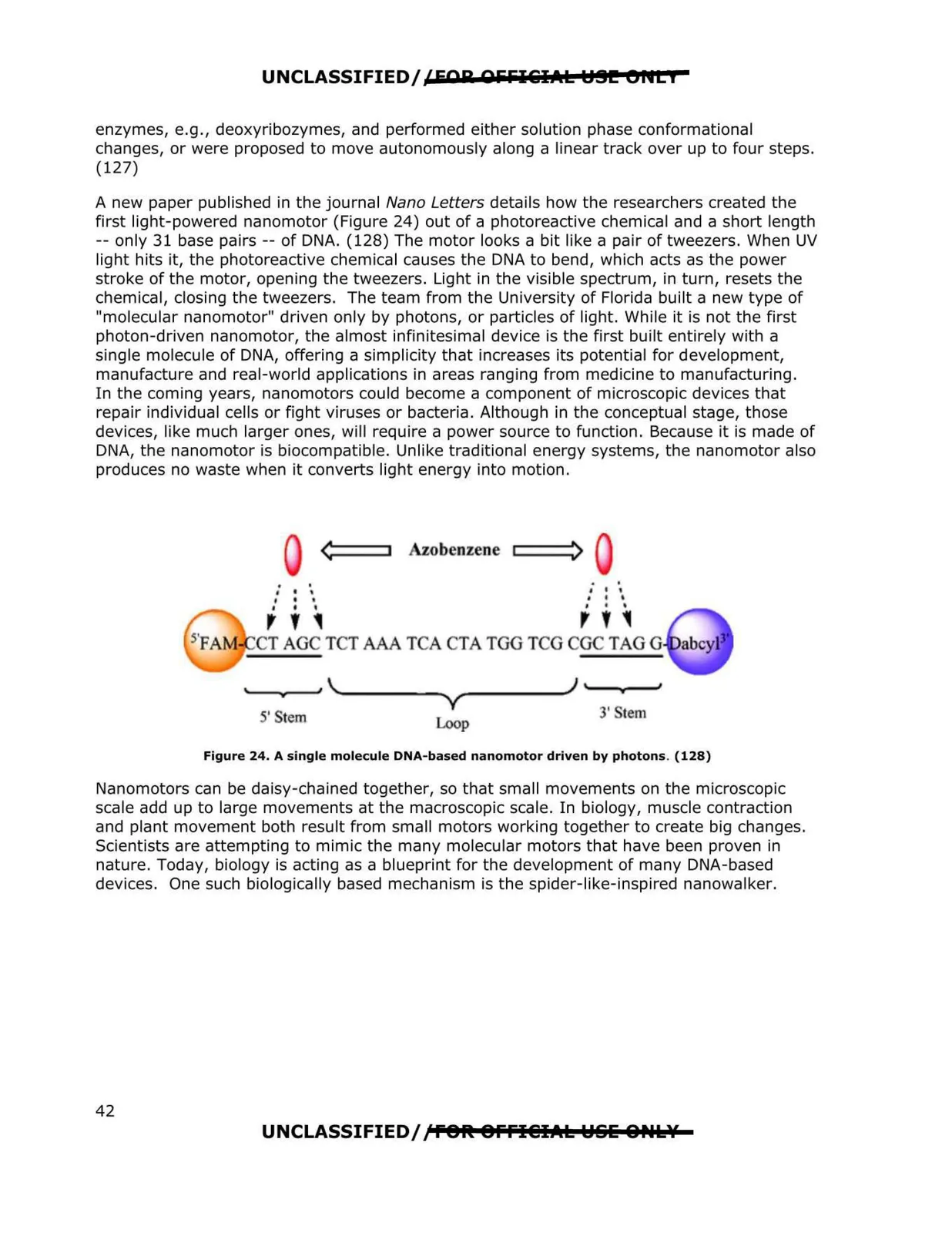
A new paper published in the journal Nano Letters details how the researchers created the
first light-powered nanometer (Figure 24) out of a photoreactive chemical and a short length
-- only 31 base pairs -- of DNA. (128) The motor looks a bit like a pair of tweezers. When UV
light hits it, the photoreactive chemical causes the DNA to bend, which acts as the power
stroke of the motor, opening the tweezers. Light in the visible spectrum, in turn, resets the
chemical, closing the tweezers. The team from the University of Florida built a new type of
"molecular nanometer" driven only by photons, or particles of light. While it is not the first
photon-driven nanomotor, the almost infinitesimal device is the first built entirely with a
single molecule of DNA, offering a simplicity that increases its potential for development,
manufacture and real-world applications in areas ranging from medicine to manufacturing.
In the coming years, nanometers could become a component of microscopic devices that
repair individual cells or fight viruses or bacteria. Although in the conceptual stage, those
devices, like much larger ones, will require a power source to function . Because it is made of
DNA, the nanomotor is biocompatible. Unlike traditional energy systems, the nanomotor also
produces no waste when it converts light energy into motion.
zob oz n
<
> .
'. . .
'I '
•
I . •.
T TOOT G
____, \._....
)
.
V
I
tern
' tem
Loop
Figure 24. A single molecule DNA-based nanomotor driven by photons. (128)
Nanometers can be daisy-chained together, so that small movements on the microscopic
scale add up to large movements at the macroscopic scale. In biology, muscle contraction
and plant movement both result from small motors working together to create big changes.
Scientists are attempting to mimic the many molecular motors that have been proven in
nature. Today, biology is acting as a blueprint for the development of many DNA-based
devices. One such biologically based mechanism is the spider-like-inspired nanowalker.
UNCLASSIFIED//POR: Offl@IAL Y&li 8Ptllf
42