AAWSAP DIRD, Quantum Computing and Utilizing Organic Molecules in Automation Technology, December 2010
DOW-UAP-D150 · page 44 of 54
Text
This text came with the file. It may have mistakes. When the text and the image disagree, the image is right.
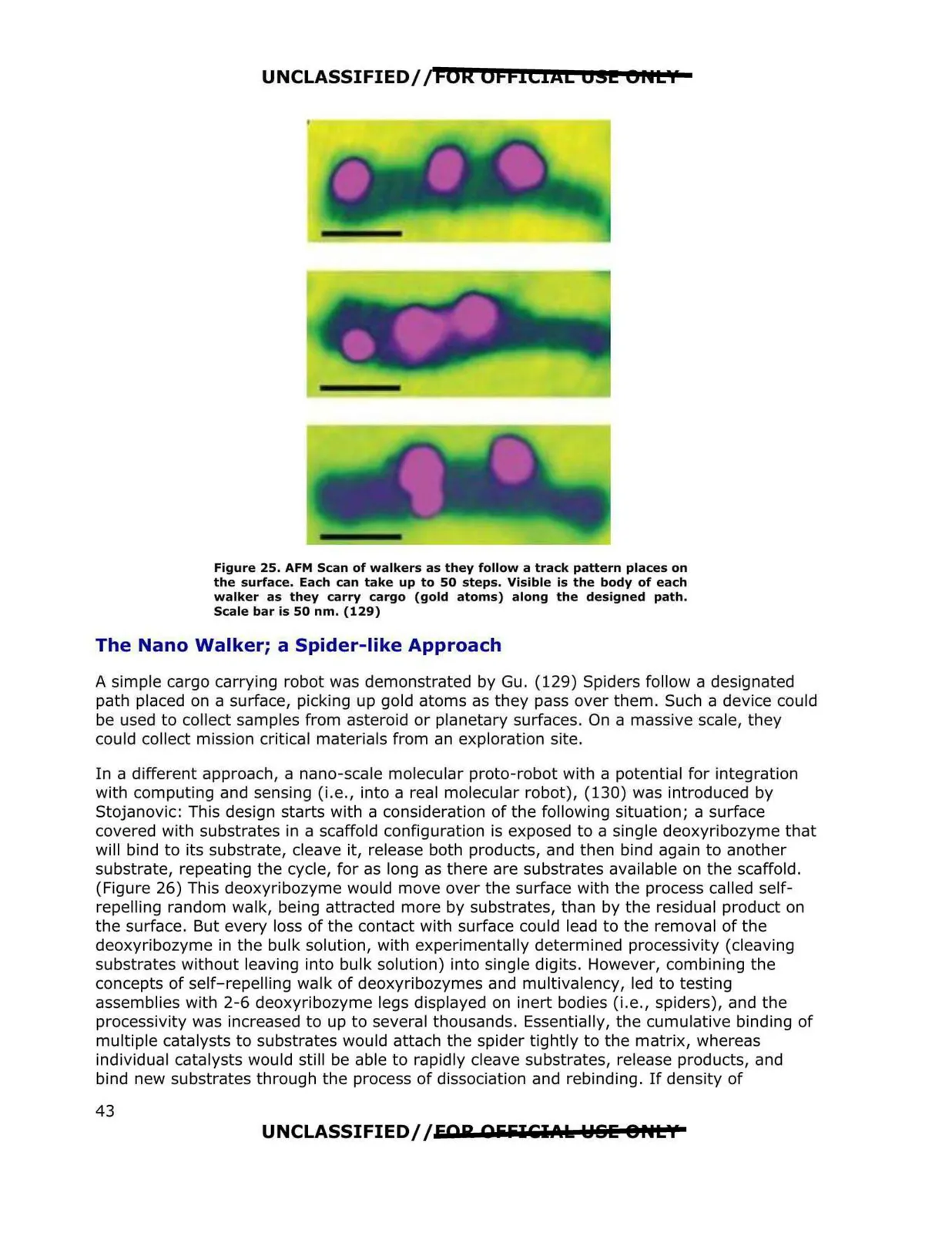
UNCLASSIFIED//Fdk OFFICIAL USE l>flti" Figure 25. AFM Scan of walkers as they follow a track pattern places on the surface. Each can take up to 50 steps. Visible is the body of each walker as they carry cargo (gold atoms} along the designed path. Scale bar is 50 nm. (129} The Nano Walker; a Spider-like Approach A simple cargo carrying robot was demonstrated by Gu. (129) Spiders follow a designated path placed on a surface, picking up gold atoms as they pass over them. Such a device could be used to collect samples from asteroid or planetary surfaces. On a massive scale, they could collect mission critical materials from an exploration site. In a different approach, a nano-scale molecular proto-robot with a potential for integration with computing and sensing (i.e., into a real molecular robot), (130) was introduced by Stojanovic: This design starts with a consideration of the following situation; a surface covered with substrates in a scaffold configuration is exposed to a single deoxyribozyme that will bind to its substrate, cleave it, release both products, and then bind again to another substrate, repeating the cycle, for as long as there are substrates available on the scaffold. (Figure 26) This deoxyribozyme would move over the surface with the process called self repelling random walk, being attracted more by substrates, than by the residual product on the surface. But every loss of the contact with surface could lead to the removal of the deoxyribozyme in the bulk solution, with experimentally determined processivity (cleaving substrates without leaving into bulk solution) into single digits. However, combining the concepts of self-repelling walk of deoxyribozymes and multivalency, led to testing assemblies with 2-6 deoxyribozyme legs displayed on inert bodies (i.e., spiders), and the processivity was increased to up to several thousands. Essentially, the cumulative binding of multiple catalysts to substrates would attach the spider tightly to the matrix, whereas individual catalysts would still be able to rapidly cleave substrates, release products, and bind new substrates through the process of dissociation and rebinding. If density of UNCLASSIFIED//FAR OSSICl.\k W&E 8HLY 43