AAWSAP DIRD, Cognitive Limits on Simultaneous Control of Multiple Unmanned Spacecraft, December 2010
DOW-UAP-D151 · page 7 of 31
Text
This text came with the file. It may have mistakes. When the text and the image disagree, the image is right.
UNCLASSIFIED/ /FOR OSSICIAl WSE 8HLY
audio processing, and this is where multiple resource theory enters: different resources
can be considered independent if demands on one resource do not tax the availability of
capacity of the other. Performance of a task can be high or low: in general if spare
capacity is available, performance is high, and if capacity is limited or exceeded,
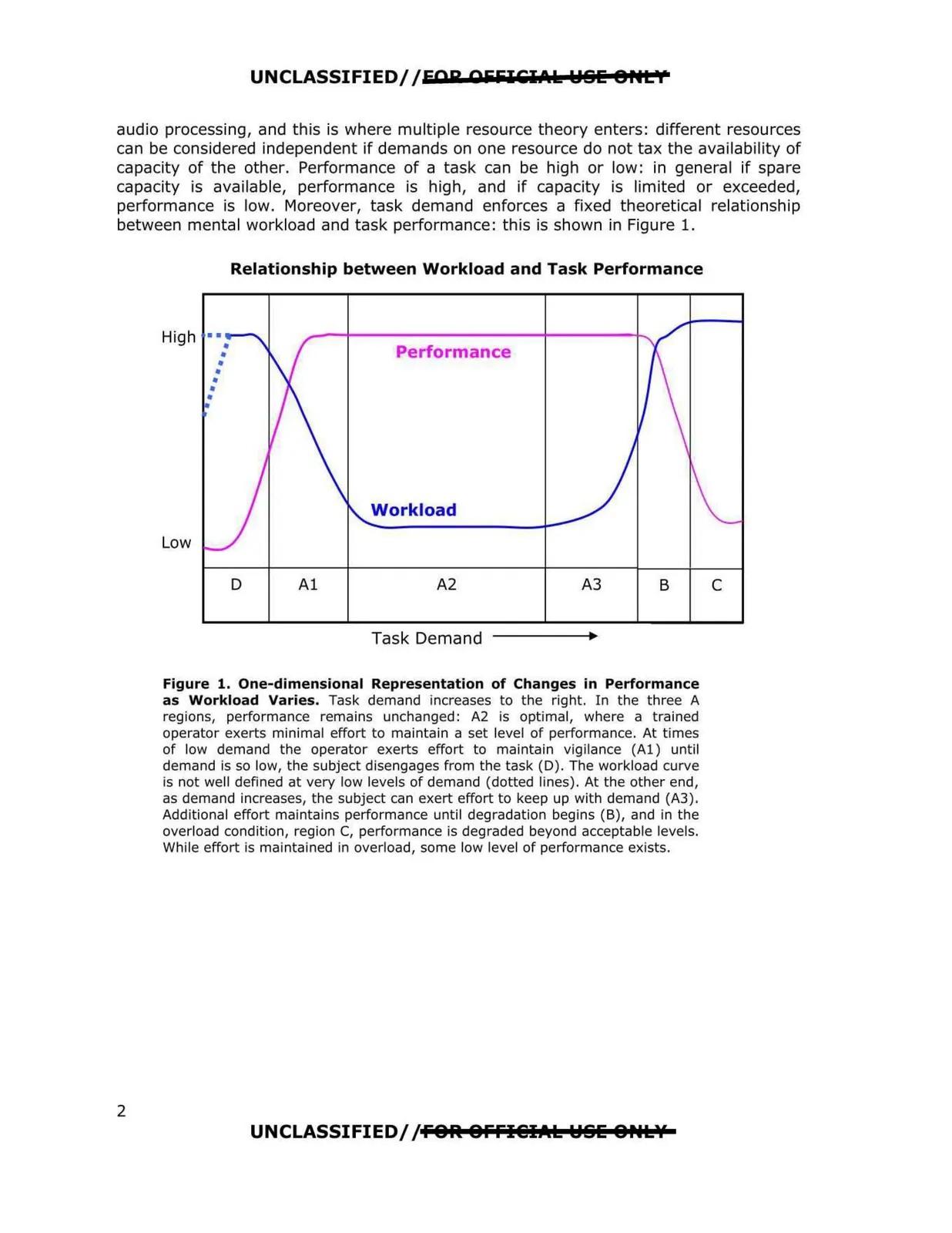
performance is low. Moreover, task demand enforces a fixed theoretical relationship
between mental workload and task performance: this is shown in Figure l.
Relationship between Workload and Task Performance
High
Performance
Workload
Low
D
Al
A2
A3
B
C
Task Demand
Figure 1. One-dimensional Representation of Changes in Performance
as Workload Varies. Task demand increases to the right. In the three A
regions, performance remains unchanged : A2 is optimal, where a trained
operator exerts minimal effort to maintain a set level of performance. At times
of low demand the operator exerts effort to maintain vigilance (Al) until
demand is so low, the subject disengages from the task (D). The workload curve
is not well defined at very low levels of demand (dotted lines). At the other end,
as demand increases, the subject can exert effort to keep up with demand (A3).
Additional effort maintains performance until degradation begins (B), and in the
overload condition, region C, performance is degraded beyond acceptable levels.
While effort is maintained in overload, some low level of performance exists.
UNCLASSIFIED/ /FOR OFFI@IAI: WSE OHl:l/
2