AAWSAP DIRD, Negative Mass Propulsion, January 2011
DOW-UAP-D152 · page 14 of 43
Text
This text came with the file. It may have mistakes. When the text and the image disagree, the image is right.
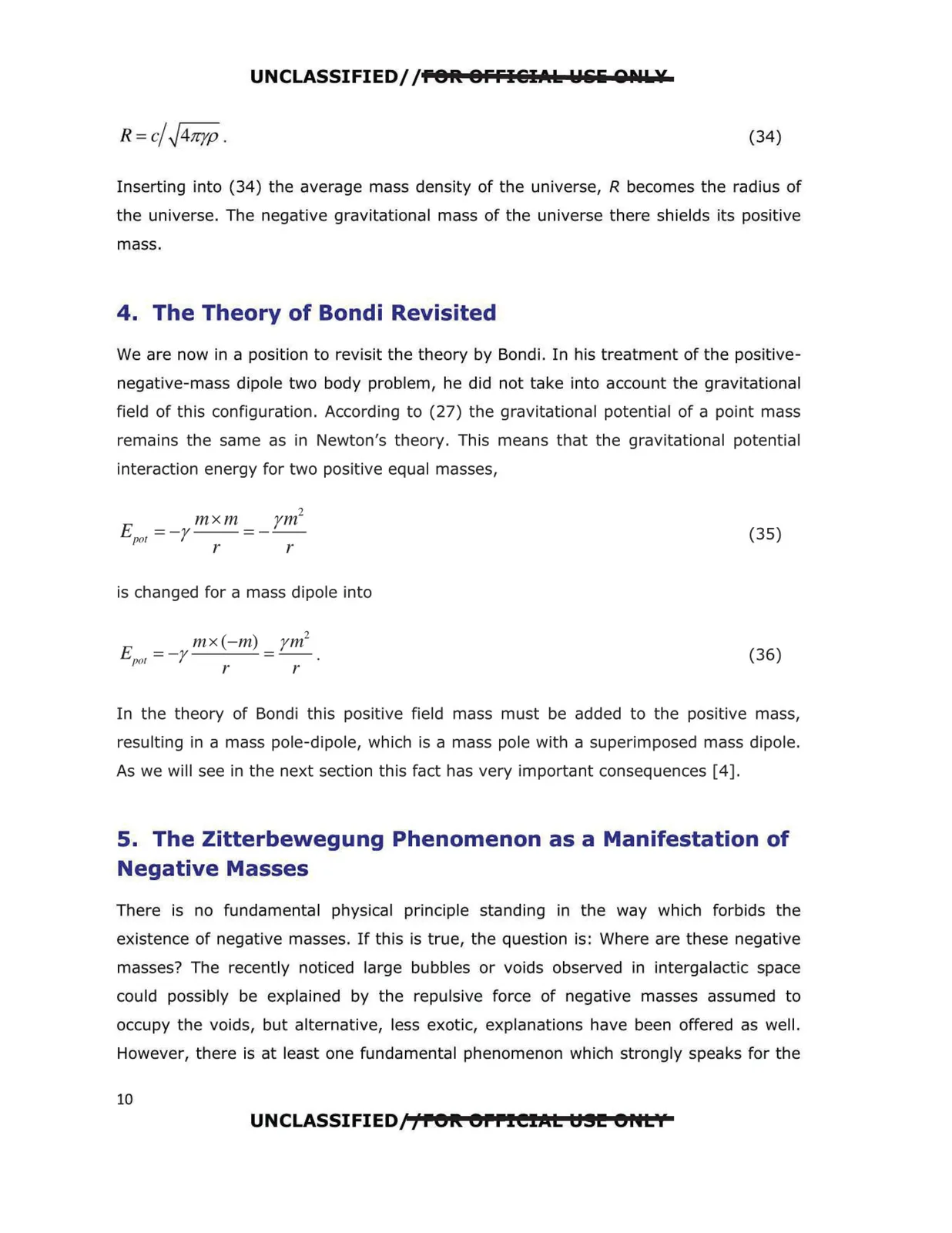
UNCLASSIFIED/ /fOR. 8FFl&I.t.k W&li ,HIia¥ (34) Inserting into (34) the average mass density of the universe, R becomes the radius of the universe. The negative gravitational mass of the universe there shields its positive mass. 4. The Theory of Bondi Revisited We are now in a position to revisit the theory by Bondi. In his treatment of the positive negative-mass dipole two body problem, he did not take into account the gravitational field of this configuration. According to (27) the gravitational potential of a point mass remains the same as in Newton's theory . This means that the gravitational potential interaction energy for two positive equal masses, 2 £ = -r m X m = _ ym pot (35) r r is changed for a mass dipole into E __ mx(-m) _ ym2 pot - r - (36) r r In the theory of Bondi this positive field mass must be added to the positive mass, resulting in a mass pole-dipole, which is a mass pole with a superimposed mass dipole. As we will see in the next section this fact has very important consequences [4). 5. The Zitterbewegung Phenomenon as a Manifestation of Negative Masses There is no fundamental physical principle standing in the way which forbids the existence of negative masses. If this is true, the question is: Where are these negative masses? The recently noticed large bubbles or voids observed in intergalactic space could possibly be explained by the repulsive force of negative masses assumed to occupy the voids, but alternative, less exotic, explanations have been offered as well. However, there is at least one fundamental phenomenon which strongly speaks for the UNCLASSIFIED//POlt OPPIEIAL tf!II! or~LY 10