AAWSAP DIRD, Negative Mass Propulsion, January 2011
DOW-UAP-D152 · page 15 of 43
Text
This text came with the file. It may have mistakes. When the text and the image disagree, the image is right.
UNCLASSIFIED/ /P'OR. 8FFIEil1'1.k lellii Ql'II.¥
existence of negative masses. It is the spin of the fermions, like the spin of the electron.
Fermions are described by Dirac's relativistic wave equation. This equation has both
positive and negative energy components and because of the mass-energy relation, it
therefore must have negative mass components. According to Schrodinger [4], it is
these negative mass components which lead to the phenomenon of the spin. Since the
overall mass of the electron is positive, the occurrence of negative masses in the Dirac
equation must mean that the electron is a mass pole with a superimposed mass dipole
[5].
The spin is definitely not an intrinsic rotational motion of a finite size particle, as older
models had suggested it to be. The original model by Uhlenbeck and Goudsmit, for
example, cannot possibly be correct because it requires superluminal rotation velocities
for an electron with the classical radius 'o =e2/ mc2 .
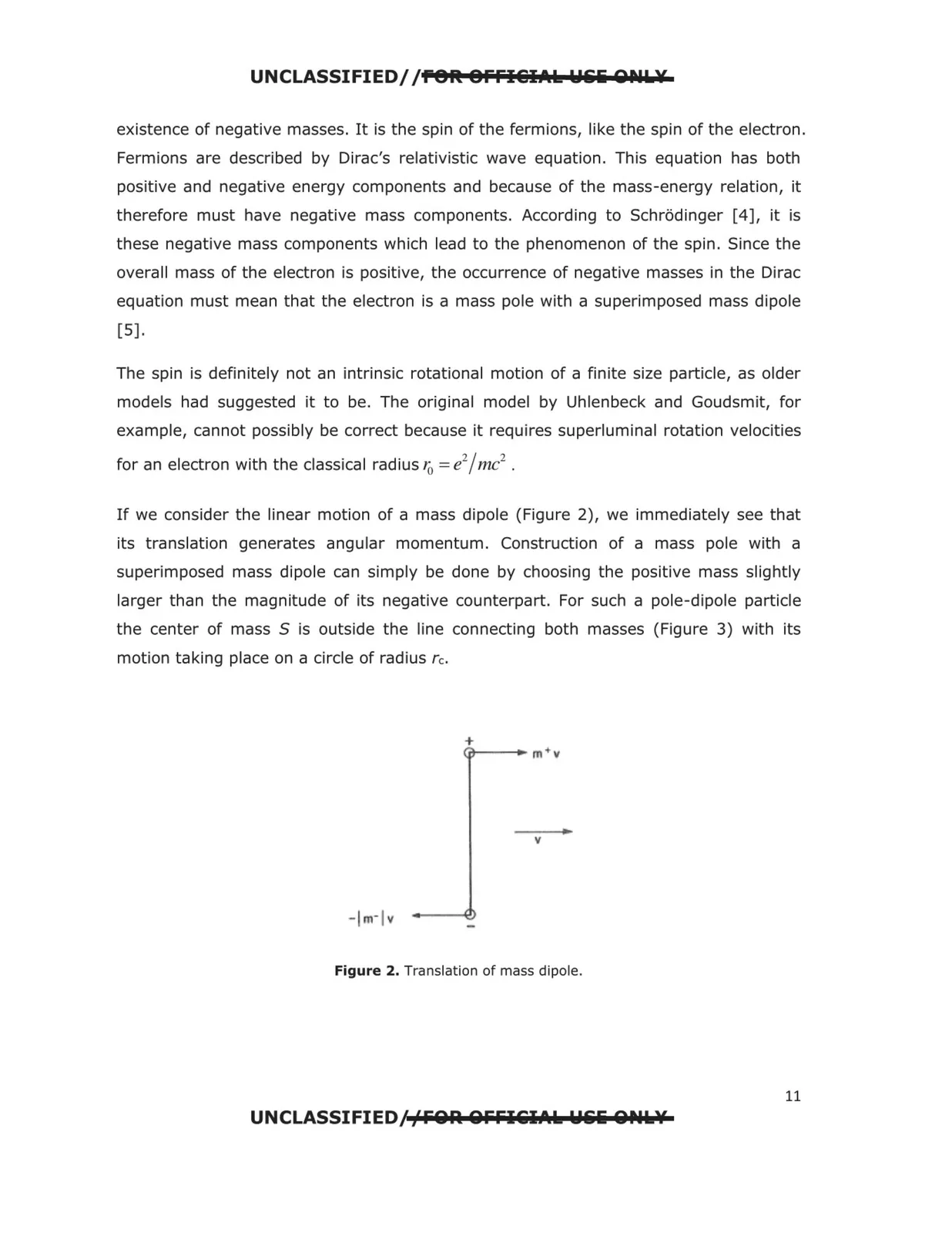
If we consider the linear motion of a mass dipole (Figure 2), we immediately see that
its translation generates angular momentum. Construction of a mass pole with a
superimposed mass dipole can simply be done by choosing the positive mass slightly
larger than the magnitude of its negative counterpart. For such a pole-dipole particle
the center of mass S is outside the line connecting both masses (Figure 3) with its
motion taking place on a circle of radius re.
Figure 2. Translation of mass dipole.
UNCLASSIFIED/fFOA OFFI&il.t.k lellii OJi,k¥
11