AAWSAP DIRD, Negative Mass Propulsion, January 2011
DOW-UAP-D152 · page 16 of 43
Text
This text came with the file. It may have mistakes. When the text and the image disagree, the image is right.
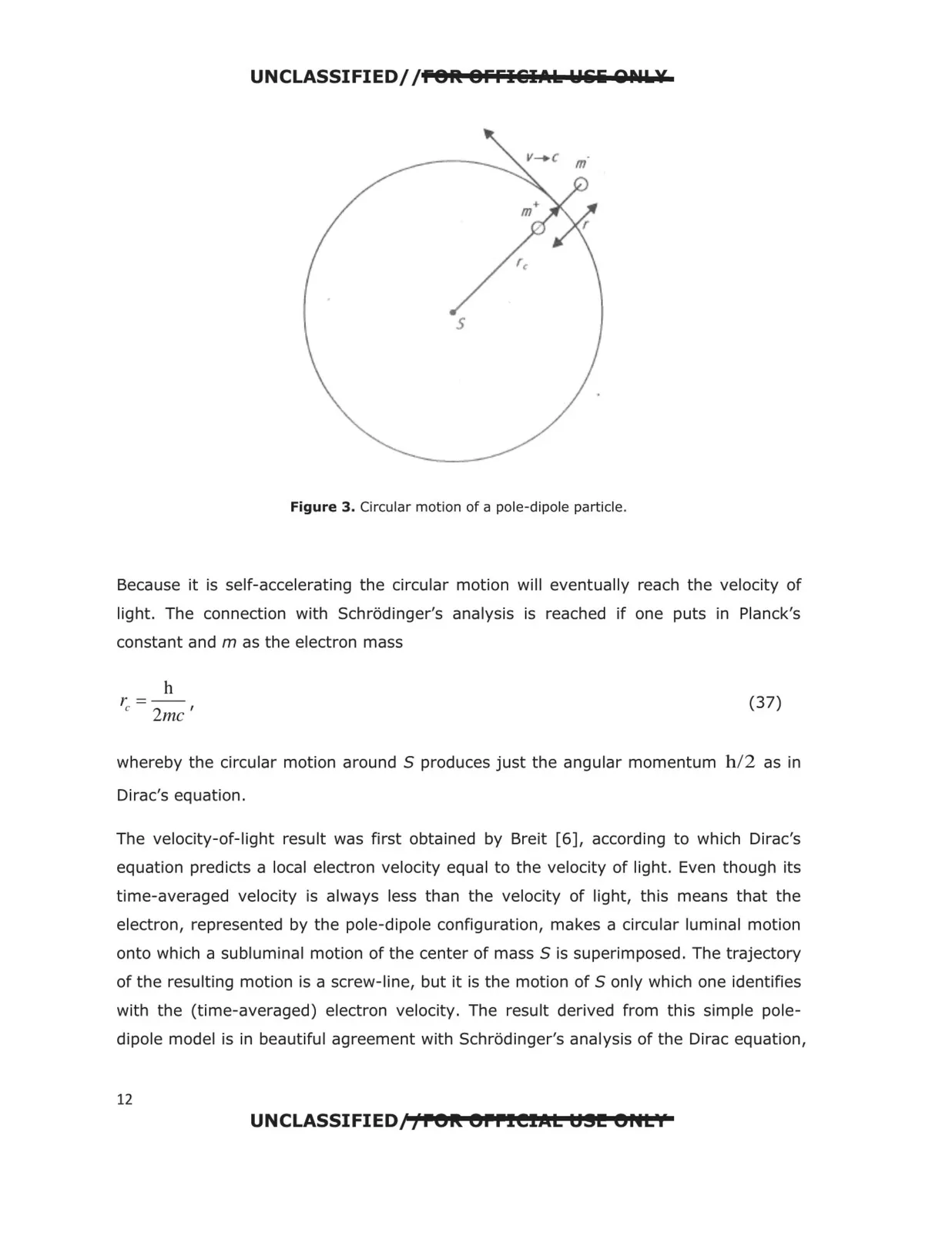
UNCLASSIFIED/ /P'OR. 8FFIEil1'1.k lellii Ql'II.¥ s Figure 3. Circular motion of a pole-dipole particle. Because it is self-accelerating the circular motion will eventually reach the velocity of light. The connection with Schrodinger's analysis is reached if one puts in Planck's constant and m as the electron mass h r c =- 2mc' (37) whereby the circular motion around S produces just the angular momentum h/2 as in Dirac's equation. The velocity-of-light result was first obtained by Breit [6], according to which Dirac's equation predicts a local electron velocity equal to the velocity of light. Even though its time-averaged velocity is always less than the velocity of light, this means that the electron, represented by the pole-dipole configuration, makes a circular luminal motion onto which a subluminal motion of the center of mass Sis superimposed. The trajectory of the resulting motion is a screw-line, but it is the motion of Sonly which one identifies with the (time-averaged) electron velocity. The result derived from this simple pole dipole model is in beautiful agreement with Schrodinger's analysis of the Dirac equation, UNCLASSIFIED//P'Olll OPPIEll<L tt!II!! or~LY 12