AAWSAP DIRD, Negative Mass Propulsion, January 2011
DOW-UAP-D152 · page 22 of 43
Text
This text came with the file. It may have mistakes. When the text and the image disagree, the image is right.
UNCLASSIFIED//fOR. 8FFI61.t..k W&i QJsll,¥
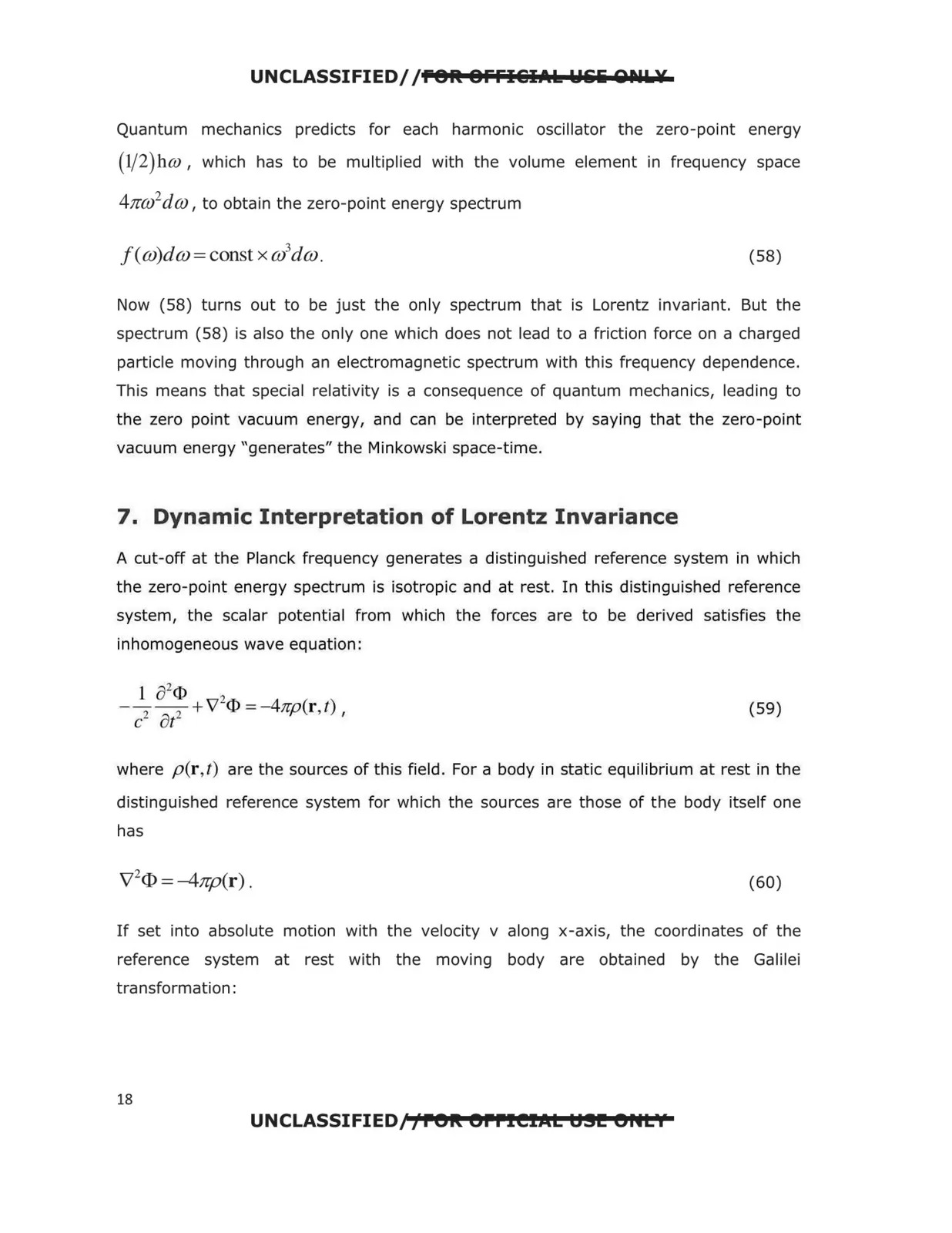
Quantum mechanics predicts for each harmonic oscillator the zero-point energy
(1/2)hm, which has to be multiplied with the volume element in frequency space
41'Ca>2dm, to obtain the zero-point energy spectrum
f((J))d(J)=Const X (J)3d(J)_
(58)
Now (58) turns out to be just the only spectrum that is Lorentz invariant. But the
spectrum (58) is also the only one which does not lead to a friction force on a charged
particle moving through an electromagnetic spectrum with this frequency dependence.
This means that special relativity is a consequence of quantum mechanics, leading to
the zero point vacuum energy, and can be interpreted by saying that the zero-point
vacuum energy "generates" the Minkowski space-time.
7. Dynamic Interpretation of Lorentz Invariance
A cut-off at the Planck frequency generates a distinguished reference system in which
the zero-point energy spectrum is isotropic and at rest. In this distinguished reference
system, the scalar potential from which the forces are to be derived satisfies the
inhomogeneous wave equation:
1 if <l>
,
- - -- + v-<1> = -47Z'p(r t)
(59)
c2 8t2
>
I
where p(r,t) are the sources of this field. For a body in static equilibrium at rest in the
distinguished reference system for which the sources are those of the body itself one
has
(60)
If set into absolute motion with the velocity v along x-axis, the coordinates of the
reference system at rest with the moving body are obtained by the Galilei
transformation:
UNCLASSIFIED//POlt orr1e11tt tt!II!! or~LY
18