AAWSAP DIRD, Negative Mass Propulsion, January 2011
DOW-UAP-D152 · page 23 of 43
Text
This text came with the file. It may have mistakes. When the text and the image disagree, the image is right.
I
UNCLASSIFIED/ /P'OR. 8FFIEil1'1.k lellii Ql'II.¥
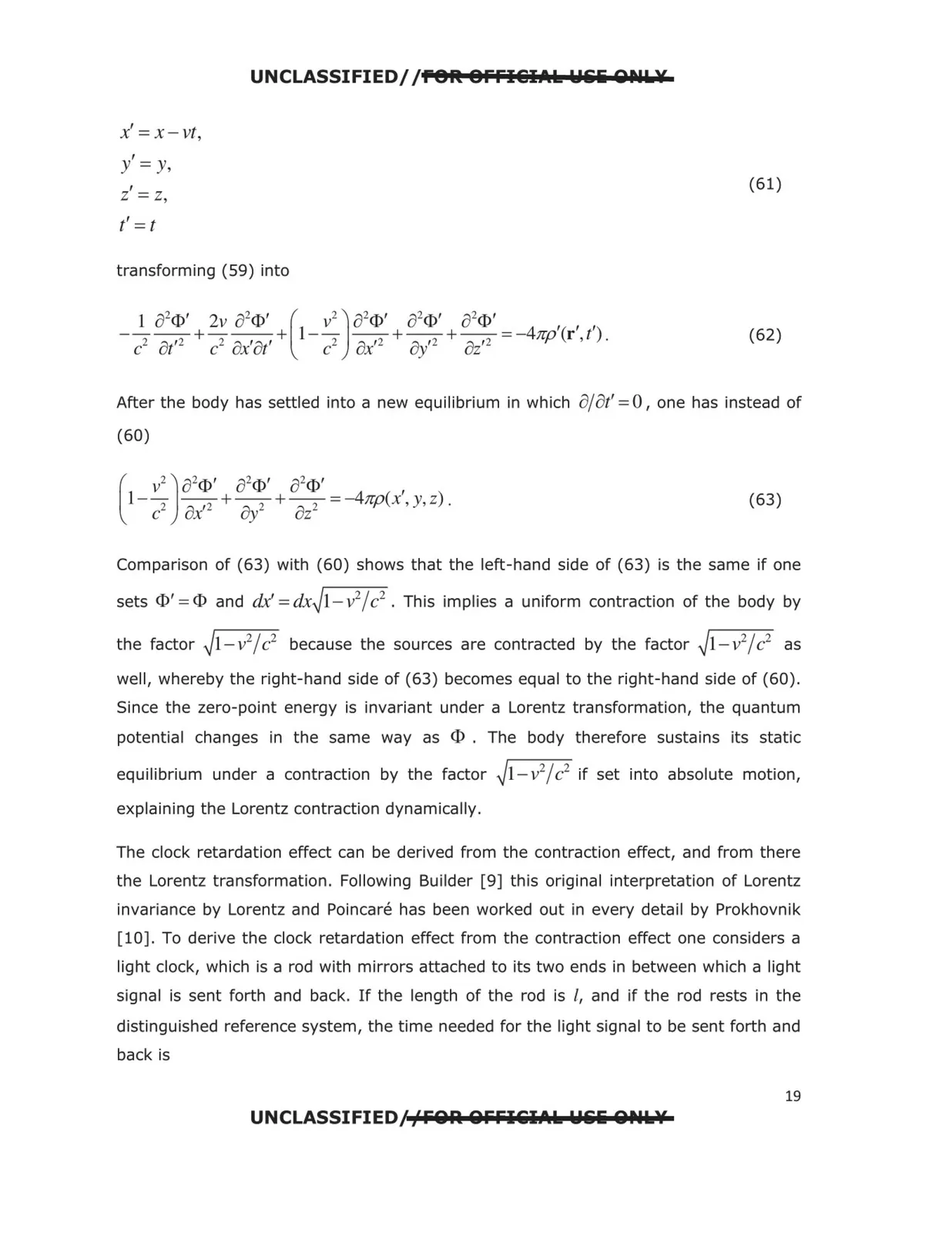
x' =x-vt,
y =y,
(61)
z' =z,
t' =t
transforming (59) into
(62)
After the body has settled into a new equilibrium in which 8/8t' = 0, one has instead of
(60)
(63)
Comparison of (63) with (60) shows that the left-hand side of (63) is the same if one
sets <D' =<D and dx' =dx.jI-v2/ c2 . This implies a uniform contraction of the body by
the factor .jl- v2/c2 because the sources are contracted by the factor .J1- v2/c2 as
well, whereby the right-hand side of (63) becomes equal to the right-hand side of (60).
Since the zero-point energy is invariant under a Lorentz transformation, the quantum
potential changes in the same way as <I> . The body therefore sustains its static
equilibrium under a contraction by the factor .J1 - v2/ c2 if set into absolute motion,
explaining the Lorentz contraction dynamically.
The clock retardation effect can be derived from the contraction effect, and from there
the Lorentz transformation. Following Builder [9] this original interpretation of Lorentz
invariance by Lorentz and Poincare has been worked out in every detail by Prokhovnik
[10]. To derive the clock retardation effect from the contraction effect one considers a
light clock, which is a rod with mirrors attached to its two ends in between which a light
signal is sent forth and back. If the length of the rod is l, and if the rod rests in the
distinguished reference system, the time needed for the light signal to be sent forth and
back is
UNCLASSIFIED/fFOA OFFI&il.t.k lellii OJi,k¥
19