AAWSAP DIRD, Negative Mass Propulsion, January 2011
DOW-UAP-D152 · page 26 of 43
Text
This text came with the file. It may have mistakes. When the text and the image disagree, the image is right.
UNCLASSIFIED/ /P'OR. 8FFIEil1'1.k lellii Ql'II.¥
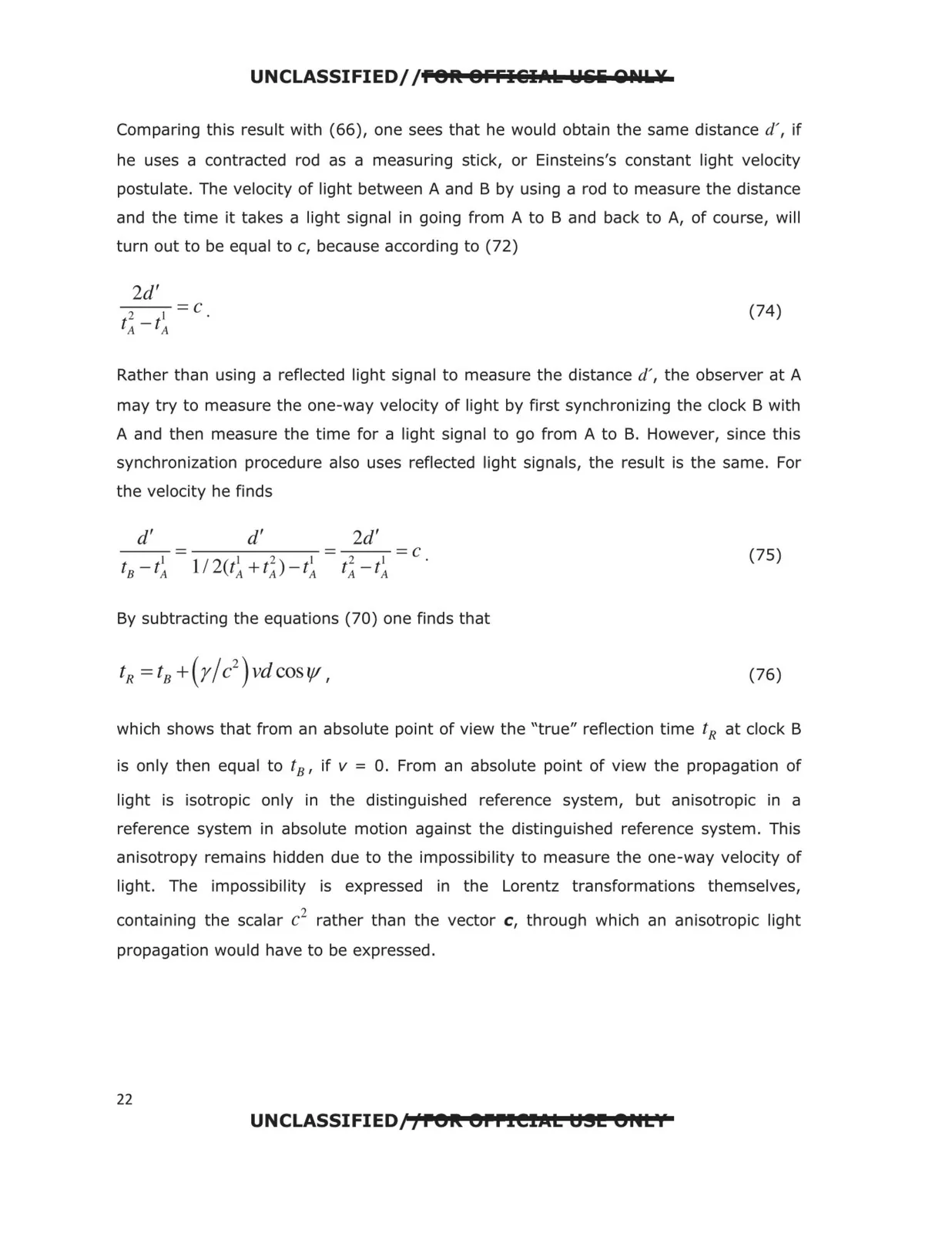
Comparing this result with (66), one sees that he would obtain the same distance d', if
he uses a contracted rod as a measuring stick, or Einsteins's constant light velocity
postulate. The velocity of light between A and B by using a rod to measure the distance
and the time it takes a light signal in going from A to B and back to A, of course, will
turn out to be equal to c, because according to (72)
2d'
---=C
(74)
t 2 - ti
A
A
Rather than using a reflected light signal to measure the distance d', the observer at A
may try to measure the one-way velocity of light by first synchronizing the clock B with
A and then measure the time for a light signal to go from A to B. However, since this
synchronization procedure also uses reflected light signals, the result is the same. For
the velocity he finds
d'
d'
2d'
---=c
(75)
l I 2(t1 + t 2 ) - t 1
t 2 - ti
A
A
A
A
A
By subtracting the equations (70) one finds that
tR = fB + ( rIC2) vd cos If/ ,
(76)
which shows that from an absolute point of view the "true" reflection time tR at clock B
is only then equal to t8 , if v = 0. From an absolute point of view the propagation of
light is isotropic only in the distinguished reference system, but anisotropic in a
reference system in absolute motion against the distinguished reference system. This
anisotropy remains hidden due to the impossibility to measure the one-way velocity of
light. The impossibility is expressed in the Lorentz transformations themselves,
containing the scalar c2 rather than the vector c, through which an anisotropic light
propagation would have to be expressed.
UNCLASSIFIED//P'Olll OPPIEll<L tt!II!! or~LY
22