AAWSAP DIRD, Negative Mass Propulsion, January 2011
DOW-UAP-D152 · page 25 of 43
Text
This text came with the file. It may have mistakes. When the text and the image disagree, the image is right.
UNCLASSIFIED/ /P'OR. 8FFIEil1'1.k lellii Ql'II.¥
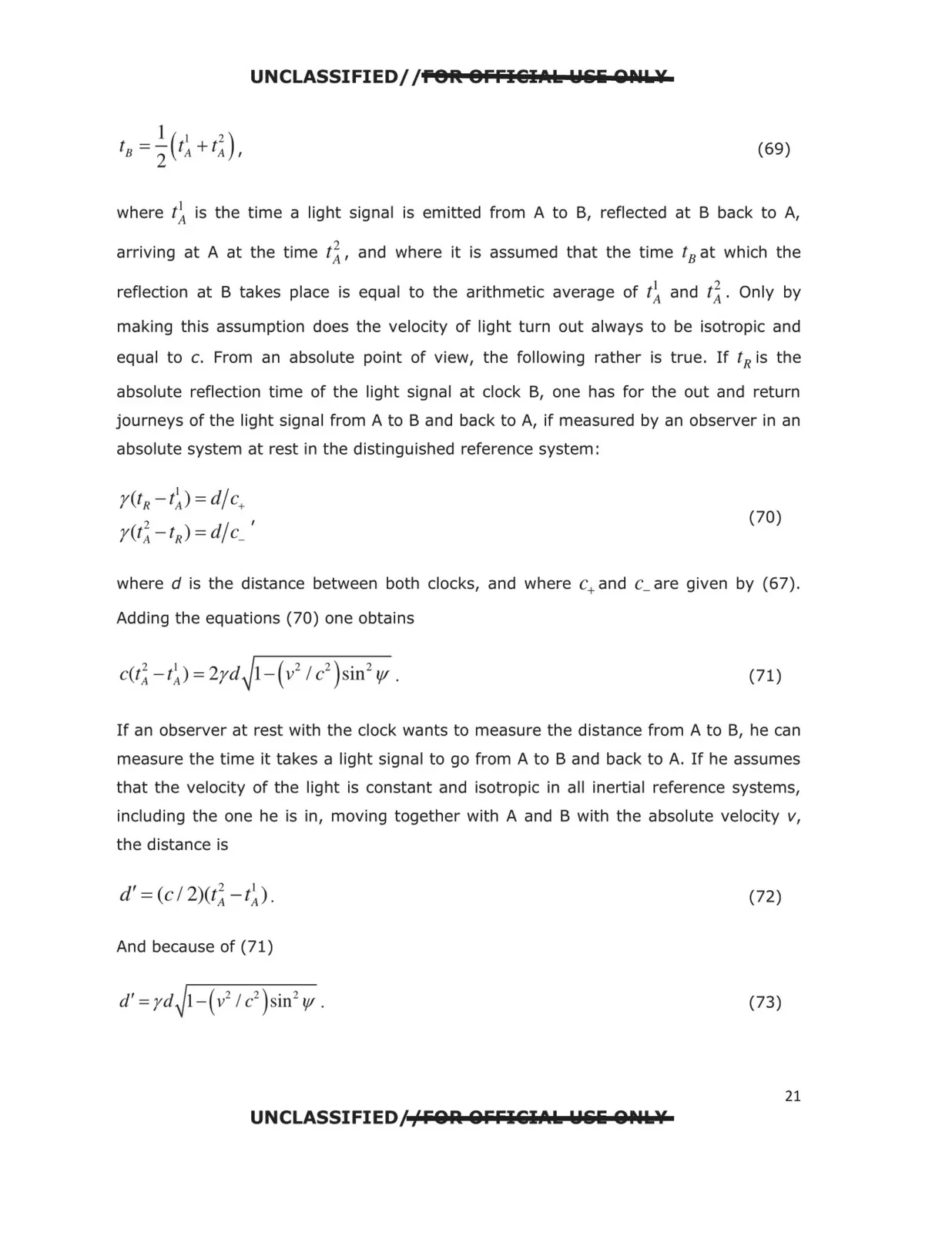
(69)
where t~ is the time a light signal is emitted from A to B, reflected at B back to A,
arriving at A at the time t~, and where it is assumed that the time t8 at which the
reflection at B takes place is equal to the arithmetic average of t~ and t~. Only by
making this assumption does the velocity of light turn out always to be isotropic and
equal to c. From an absolute point of view, the following rather is true. If tR is the
absolute reflection time of the light signal at clock B, one has for the out and return
journeys of the light signal from A to B and back to A, if measured by an observer in an
absolute system at rest in the distinguished reference system:
y(tR -t~) = dfc+
(70)
y(t; -tR) = d/c_'
where d is the distance between both clocks, and where c+ and c_ are given by (67).
Adding the equations (70) one obtains
(71)
If an observer at rest with the clock wants to measure the distance from A to B, he can
measure the time it takes a light signal to go from A to B and back to A. If he assumes
that the velocity of the light is constant and isotropic in all inertial reference systems,
including the one he is in, moving together with A and B with the absolute velocity v,
the distance is
d' = (c I 2)(t! -t~) .
And because of (71)
(72)
d' = rd.Ji-( v2 I c2 )sin2 f//.
(73)
UNCLASSIFIED/fFOA OFFI&il.t.k lellii OJi,k¥
21