AAWSAP DIRD, Negative Mass Propulsion, January 2011
DOW-UAP-D152 · page 32 of 43
Text
This text came with the file. It may have mistakes. When the text and the image disagree, the image is right.
UNCLASSIFIED//fOR. 8FFI61.t..k W&i QJsll,¥
5:'
e
z
ucp = - -
Htrr
r<R
he
r>R.
(99)
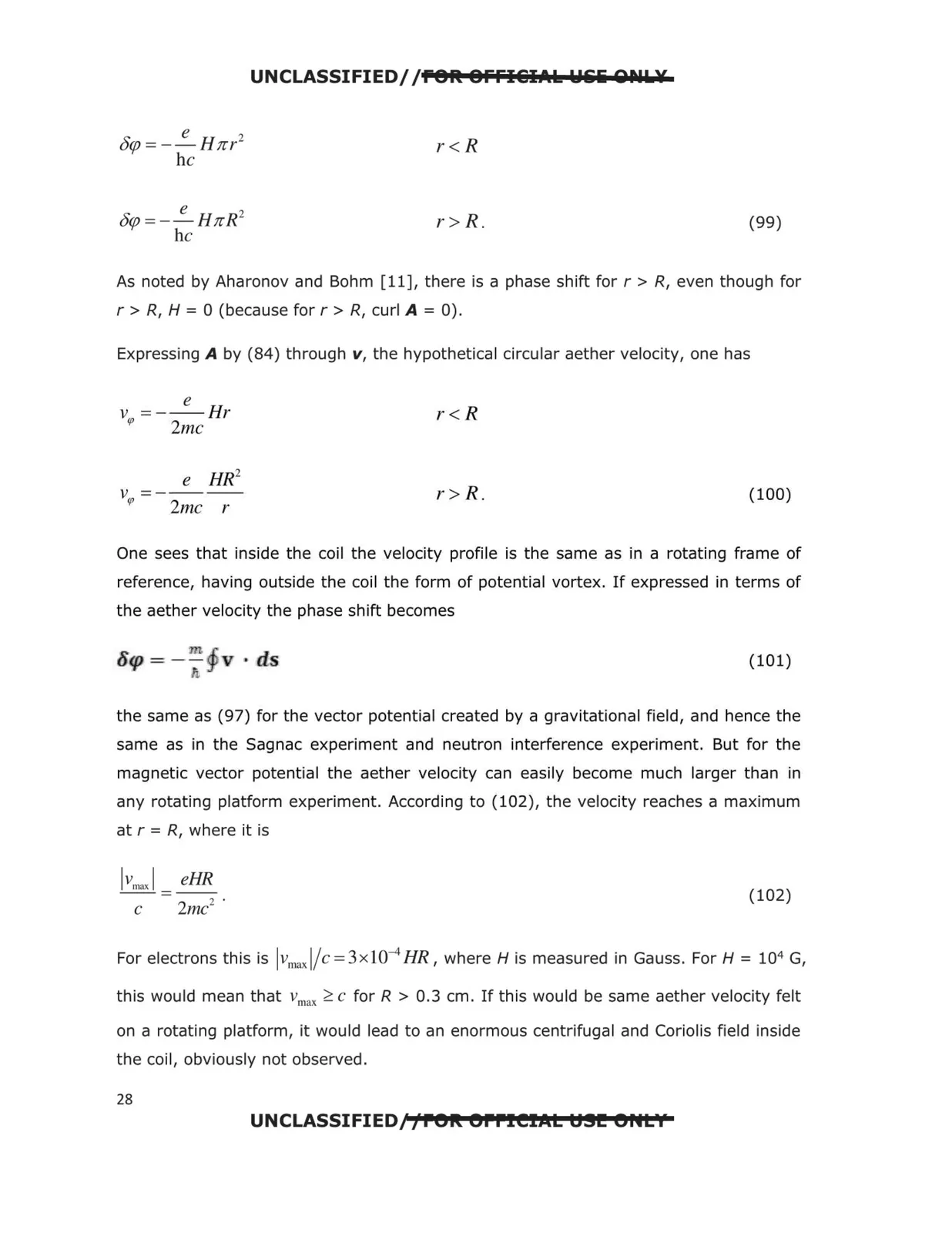
As noted by Aharonov and Bohm [11], there is a phase shift for r > R, even though for
r > R, H = O (because for r > R, curl A = 0).
Expressing A by (84) through v, the hypothetical circular aether velocity, one has
e
v = - -- Hr
r<R
,p
2mc
e HR2
V = -----
r>R.
(100)
,p
2mc
r
One sees that inside the coil the velocity profile is the same as in a rotating frame of
reference, having outside the coil the form of potential vortex. If expressed in terms of
the aether velocity the phase shift becomes
lJ<p = -- v • ds
(101)
I
the same as (97) for the vector potential created by a gravitational field, and hence the
same as in the Sagnac experiment and neutron interference experiment. But for the
magnetic vector potential the aether velocity can easily become much larger than in
any rotating platform experiment. According to (102), the velocity reaches a maximum
at r = R, where it is
2 •
(102)
C
2mc
For electrons this is lvmaxl/c=3xl0-4 HR, where H is measured in Gauss. For H = 104 G,
this would mean that vmax ;?: c for R > 0.3 cm. If this would be same aether velocity felt
on a rotating platform, it would lead to an enormous centrifugal and Coriolis field inside
the coil, obviously not observed.
28
UNCLASSIFIED//POlt orr1e11tt tt!II!! or~LY