AAWSAP DIRD, Negative Mass Propulsion, January 2011
DOW-UAP-D152 · page 37 of 43
Text
This text came with the file. It may have mistakes. When the text and the image disagree, the image is right.
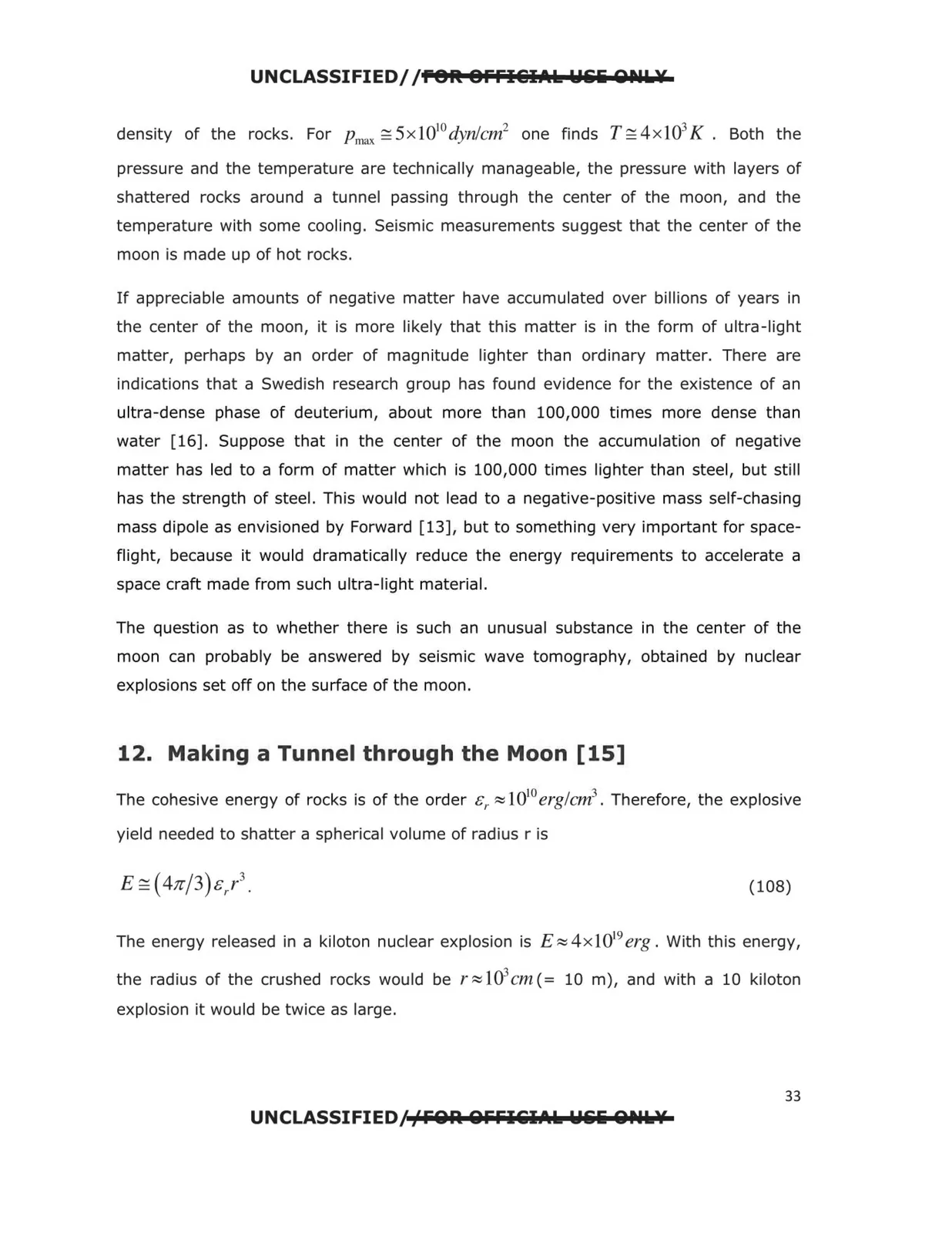
UNCLASSIFIED//fOR. 8FFI61.t..k W&i QJsll,¥ density of the rocks. For Pmax =5 x 10¹⁰ dyn/cm2 one finds T =4 x 10³ K . Both the pressure and the temperature are technically manageable, the pressure with layers of shattered rocks around a tunnel passing through the center of the moon, and the temperature with some cooling. Seismic measurements suggest that the center of the moon is made up of hot rocks. If appreciable amounts of negative matter have accumulated over billions of years in the center of the moon, it is more likely that this matter is in the form of ultra-light matter, perhaps by an order of magnitude lighter tha n ordinary matter. There are indications that a Swedish research group has found evidence for the existence of an ultra-dense phase of deuterium, about more than 100,000 times more dense than water [16]. Suppose that in the center of the moon the accumulation of negative matter has led to a form of matter which is 100,000 times lighter than steel, but still has the strength of steel. This would not lead to a negative-positive mass self-chasing mass dipole as envisioned by Forward [13], but to something very important for space flight, because it would dramatically reduce the energy requirements to accelerate a space craft made from such ultra-light material. The question as to whether there is such an unusual substance in the center of the moon can probably be answered by seismic wave tomography, obtained by nuclear explosions set off on the surface of the moon. 12. Making a Tunnel through the Moon [15] The cohesive energy of rocks is of the order &,. ,;:::, 1010 erg/cm3 . Therefore, the explosive yield needed to shatter a spherical volume of radius r is (108) The energy released in a kiloton nuclear explosion is E,;:::, 4xl019 erg. With this energy, the radius of the crushed rocks would be r,;:::, 103cm (= 10 m), and with a 10 kiloton explosion it would be twice as large. UNCLASSIFIED/fFOA OFFI&I.t.k W&li OJi,k¥ 33