AAWSAP DIRD, Negative Mass Propulsion, January 2011
DOW-UAP-D152 · page 38 of 43
Text
This text came with the file. It may have mistakes. When the text and the image disagree, the image is right.
UNCLASSIFIED/ /P'OR. 8FFIEil1'1.k lellii Ql'II.¥
To make a tunnel, a cylindrical, rather than spherical, volume of crushed rocks is
desired. For this reason a thermonuclear shape charge or an explosive lens is better
suited to shatter the rocks.
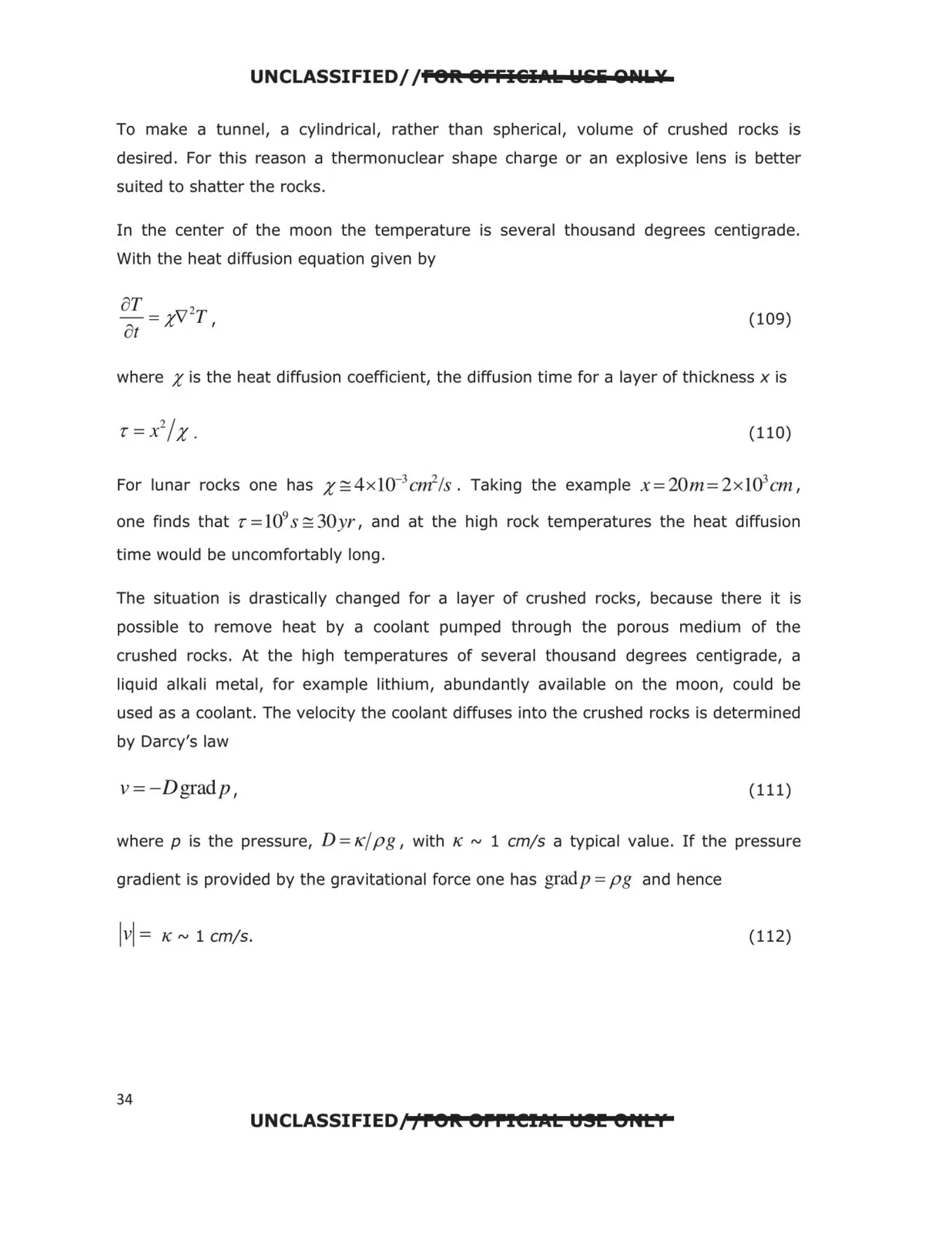
In the center of the moon the temperature is several thousand degrees centigrade.
With the heat diffusion equation given by
(109)
where x is the heat diffusion coefficient, the diffusion time for a layer of thickness x is
(110)
For lunar rocks one has x~4x10⁻³cm2/s. Taking the example x =20m=2xl03cm,
one finds that r = 109s ~ 30yr, and at the high rock temperatures the heat diffusion
time would be uncomfortably long.
The situation is drastically changed for a layer of crushed rocks, because there it is
possible to remove heat by a coolant pumped through the porous medium of the
crushed rocks. At the high temperatures of several thousand degrees centigrade, a
liquid alkali metal, for example lithium, abundantly available on the moon, could be
used as a coolant. The velocity the coolant diffuses into the crushed rocks is determined
by Darcy's law
v=-Dgradp,
(111)
where p is the pressure, D =Kjpg, with K ~ 1 cm/s a typical value. If the pressure
gradient is provided by the gravitational force one has gradp =pg and hence
lvl = K ~1 cm/s.
(112)
UNCLASSIFIED//P'Olll OPPIEll<L tt!II!! or~LY
34