AAWSAP DIRD, Negative Mass Propulsion, January 2011
DOW-UAP-D152 · page 41 of 43
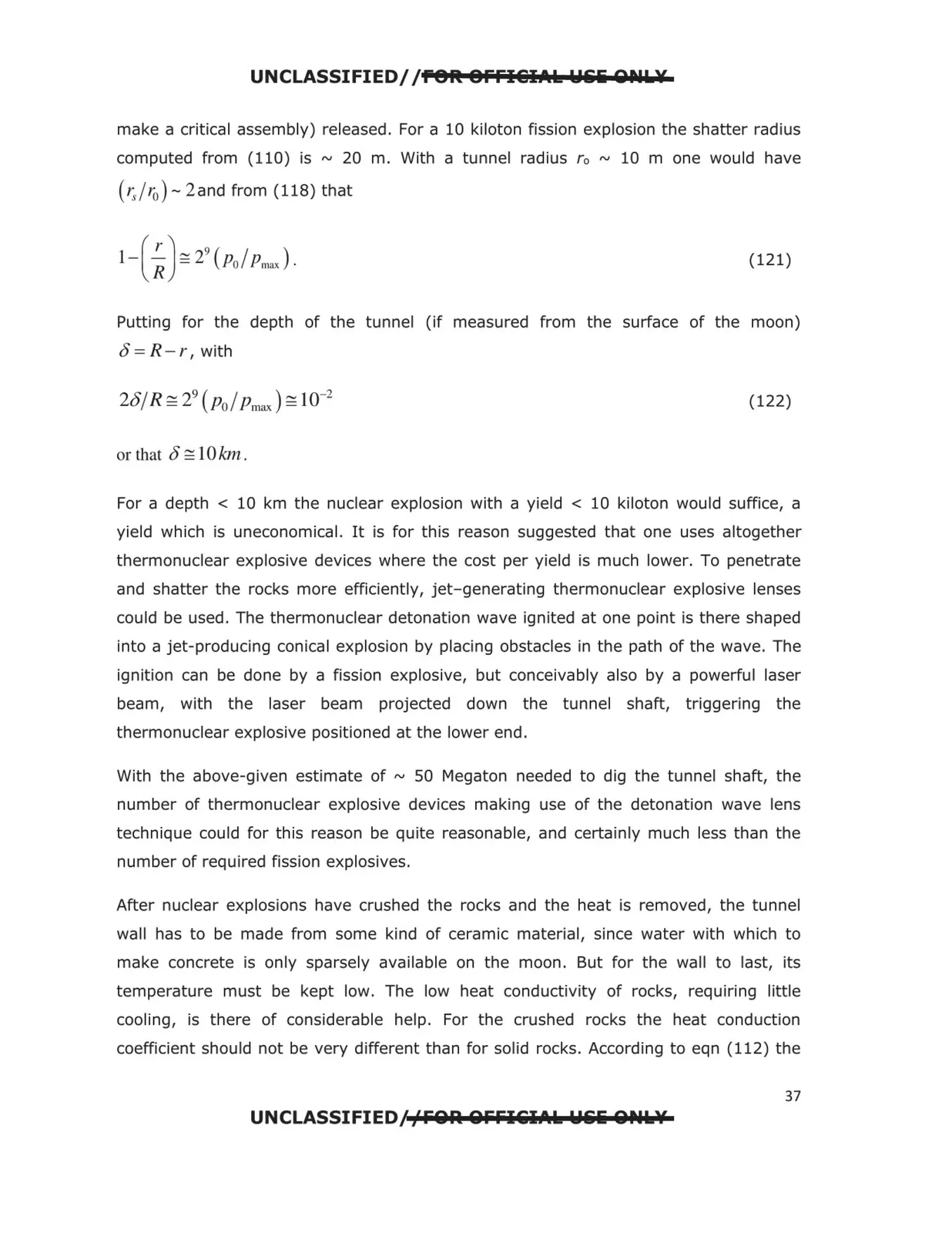
Text
This text came with the file. It may have mistakes. When the text and the image disagree, the image is right.
UNCLASSIFIED/ /P'OR. 8FFIEil1'1.k lellii Ql'II.¥
make a critical assembly) released. For a 10 kiloton fission explosion the shatter radius
computed from (110) is ~ 20 m. With a tunnel radius ro ~ 10 m one would have
(rs/ r0 ) ~ 2and from (118) that
1-(!_) ~ 29(
/
)
(121)
R -
Po Pmax
•
Putting for the depth of the tunnel (if measured from the surface of the moon)
8=R - r, with
(122)
or that 8 ~ 10km .
For a depth < 10 km the nuclear explosion with a yield < 10 kiloton would suffice, a
yield which is uneconomical. It is for this reason suggested that one uses altogether
thermonuclear explosive devices where the cost per yield is much lower. To penetrate
and shatter the rocks more efficiently, jet-generating thermonuclear explosive lenses
could be used. The thermonuclear detonation wave ignited at one point is there shaped
into a jet-producing conical explosion by placing obstacles in the path of the wave. The
ignition can be done by a fission explosive, but conceivably also by a powerful laser
beam, with the laser beam projected down the tunnel shaft, triggering the
thermonuclear explosive positioned at the lower end.
With the above-given estimate of ~ 50 Megaton needed to dig the tunnel shaft, the
number of thermonuclear explosive devices making use of the detonation wave lens
technique could for this reason be quite reasonable, and certainly much less than the
number of required fission explosives.
After nuclear explosions have crushed the rocks and the heat is removed, the tunnel
wall has to be made from some kind of ceramic material, since water with which to
make concrete is only sparsely available on the moon. But for the wall to last, its
temperature must be kept low. The low heat conductivity of rocks, requiring little
cooling, is there of considerable help. For the crushed rocks the heat conduction
coefficient should not be very different than for solid rocks. According to eqn (112) the
UNCLASSIFIED/fFOA OFFI&il.t.k lellii OJi,k¥
37