AAWSAP DIRD, Negative Mass Propulsion, January 2011
DOW-UAP-D152 · page 40 of 43
Text
This text came with the file. It may have mistakes. When the text and the image disagree, the image is right.
UNCLASSIFIED/ /P'OR. 8FFIEil1'1.k lellii Ql'II.¥
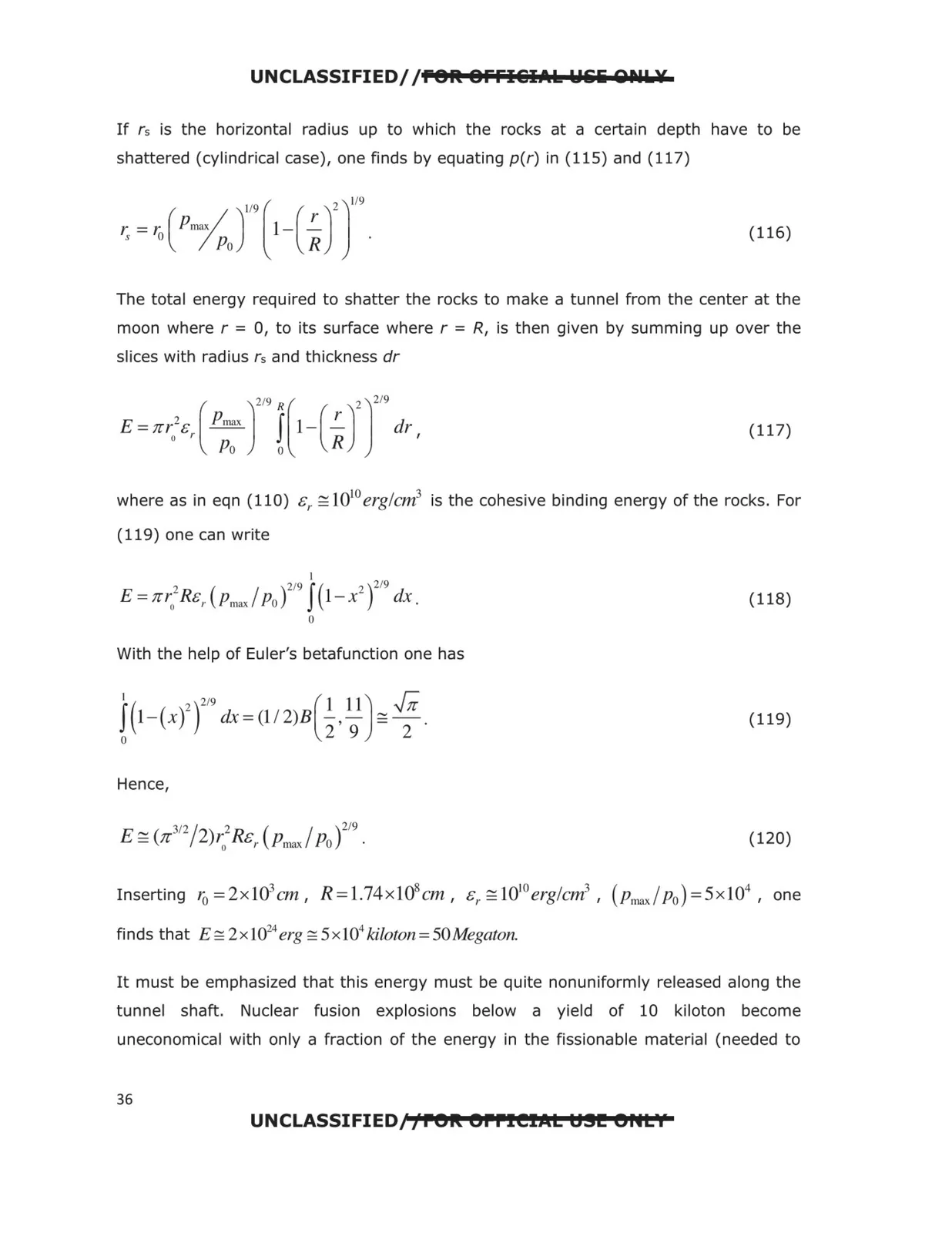
If rs is the horizontal radius up to which the rocks at a certain depth have to be
shattered (cylindrical case), one finds by equating p(r) in (115) and (117)
(116)
The total energy required to shatter the rocks to make a tunnel from the center at the
moon where r = 0, to its surface where r = R, is then given by summing up over the
slices with radius rs and thickness dr
2/9 R (
2 ] 2/9
E = 1U0 1e,
( p~7
]
[
dr,
(117)
1-(;)
where as in eqn (110) &r ~ 1010 erglcm3 is the cohesive binding energy of the rocks. For
(119) one can write
I
2/9 f (
) 2/9
E = Jr r0
2R&,. (Pmaxf Po)
J 1- X 2
dx.
(118)
0
With the help of Euler's betafunction one has
(119)
Hence,
312;
2
(
I
) 219
E
Po
.
~ (,r
2),: R &,. Pmax
(120)
Inserting r0 =2xl03cm, R=l.74xl08cm , &,.~1010 erglcm3 , (Pinax /P0) =5xl04 , one
finds that E~ 2xl024 erg ~5xl04 ld.loton=50Megaton.
It must be emphasized that this energy must be quite nonuniformly released along the
tunnel shaft.
Nuclear fusion explosions below a yield of 10 kiloton become
uneconomical with only a fraction of the energy in the fissionable material (needed to
UNCLASSIFIED//P'Olll OPPIEll<L tt!II!! or~LY
36