AAWSAP DIRD, Negative Mass Propulsion, January 2011
DOW-UAP-D152 · page 6 of 43
Text
This text came with the file. It may have mistakes. When the text and the image disagree, the image is right.
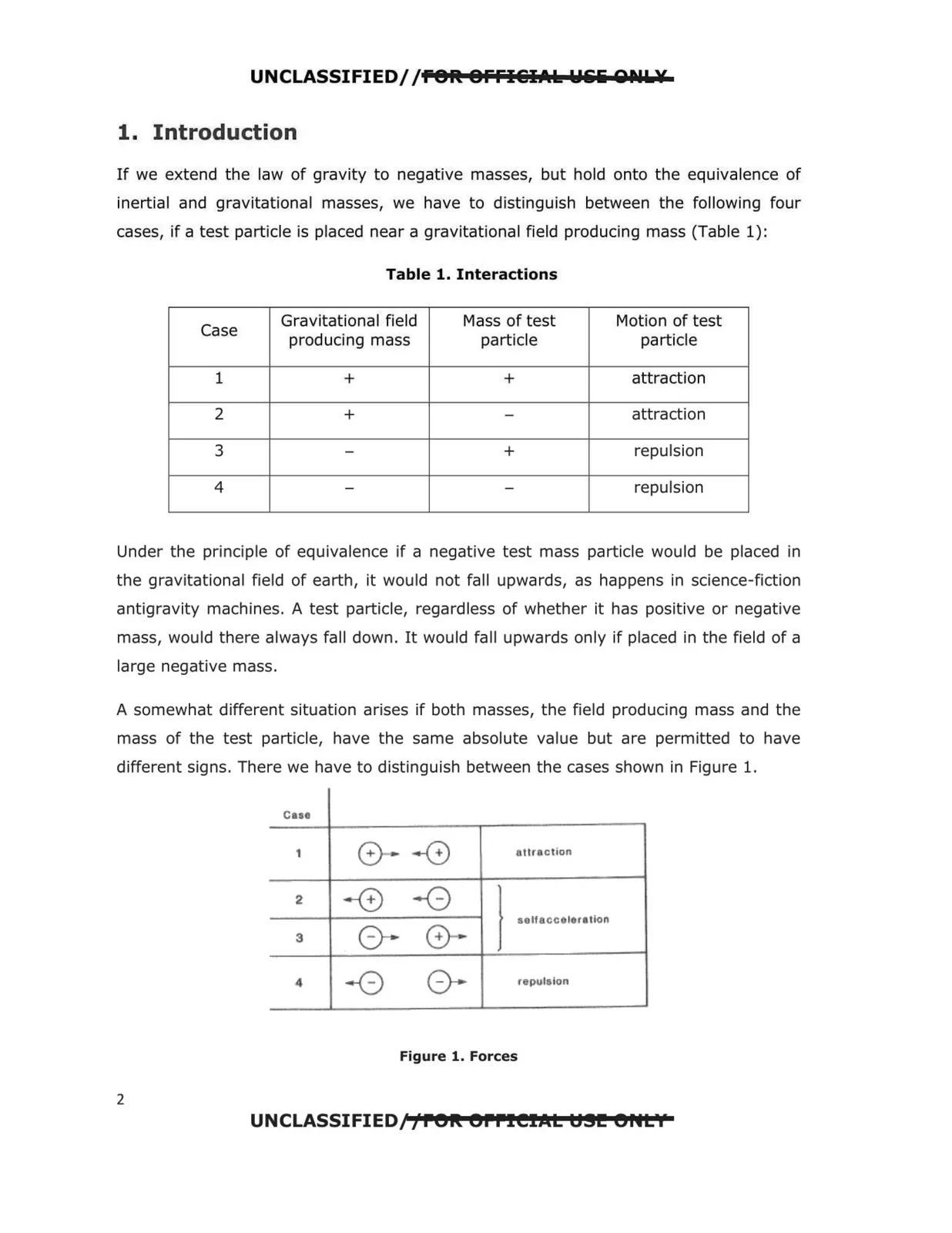
UNCLASSIFIED//fOR. 8FFl&I.t.k W&li ,HIia¥ 1. Introduction If we extend the law of gravity to negative masses, but hold onto the equivalence of inertial and gravitational masses, we have to distinguish between the following four cases, if a test particle is placed near a gravitational field producing mass (Table 1): Table 1. Interactions Case Gravitational field producing mass Mass of test particle Motion of test particle 1 + + attraction 2 + - attraction 3 - + repulsion 4 - - repulsion Under the principle of equivalence if a negative test mass particle would be placed in the gravitational field of earth, it wou ld not fall upwards, as happens in science-fiction antigravity machines. A test particle, regardless of whether it has positive or negative mass, would there always fall down. It would fall upwards only if placed in the field of a large negative mass. A somewhat different situation arises if both masses, the field producing mass and the mass of the test particle, have the same absolute value but are permitted to have different signs. There we have to distinguish between the cases shown in Figure 1. Case 1 ttnu:tion -0 2 -0 -0 l aellaeceleretlon 3 0 repulsion 4 -0 0- Figure 1. Forces UNCLASSIFIED//POlt orr1e11tt tt!II!! or~LY 2