AAWSAP DIRD, Negative Mass Propulsion, January 2011
DOW-UAP-D152 · page 7 of 43
Text
This text came with the file. It may have mistakes. When the text and the image disagree, the image is right.
UNCLASSIFIED/ /P'OR. 8FFIEil1'1.k lellii Ql'II.¥
If both masses are positive, we have the usual Newtonian attraction. For negative
masses, the force has the same magnitude but is repulsive. A quite different situation
exists if one mass is positive and the other one is negative. With both forming a mass
dipole, the system becomes self-accelerating, because one mass is repelled and the
other one attracted. With the two masses having opposite sign, the total energy and
momentum of the combined system remains zero for all times, leaving intact the
conservation laws of energy and momentum. Under its self-acceleration, the mass
dipole would eventually reach the velocity of light. It is this property of self-acceleration
without expenditure of energy that has intrigued many researchers and raised the
prospect of a propulsion system without limits. We remark that even without an
appreciable gravitational interaction, a mass dipole with zero, or close to zero inertial
mass, could be accelerated to very high velocities with negligible jet power and energy.
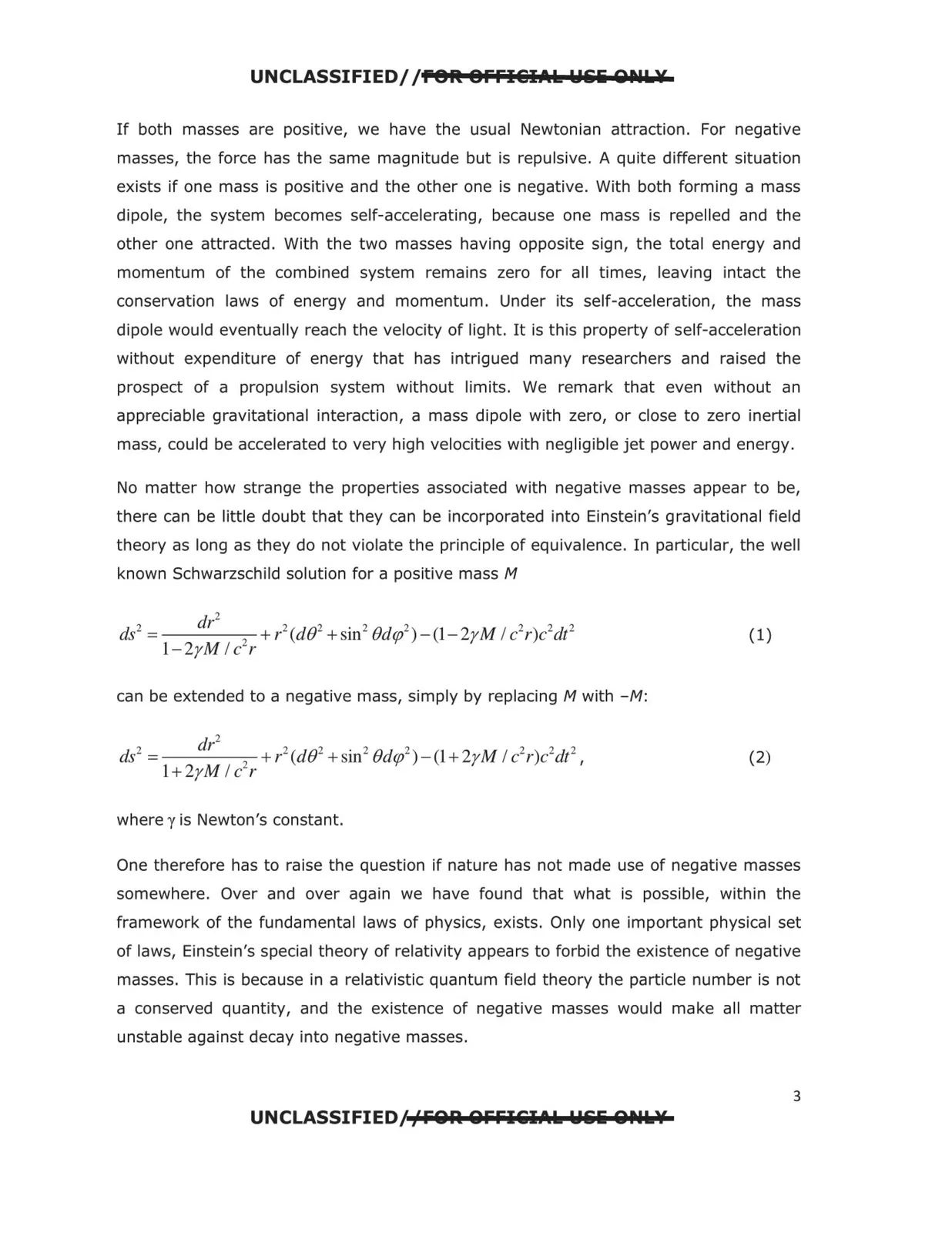
No matter how strange the properties associated with negative masses appear to be,
there can be little doubt that they can be incorporated into Einstein's gravitational field
theory as long as they do not violate the principle of equivalence. In particular, the well
known Schwarzschild solution for a positive mass M
ds2 =
dr
2
2 +r2(d02 +sin 2 0dqi)-(l-2yM!c2r)c2dt2
(1)
l-2yM le r
can be extended to a negative mass, simply by replacing M with -M:
(2)
where y is Newton's constant.
One therefore has to raise the question if nature has not made use of negative masses
somewhere. Over and over again we have found that what is possible, within the
framework of the fundamental laws of physics, exists. Only one important physical set
of laws, Einstein's special theory of relativity appears to forbid the existence of negative
masses. This is because in a relativistic quantum field theory the particle number is not
a conserved quantity, and the existence of negative masses would make all matter
unstable against decay into negative masses.
UNCLASSIFIED/fFOA OFFI&il.t.k lellii OJi,k¥
3