AAWSAP DIRD, Negative Mass Propulsion, January 2011
DOW-UAP-D152 · page 9 of 43
Text
This text came with the file. It may have mistakes. When the text and the image disagree, the image is right.
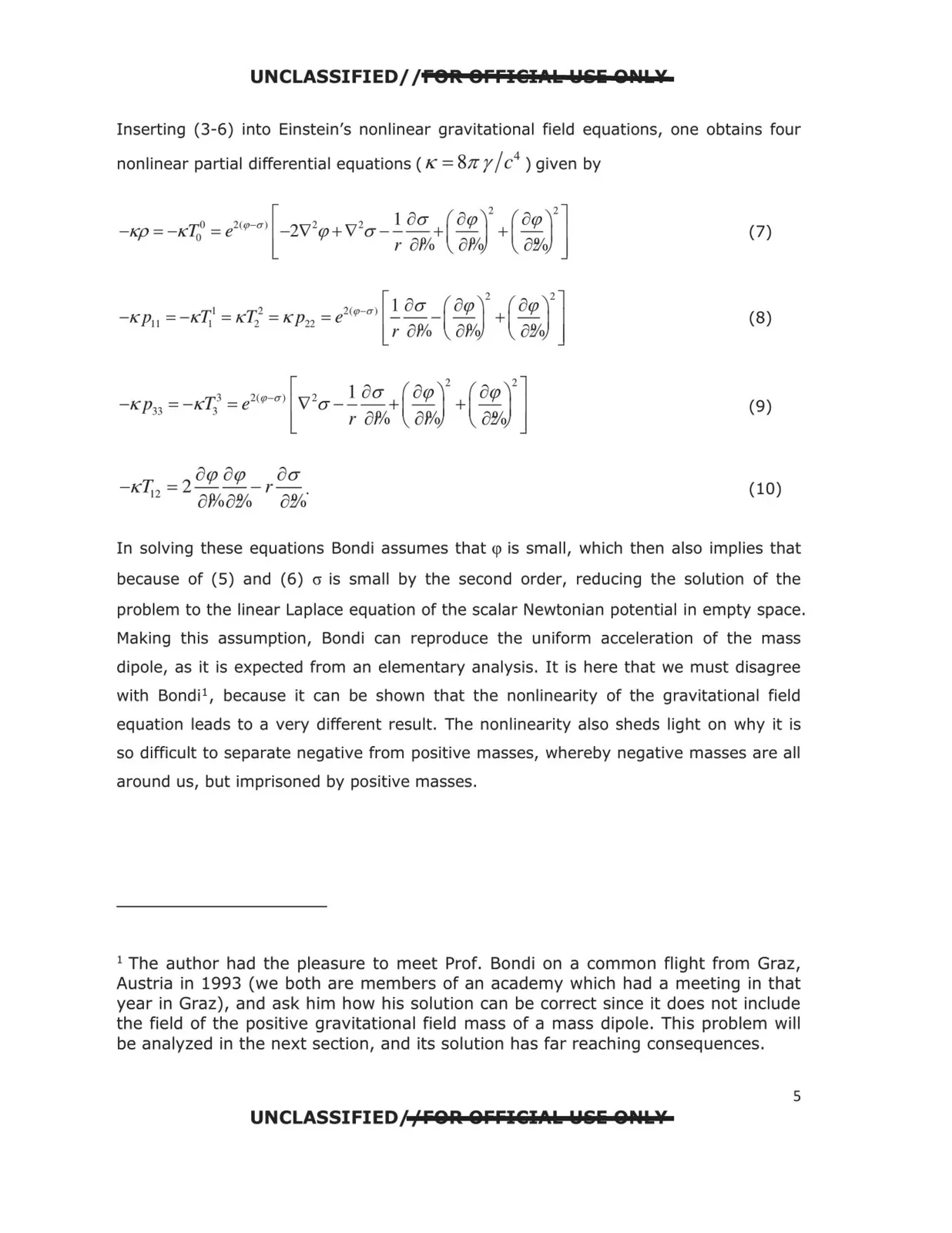
UNCLASSIFIED/ /P'OR. 8FFIEil1'1.k lellii Ql'II.¥ Inserting (3-6) into Einstein's nonlinear gravitational field equations, one obtains four nonlinear partial differential equations ( K =S;r y / c4 ) given by (7) (8) (9) arp arp aa - K T. p =2-- - r . (10) - awoa% a% I n solving these equations Bondi assumes that <p is small, which then also implies that because of (5) and (6) cr is small by the second order, reducing the solution of the problem to the linear Laplace equation of the scalar Newtonian potential in empty space. Making this assumption, Bondi can reproduce the uniform acceleration of the mass dipole, as it is expected from an elementary analysis. It is here that we must disagree with Bondi1 , because it can be shown that the nonlinearity of the gravitational field equation leads to a very different result. The nonlinearity also sheds light on why it is so difficult to separate negative from positive masses, whereby negative masses are all around us, but imprisoned by positive masses. 1 The author had the pleasure to meet Prof. Bondi on a common flight from Graz, Austria in 1993 (we both are members of an academy which had a meeting in that year in Graz), and ask him how his solution can be correct since it does not include the field of the positive gravitational field mass of a mass dipole. This problem will be analyzed in the next section, and its solution has far reaching consequences. UNCLASSIFIED/fFOA OFFI&il.t.k lellii OJi,k¥ 5