AAWSAP DIRD, Negative Mass Propulsion, January 2011
DOW-UAP-D152 · page 8 of 43
Text
This text came with the file. It may have mistakes. When the text and the image disagree, the image is right.
UNCLASSIFIED//fOR. 8FFI61.t..k W&i QJsll,¥
Apart from Einstein's purely kinematic interpretation of special relativity, being the
expression of a Minkowskian space-time structure, there is an older alternative dynamic
interpretation by Lorentz and Poincare. In it space and time are absolute, but it can
explain all relativistic effects as well. It assumes the existence of an aether, with all
objects in absolute motion through the aether suffering a Lorentz contraction and time
dilation. If this aether has a grainy structure, characterized by some smallest length
(e.g., the Planck length ~ 10-33 cm), then according to Heisenberg's uncertainty
principle special relativity would ultimately break down at a high energy. If the length is
very small, this energy can be so high as to be far beyond the capabilities of any
existing particle accelerator or even beyond the high energy of cosmic ray particles,
making both interpretations of special relativity experimentally indistinguishable at the
energies presently available.
2. The Theory of Bondi
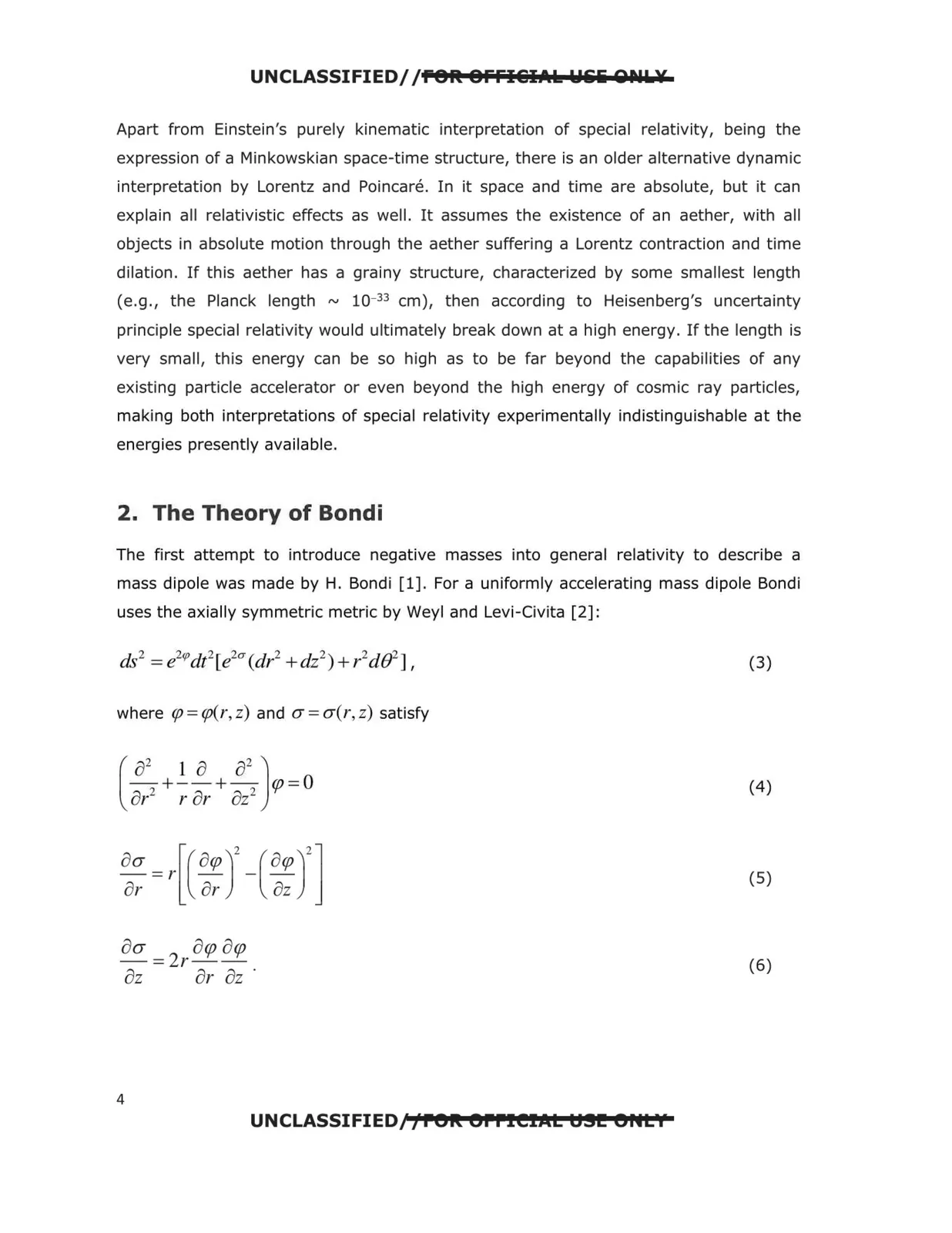
The first attempt to introduce negative masses into general relativity to describe a
mass dipole was made by H. Bondi [1]. For a uniformly accelerating mass dipole Bondi
uses the axially symmetric metric by Weyl and Levi-Civita [2]:
(3)
where rp =rp(r, z) and a= a(r, z) satisfy
( a2
1 a a2 )
-
+-- +-
rp=O
(4)
ar2
far az 2
(5)
8<:Y = 2r arp arp
(6)
az
ar az •
UNCLASSIFIED//POlt orr1e11tt tt!II!! or~LY
4