AAWSAP DIRD, Quantum Tomography of Negative Energy States in the Vacuum, January 2011
DOW-UAP-D153 · page 15 of 51
Text
This text came with the file. It may have mistakes. When the text and the image disagree, the image is right.
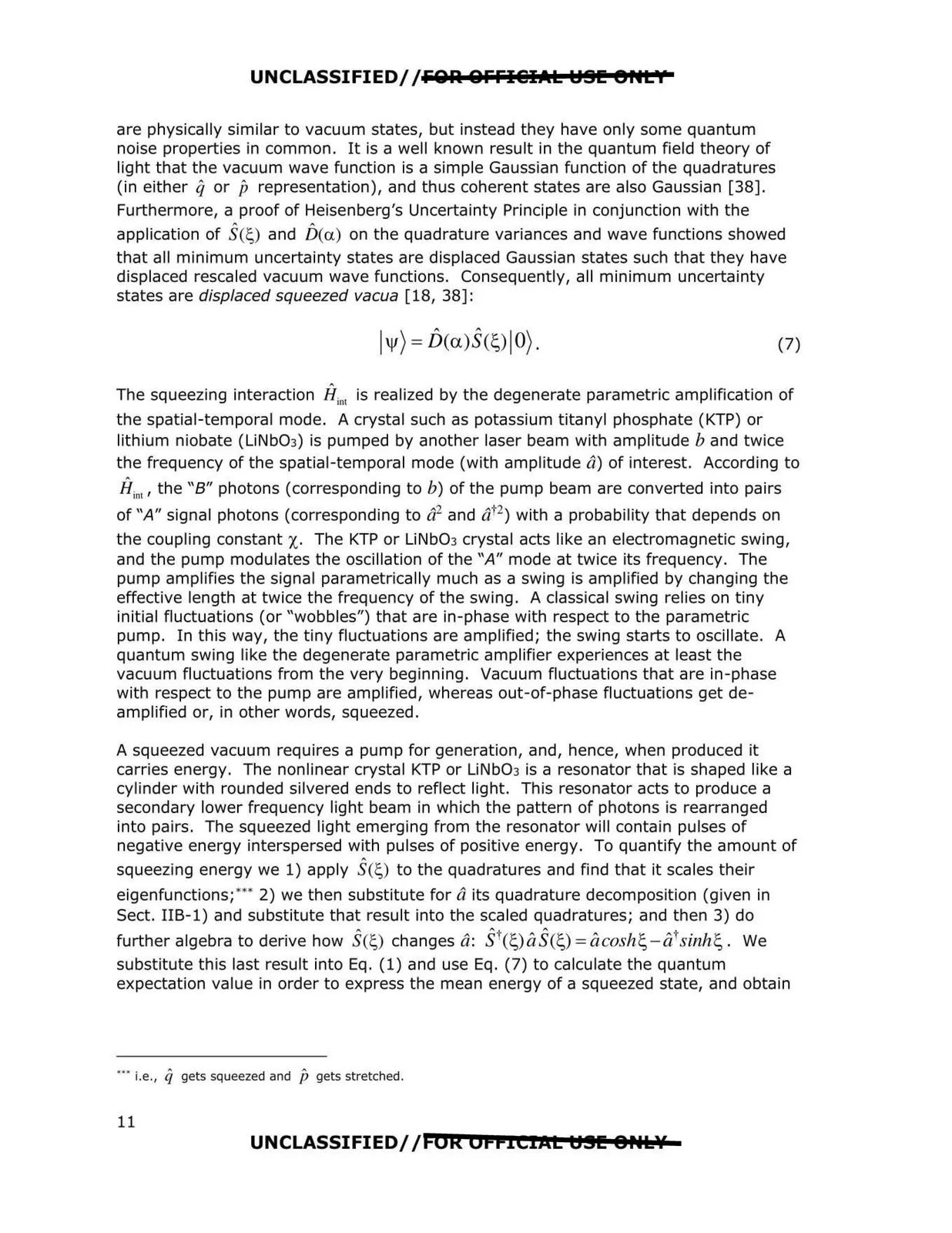
UNCLASSIFIED//FOA QFFIEJIAL YSI!! f>Ht'I" are physically similar to vacuum states, but instead they have only some quantum noise properties in common. It is a well known result in the quantum field theory of light that the vacuum wave function is a simple Gaussian function of the quadratures (in either q or jJ representation), and thus coherent states are also Gaussian [38]. Furthermore, a proof of Heisenberg's Uncertainty Principle in conjunction with the application of S(~) and D(a) on the quadrature variances and wave functions showed that all minimum uncertainty states are displaced Gaussian states such that they have displaced rescaled vacuum wave functions. Consequently, all minimum uncertainty states are displaced squeezed vacua [18, 38]: I\jf) = fJ ca)scs) Io) . (7) The squeezing interaction Hi"' is realized by the degenerate parametric amplification of the spatial-temporal mode. A crystal such as potassium titanyl phosphate (KTP) or lithium niobate (LiNbQ3) is pumped by another laser beam with amplitude band twice the frequency of the spatial-temporal mode (with amplitude a) of interest. According to H ;m , the "B" photons (corresponding to b) of the pump beam are converted into pairs of "A" signal photons (corresponding to a.2 and a,t2) with a probability that depends on the coupling constant X· The KTP or LiNb03 crystal acts like an electromagnetic swing, and the pump modulates the oscillation of the "A" mode at twice its frequency. The pump amplifies the signal parametrically much as a swing is amplified by changing the effective length at twice the frequency of the swing. A classical swing relies on tiny initial fluctuations (or "wobbles") that are in-phase with respect to the parametric pump. In this way, the tiny fluctuations are amplified; the swing starts to oscillate. A quantum swing like the degenerate parametric amplifier experiences at least the vacuum fluctuations from the very beginning. Vacuum fluctuations that are in-phase with respect to the pump are amplified, whereas out-of-phase fluctuations get de amplified or, in other words, squeezed. A squeezed vacuum requires a pump for generation, and, hence, when produced it carries energy. The nonlinear crystal KTP or LiNb03 is a resonator that is shaped like a cylinder with rounded silvered ends to reflect light. This resonator acts to produce a secondary lower frequency light beam in which the pattern of photons is rearranged into pairs. The squeezed light emerging from the resonator will contain pulses of negative energy interspersed with pulses of positive energy. To quantify the amount of squeezing energy we 1) apply S(~) to the quadratures and find that it scales their eigenfunctions;*** 2) we then substitute for aits quadrature decomposition (given in Sect. IIB-1) and substitute that result into the scaled quadratures; and then 3) do further algebra to derive how S(~) changes a: stcs)aS(s) =Gcoshs- atsinhs. We substitute this last result into Eq. (1) and use Eq. (7) to calculate the quantum expectation value in order to express the mean energy of a squeezed state, and obtain ,.. i.e., q gets squeezed and p gets stretched. UNCLASSIFIED// FOR OFFICIAL H.!l! 8PU:.lf 11