AAWSAP DIRD, Quantum Tomography of Negative Energy States in the Vacuum, January 2011
DOW-UAP-D153 · page 16 of 51
Text
This text came with the file. It may have mistakes. When the text and the image disagree, the image is right.
UNCLASSIFIED//FOA QFFI@IAL l:191! t>flt I
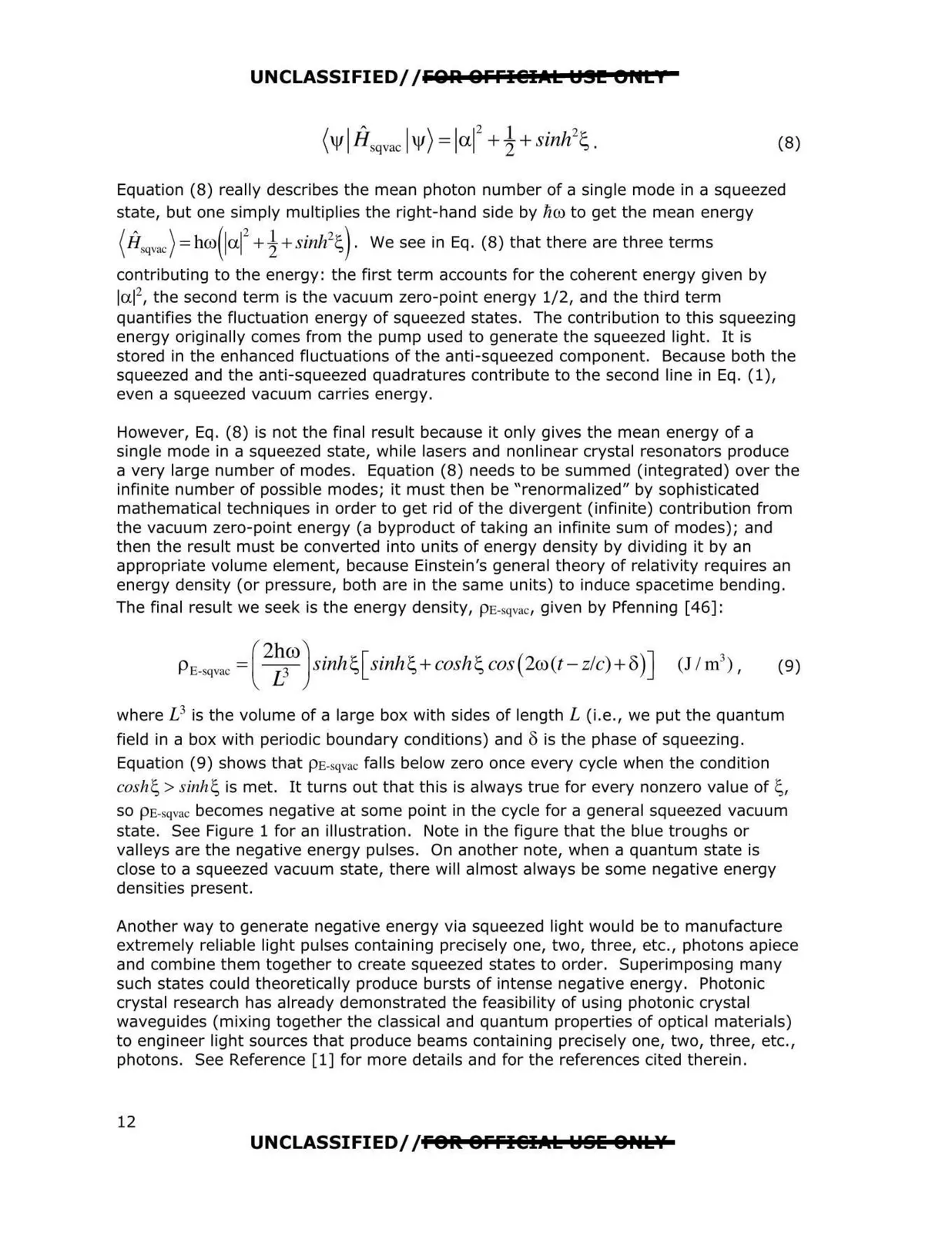
(8)
Equation (8) really describes the mean photon number of a single mode in a squeezed
state, but one simply multiplies the right-hand side by /iro to get the mean energy
(Asqvac ) = hw(la.12 + ½+sinh2~ )-
We see in Eq. (8) that there are three terms
contributing to the energy: the first term accounts for the coherent energy given by
lal2, the second term is the vacuum zero-point energy 1/2, and the third term
quantifies the fluctuation energy of squeezed states. The contribution to this squeezing
energy originally comes from the pump used to generate the squeezed light. It is
stored in the enhanced fluctuations of the anti-squeezed component. Because both the
squeezed and the anti-squeezed quadratures contribute to the second line in Eq. (1),
even a squeezed vacuum carries energy.
However, Eq. (8) is not the final result because it only gives the mean energy of a
single mode in a squeezed state, while lasers and nonlinear crystal resonators produce
a very large number of modes. Equation (8) needs to be summed (integrated) over the
infinite number of possible modes; it must then be "renormalized" by sophisticated
mathematical techniques in order to get rid of the divergent (infinite) contribution from
the vacuum zero-point energy (a byproduct of taking an infinite sum of modes); and
then the result must be converted into units of energy density by dividing it by an
appropriate volume element, because Einstein's general theory of relativity requires an
energy density (or pressure, both are in the same units) to induce spacetime bending.
The final result we seek is the energy density, PE-sqvac, given by Pfenning [ 46]:
Pe.sq= = ( 21,co) sinh c; [sinh c; +cos hi:; cos ( 2ro(t - z/c) +8)]
(J / m3) ,
(9)
where L 3 is the volume of a large box with sides of length L (i.e., we put the quantum
field in a box with periodic boundary conditions) and 8 is the phase of squeezing.
Equation (9) shows that PE-sqvac falls below zero once every cycle when the condition
cosh~ > sinh~ is met. It turns out that this is always true for every nonzero value of ; ,
so PE-sqvac becomes negative at some point in the cycle for a general squeezed vacuum
state. See Figure 1 for an illustration. Note in the figure that the blue troughs or
valleys are the negative energy pulses. On another note, when a quantum state is
close to a squeezed vacuum state, there will almost always be some negative energy
densities present.
Another way to generate negative energy via squeezed light would be to manufacture
extremely reliable light pulses containing precisely one, two, three, etc., photons apiece
and combine them together to create squeezed states to order. Superimposing many
such states could theoretically produce bursts of intense negative energy. Photonic
crystal research has already demonstrated the feasibility of using photonic crystal
waveguides (mixing together the classical and quantum properties of optical materials)
to engineer light sources that produce beams containing precisely one, two, three, etc.,
photons. See Reference [1] for more details and for the references cited therein.
UNCLASSIFIED//fOtt 8Ffl@IAL Y§E 8,.LY
12