AAWSAP DIRD, Quantum Tomography of Negative Energy States in the Vacuum, January 2011
DOW-UAP-D153 · page 29 of 51
Text
This text came with the file. It may have mistakes. When the text and the image disagree, the image is right.
UNCLASSIFIED/ /POI': orr1c11tt U.!I! Oflt I
bosonic commutation relations: [a;' a:,;]
a, 'a,;,]
and [a;' a:,,]
al 'a,,.] =0 /
=
[
=
=
[
81 Ill
where 6c111 (= l if e= m and 0 if t ":/: m) is the Kronecker delta and the indices (t , m) are
integers [38].
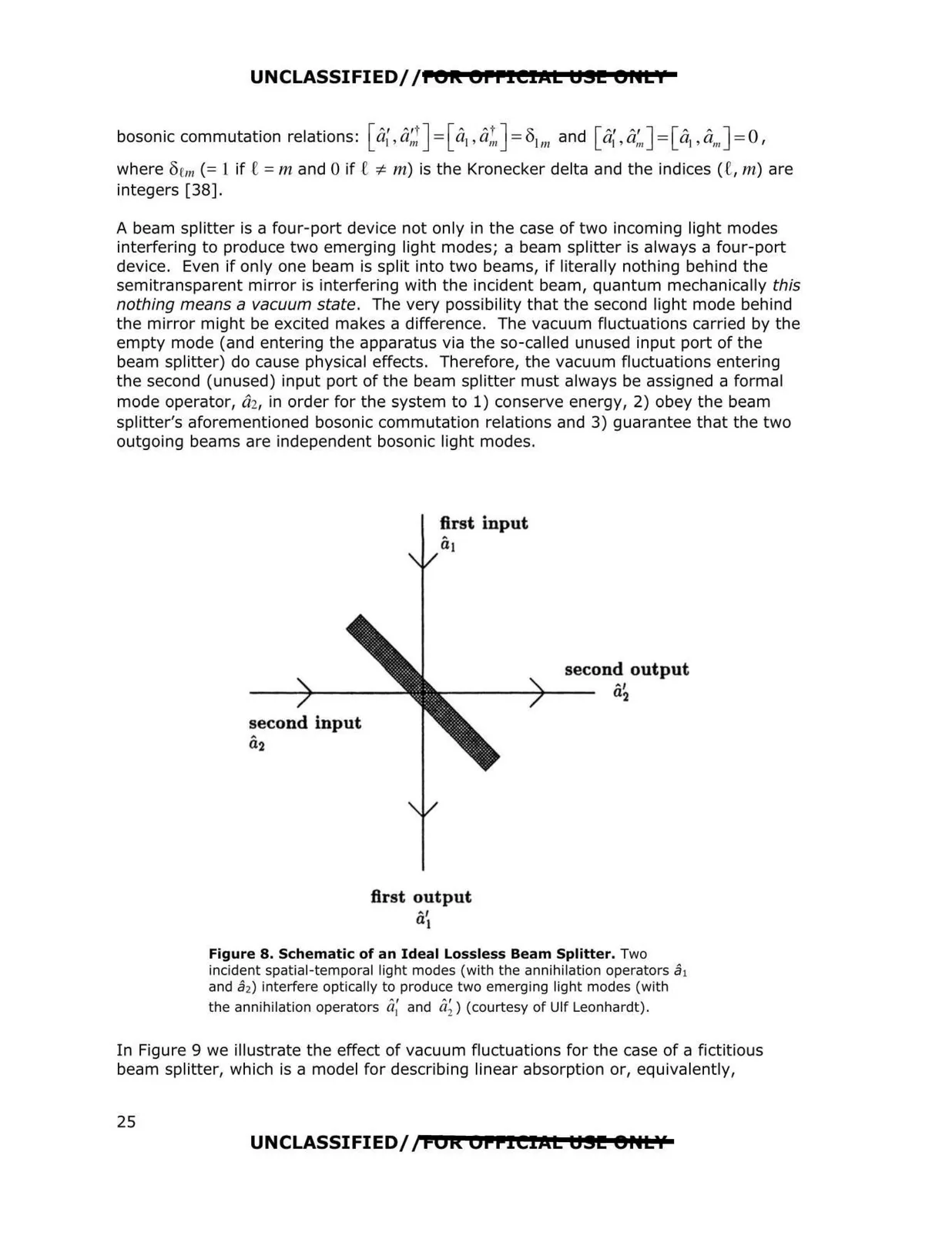
A beam splitter is a four-port device not only in the case of two incoming light modes
interfering to produce two emerging light modes; a beam splitter is always a four-port
device. Even if only one beam is split into two beams, if literally nothing behind the
semitransparent mirror is interfering with the incident beam, quantum mechanically this
nothing means a vacuum state. The very possibility that the second light mode behind
the mirror might be excited makes a difference. The vacuum fluctuations carried by the
empty mode (and entering the apparatus via the so-called unused input port of the
beam splitter) do cause physical effects. Therefore, the vacuum fluctuations entering
the second (unused) input port of the beam splitter must always be assigned a formal
mode operator, a2, in order for the system to
conserve energy, 2) obey the beam
1 )
splitter's aforementioned bosonic commutation relations and 3) guarantee that the two
outgoing beams are independent bosonic light modes.
first input
a1
second output
A/
a2
second input
a2
first output
A /
al
Figure 8. Schematic of an Ideal Lossless Beam Splitter. Two
incident spatial-temporal light modes (with the annihilation operators a 1
and a2) interfere optically to produce two emerging light modes (with
the annihilation operators a; and a; ) (courtesy of Ulf Leonhardt).
In Figure 9 we illustrate the effect of vacuum fluctuations for the case of a fictitious
beam splitter, which is a model for describing linear absorption or, equivalently,
UNCLASSIFIED)) FOR orrtClltt U.!I! OHL¥
25