AAWSAP DIRD, Quantum Tomography of Negative Energy States in the Vacuum, January 2011
DOW-UAP-D153 · page 30 of 51
Text
This text came with the file. It may have mistakes. When the text and the image disagree, the image is right.
UNCLASSIFIED/ /POI': OPPIClltt U.!I! Oflt I
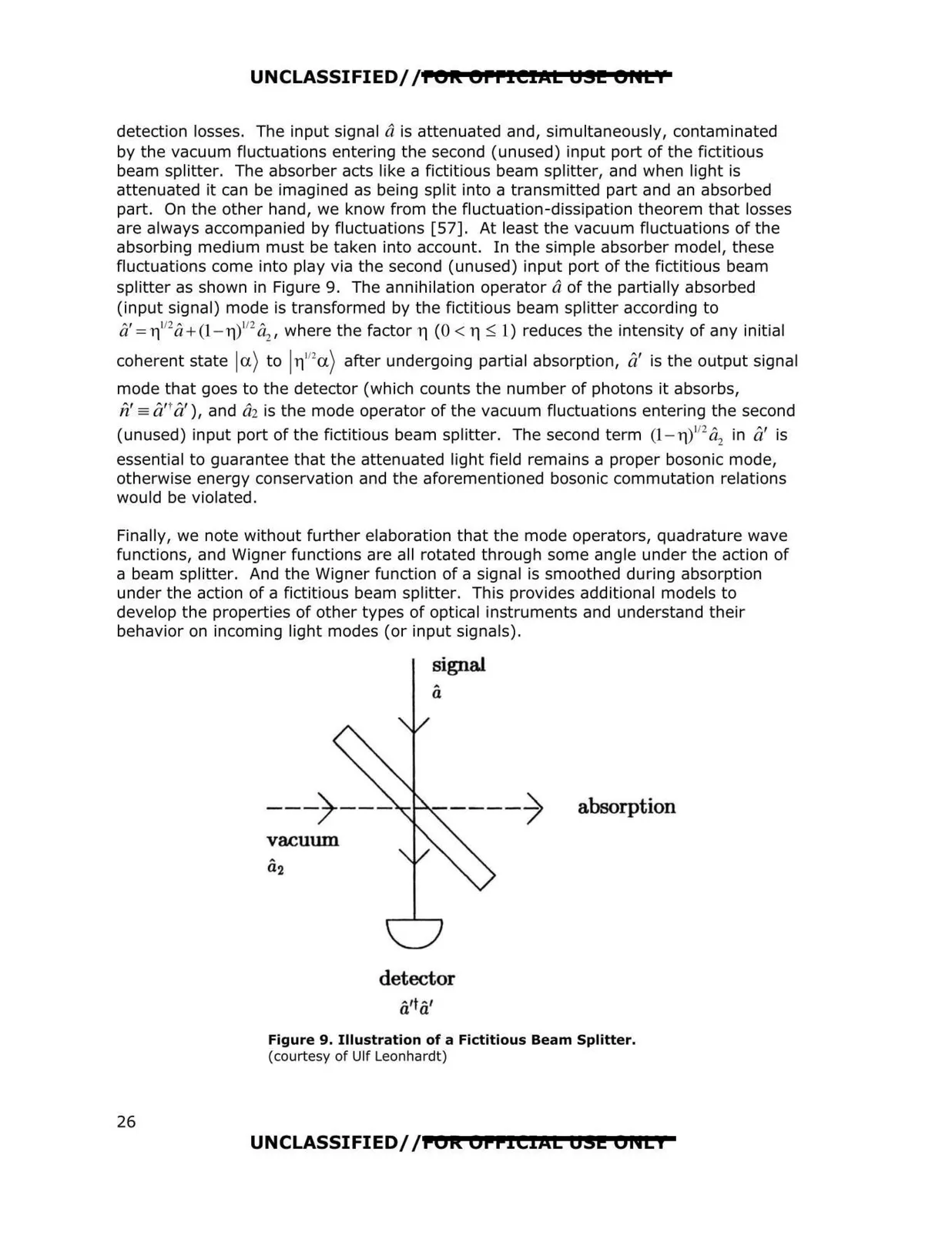
detection losses. The input signal ais attenuated and, simultaneously, contaminated
by the vacuum fluctuations entering the second (unused) input port of the fictitious
beam splitter. The absorber acts like a fictitious beam splitter, and when light is
attenuated it can be imagined as being split into a transmitted part and an absorbed
part. On the other hand, we know from the fluctuation-dissipation theorem that losses
are always accompanied by fluctuations [57]. At least the vacuum fluctuations of the
absorbing medium must be taken into account. In the simple absorber model, these
fluctuations come into play via the second (unused) input port of the fictitious beam
splitter as shown in Figure 9. The annihilation operator aof the partially absorbed
(input signal) mode is transformed by the fictitious beam splitter according to
a,' =ri'12a+(l - riY'2 a,, where the factor 17 (0 < 17 s; 1) reduces the intensity of any initial
coherent state [a) to lri l/2a) after undergoing partial absorption, a' is the output signal
mode that goes to the detector (which counts the number of photons it absorbs,
fi' = £,,'tcl), and d2 is the mode operator of the vacuum fluctuations entering the second
(unused) input port of the fictitious beam splitter. The second term (l - ri/ 2 a2 in a' is
essential to guarantee that the attenuated light field remains a proper bosonic mode,
otherwise energy conservation and the aforementioned bosonic commutation relations
would be violated.
Finally, we note without further elaboration that the mode operators, quadrature wave
functions, and Wigner functions are all rotated through some angle under the action of
a beam splitter. And the Wigner function of a signal is smoothed during absorption
under the action of a fictitious beam splitter. This provides additional models to
develop the properties of other types of optical instruments and understand their
behavior on incoming light modes (or input signals).
signal
a
---)----
absorption
vacuum
a2
detector
Figure 9. Illustration of a Fictitious Beam Splitter.
( courtesy of Ulf Leonhardt)
UNCLASSIFIED//POK OPPICIAL OSI! 014[1
26