AAWSAP DIRD, Quantum Tomography of Negative Energy States in the Vacuum, January 2011
DOW-UAP-D153 · page 41 of 51
Text
This text came with the file. It may have mistakes. When the text and the image disagree, the image is right.
UNCLASSIFIED//POK OPPIClltt l:191! 8HL'f
~
.
~ r
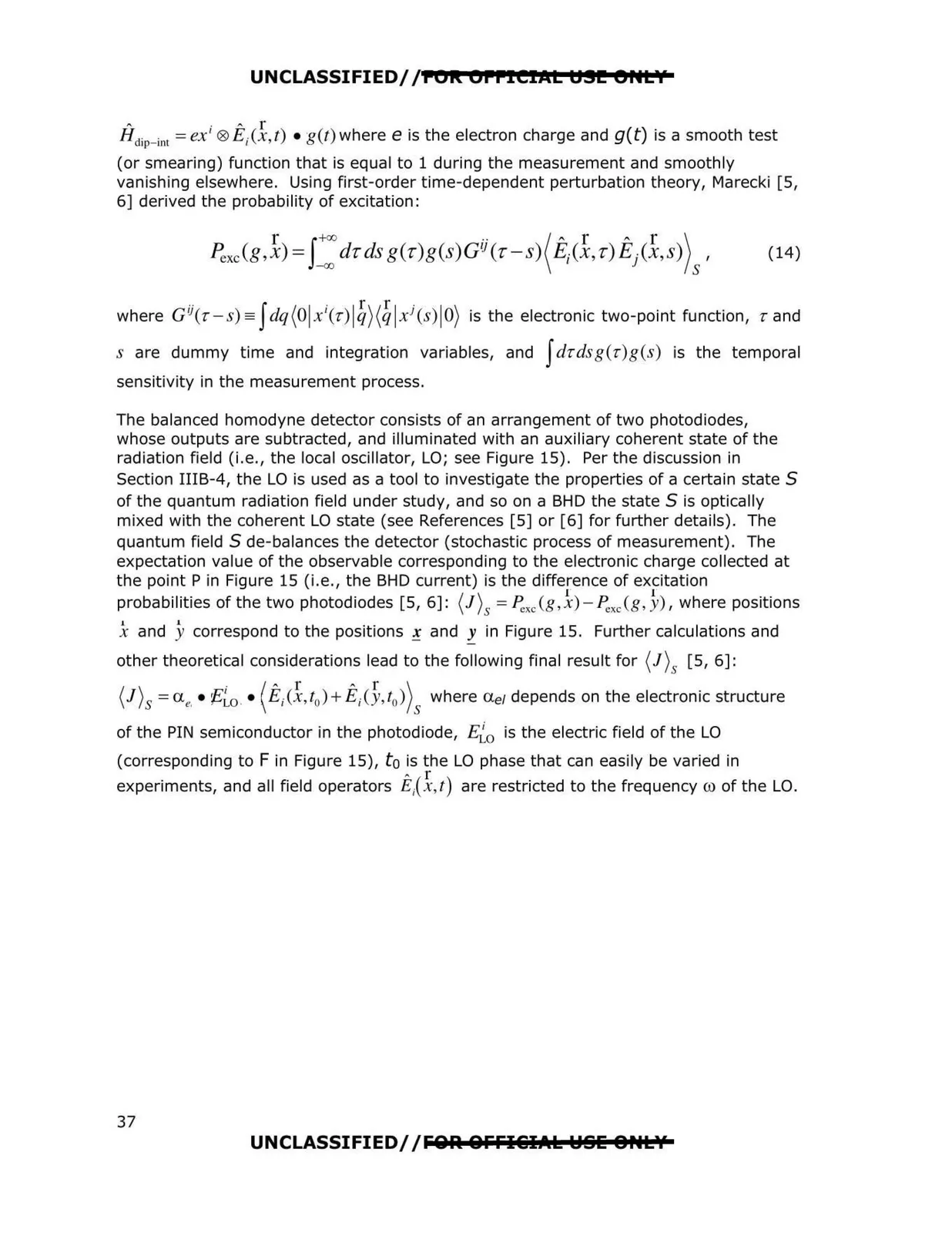
H dip-int =ex'® E;(x,t) • g(t) where e is the electron charge and g(t) is a smooth test
(or smearing) function that is equal to 1 during the measurement and smoothly
vanishing elsewhere. Using first-order time-dependent perturbation theory, Marecki [S,
6] derived the probability of excitation:
Pexc(g,1) =J::dr ds g(r)g(s)GU(r-s)(Ei(i, r) E1(1,s))s ,
(14)
where G U(r - s) =Jdq(Olx;(r) I~)(~ lxj (s)I0) is the electronic two-point function, rand
s are dummy time and integration variables, and Jdrdsg(r)g(s) is the temporal
sensitivity in the measurement process.
The balanced homodyne detector consists of an arrangement of two photodiodes,
whose outputs are subtracted, and illuminated with an auxiliary coherent state of the
radiation field (i.e., the local oscillator, LO; see Figure 15). Per the discussion in
Section IIIB-4, the LO is used as a tool to investigate the properties of a certain state S
of the quantum radiation field under study, and so on a BHD the state Sis optically
mixed with the coherent LO state (see References [5] or [6] for further details). The
quantum field S de-balances the detector (stochastic process of measurement). The
expectation value of the observable corresponding to the electronic charge collected at
the point P in Figure 15 (i.e., the BHD current) is the difference of excitation
r
r
probabilities of the two photodiodes [5, 6]: (1)5 = Pexc(g,x)-P.:,Jg,y) , where positions
x and y correspond to the positions .:! and y in Figure 15. Further calculations and
other theoretical considerations lead to the following final result for (l)s [5, 6]:
(J)5 =a e, • f:Lo . • ( E;(i, t0 ) +E;(~,t0) ls where Ue/ depends on the electronic structure
of the PIN semiconductor in the photodiode, E{0 is the electric field of the LO
(corresponding to Fin Figure 15), to is the LO phase that can easily be varied in
, r
experiments, and all field operators E;( x, t) are restricted to the frequency ro of the LO.
UNCLASSIFIED//FOA Qffl&I.t..k Y§E 8,.L'&'
37