AAWSAP DIRD, Quantum Tomography of Negative Energy States in the Vacuum, January 2011
DOW-UAP-D153 · page 42 of 51
Text
This text came with the file. It may have mistakes. When the text and the image disagree, the image is right.
UNCLASSIFIED//FOR OFFICIO~ Uilii QptL\f
p
I
t 0
t 0
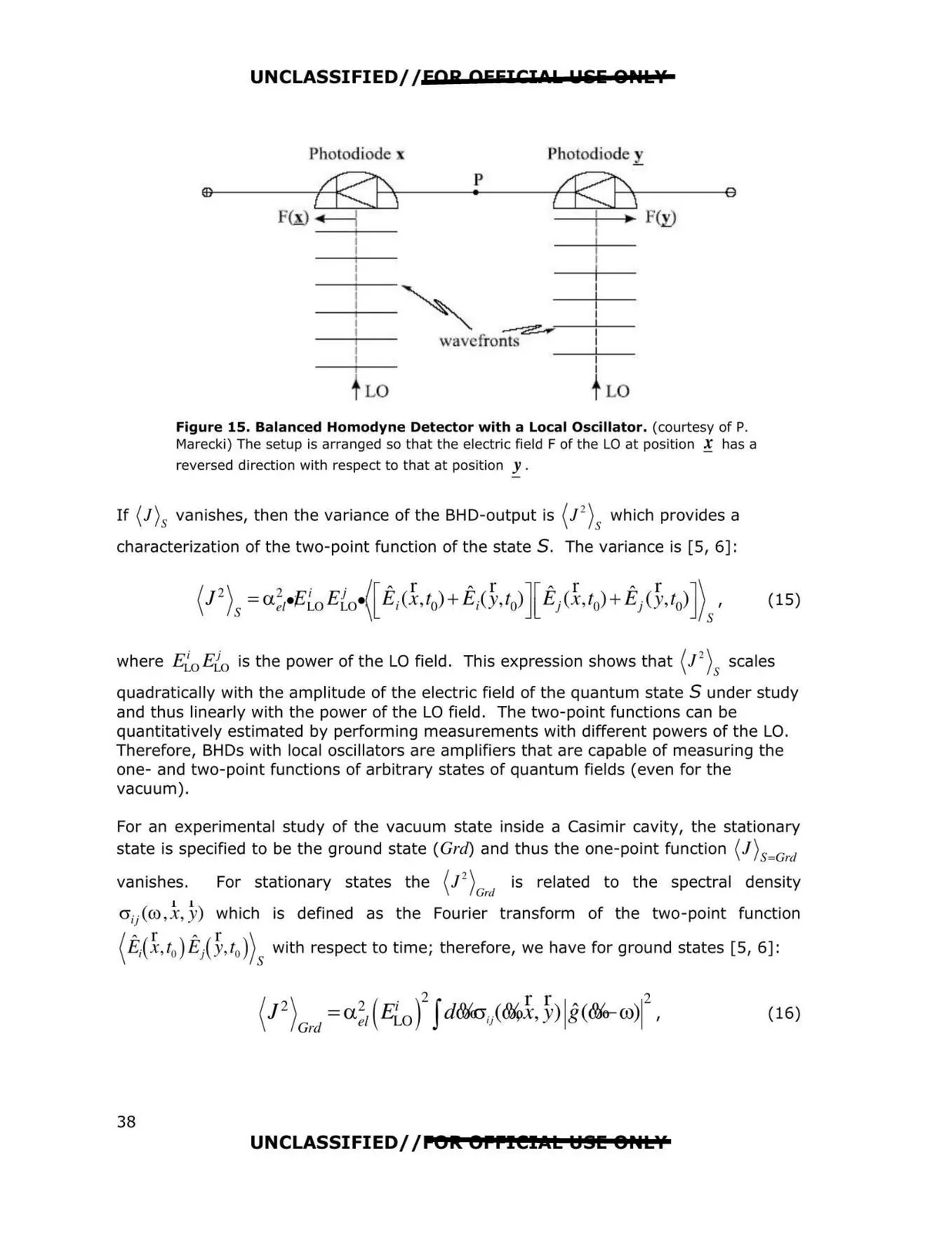
Figure 15. Balanced Homodyne Detector with a Local Oscillator. (courtesy of P.
Marecki) The setup is arranged so that the electric field F of the LO at position ! has a
reversed direction with respect to that at position y .
If (1)5 vanishes, then the variance of the BHD-output is (1 2 \
which provides a
characterization of the two-point function of the state S. The variance is [5, 6] :
(15)
where .E{_0 Elo is the power of the LO field. This expression shows that ( 12)5 scales
quadratically with the amplitude of the electric field of the quantum state Sunder study
and thus linearly with the power of the LO field. The two-point functions can be
quantitatively estimated by performing measurements with different powers of the LO.
Therefore, BHDs with local oscillators are amplifiers that are capable of measuring the
one- and two-point functions of arbitrary states of quantum fields ( even for the
vacuum).
For an experimental study of the vacuum state inside a Casimir cavity, the stationary
state is specified to be the ground state (Grd) and thus the one-point function ( l)S=Grd
vanishes.
For stationary states the (12)
is related to the spectral density
Grd
1
1
a;;(w ,x, y) which is defined as the Fourier transform of the two-point function
(E/i.t0 )E,;(},t0 )\ with respect to time; therefore, we have for ground states [5, 6]:
2
(J ?)- Grd = a el
2 (.£Lo )2f d&ku(8ir,>X,rrl
y) g " (6io-- (j))1,
(16)
UNCLASSIFIED//fl01t OPPlelJcL Y:!H!! 9HLY
38