Astronaut Scientific Debriefings, 1962-1963
NASA-UAP-D015 · page 214 of 216
Text
This text came with the file. It may have mistakes. When the text and the image disagree, the image is right.
116
MAURICE DUBIN
found by HEALEA and HouTERMANS (1940) wa in the range from 0·2 to 0·05 for
ions of He, Ne, and A at about 400 eV.
The impact ofions on a solid surface re ults also in a process known as sputtering,
wherein atoms or clusters of atoms are ejected from the surface as a result of
impact. The threshold for sputtering is of the order of 40 eV, and most values
given {or rate of sputtering lie between 1 and 10 gm/amp hour. For incident ions
at 200 e V the sputtering rate would probably fall to one-third this range of values.
For a surface containing atoms of mass number 60, one gram per ampere hour is
equivalent to approximll,tely 0·5 sputtered atoms per incident ion. Thus the
sputtering rate for metallic meteorites might be of the order of one atom per
incident air particle and possibly higher for stony meteorites.
Basicall , for all these proces ·es the important parameter for ionization is the
relative vel city. The relative amount of energy absorbed by ionization should
not be diffe ent, whe~her or not ablation of the meteoric particle occurs. Because
of the long-
ean-face path of air compared to the size of the meteoric particle, the
air particles must act independently of each other. Effectively the cross-section
for ionizatio might increase during evaporation, but this is equivalent to increas
ing the air density to allow for a larger number of collisions. Indeed, one may, as
a gross estimate, expect that on the average a fixed percentage of the kinetic
energy absorbed by the air is transmitted into ionization with an efficiency given
by GREENHOW and HAWKINS' correction of HERLOFSON's treatment.
Recently WHIPPLE (1952) has investigated the amount of meteoric material
entering the earth's atmosphere. From experiments of BURNIGHT, and BOHN and
NADIG, using rockets; CROZIER and SEELY on air pollution; VAN DE HuLST and
ALLEN by observations of zodiacal light and eclip e , and PET'l'ERSSON and ROTS HI
from observation of deep-sea sediments containing nickel: WHIPPLE noted that
data from these methods generally agree as to order of magnitude of the amount
of material falling into the earth's atmosphere. From this, the frequency of small
meteoric bodies encountering the earth's atmosphere should exceed the older
estimates 'based on meteors and meteorites (WATSON'S) by a factor of possibly
104 . The result is perhaps 103 tons or more per day on the entire earth.
Earlier the value for the number of electrons formed per cc/sec was found to
be 2 X 10- 4 erctrons per cc/sec, based on WATSO ' 'S estimates and HERLOFSON'S
theory.
Sine
GREE ' HOW has indicated that HERLOFSON's value should be
increa ed by
factor between 102 and 10, and the number of micrometeorites
should be inc ased by a factor of 10 4 to 103 , th rate of production of electrons
should be multiplied by a factor of about 105, giving an average production rate
of electrons of twenty electrons per cc.
Having determined roughly the rate of production of electrons, the rate of
disappearance of electrons must be considered in order to calculate the equilibrium
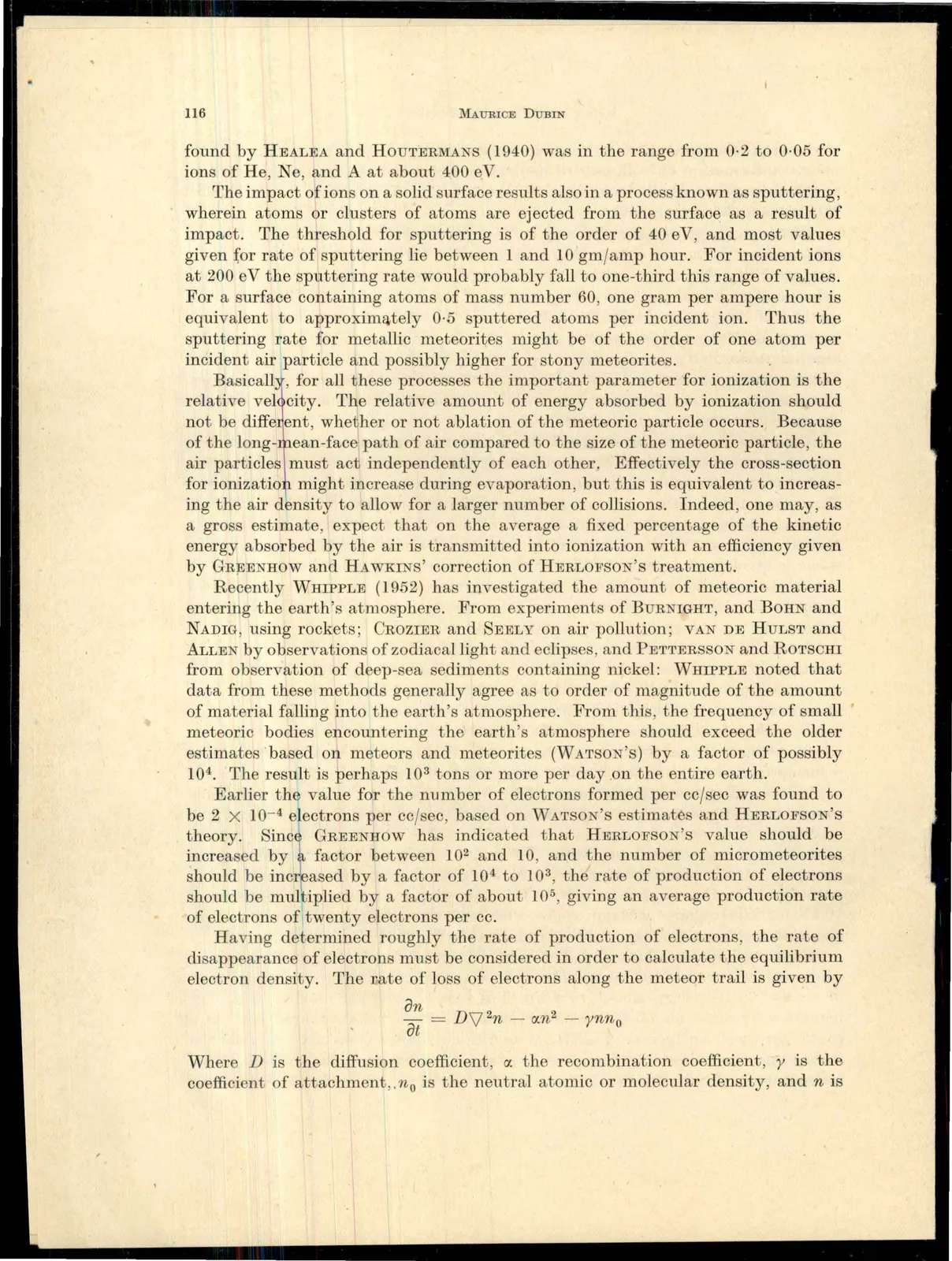
electron density. The rate of loss of electrons along the meteor trail is given by
on
-
= D \j 2n -
('J.,n 2 -
ynn 0
at
Where D is the diffusion coefficient, <J. the recombination coefficient, y is the
coefficient of attachment,.n 0 is the neutral atomic or molecular density, and n is