Astronaut Scientific Debriefings, 1962-1963
NASA-UAP-D015 · page 48 of 216
Text
This text came with the file. It may have mistakes. When the text and the image disagree, the image is right.
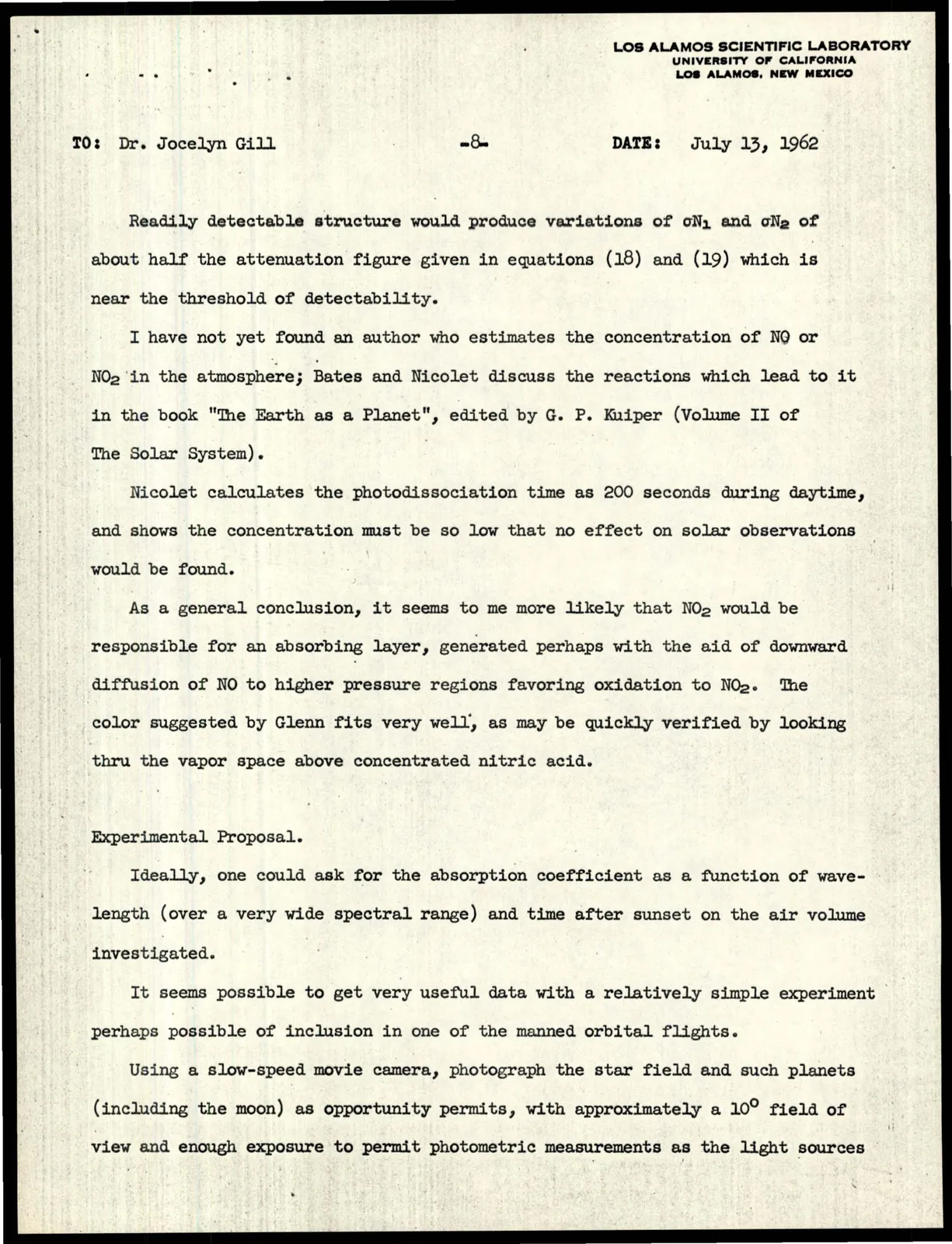
LOS ALAMOS SCIENTIFIC LABORATORY UNIVIEll81TY OP' CALIP'OIINIA LOIi ALAM09, NIEW MUICO TO: Dr. Jocelyn Gill DATE: July 13, 1962 Readily detectable structure would produce ve.r1e.t1ons of o-N1 and aNa ot about half the attenuation figure given in equations (18) and (19) which is near the threshold of detectability. I have not yet found an author who estimates the concentration of Ne or N02 'in the atmosphere; Bates and Nicolet discuss the reactions which lead to it in the book "'lhe Earth as a Planet", edited by G. P. Kuiper (Volume II of The Solar System). Nicolet calculates the photodissociation time as 200 seconds during daytime, and shows the concentration must be so low that no effect on solar observations would be found. As a general conclusion, it seems to me more likely that N02 would be responsible for an absorbing layer, generated perhaps with the aid of downward diffusion of NO to higher pressure regions favoring oxidation to N~. 'lhe color suggested by Glenn fits very well', as may be quickly verified by looking thru. the vapor space above concentrated nitric acid. Experimental Proposal. Ideally, one could ask for the absorption coefficient as a function of wave length (over a very wide spectral range) and time after sunset on the air volume investigated. It seems possible to get very useful data with a relatively simple experiment perhaps possible of inclusion in one of the manned orbital flights. Using a slow-speed movie camera, photograph the star field and such planets (including the moon) as opportunity permits, with approximately a 10° field of view and enough exposure to pennit photometric measurements as the light sources