Astronaut Scientific Debriefings, 1962-1963
NASA-UAP-D015 · page 99 of 216
Text
This text came with the file. It may have mistakes. When the text and the image disagree, the image is right.
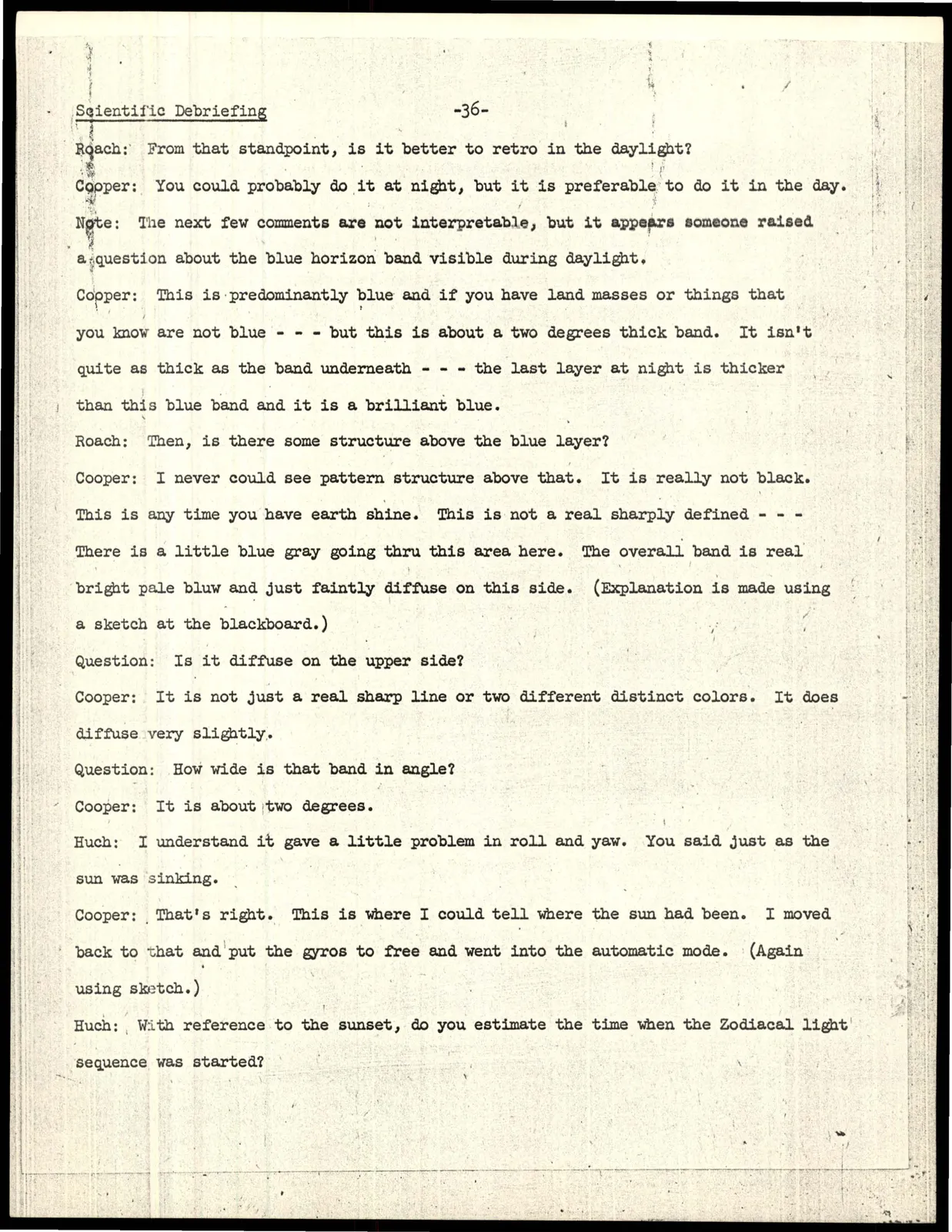
I moved , (Again 1 '1 ~ ' i I I .S~ientific Debriefing -36 l \ ; ~ . ~iach:' From that standpoint, is it better to retro in the da.yl~ft? cqpper: . You could probably do .it at night, but it is preferabl~;- to do it in the day. , ' Njte: ~'he next few comments are not interpretable, but 1t appe,-.rs eom one raised ~ . a ~question about the blue horizon band visible during daylight, Co'pper: This is ·predominantly blue· and if you have land masses or things that . ' , ' you know are not blue - - - but this is about a two degrees thick band. It isn't quite as thick as the band underneath - - - the last layer at night is thicker ' l I . . 1 than this blue band and it is a brilliant blue. Roach: Then, is there some structure above the blue layer? Cooper: I never could see pattern structure above that. It is really not black. This is any time you have earth shine. This is not a real sharply defined - - There is a little blue gray going thru this area here. The overall band is real' bright pale bluw and just faintly diffuse on this side. (Explanation is made using a sketch at the blackboard.) Question: Is it diffuse on the upper side? Cooper: It is not just a real sharp line or two different distinct colors. It does diffuse very slightly,. Question: .How wide is that band in angle? ,, Cooper: It is about 11iwo degrees. .,. Huch: I understand it gave a little problem in roll and yaw. You said just as the sun was sinking. _ Cooper:. That's right •. Tb.is is where I could tell where the sun had been. back to t hat and Iput the gyros to free and went into the automatic mode. using sketch.) Huch: , Wi th reference .to the sunset, do you estimate the time when the Zodiacal light' sequence was started? ' -:----....,..•• p ,--• ..-:-T"'7- ;--