Gemini 4 Experiment Debriefing, 1967
NASA-UAP-D018 · page 103 of 224
Text
This text came with the file. It may have mistakes. When the text and the image disagree, the image is right.
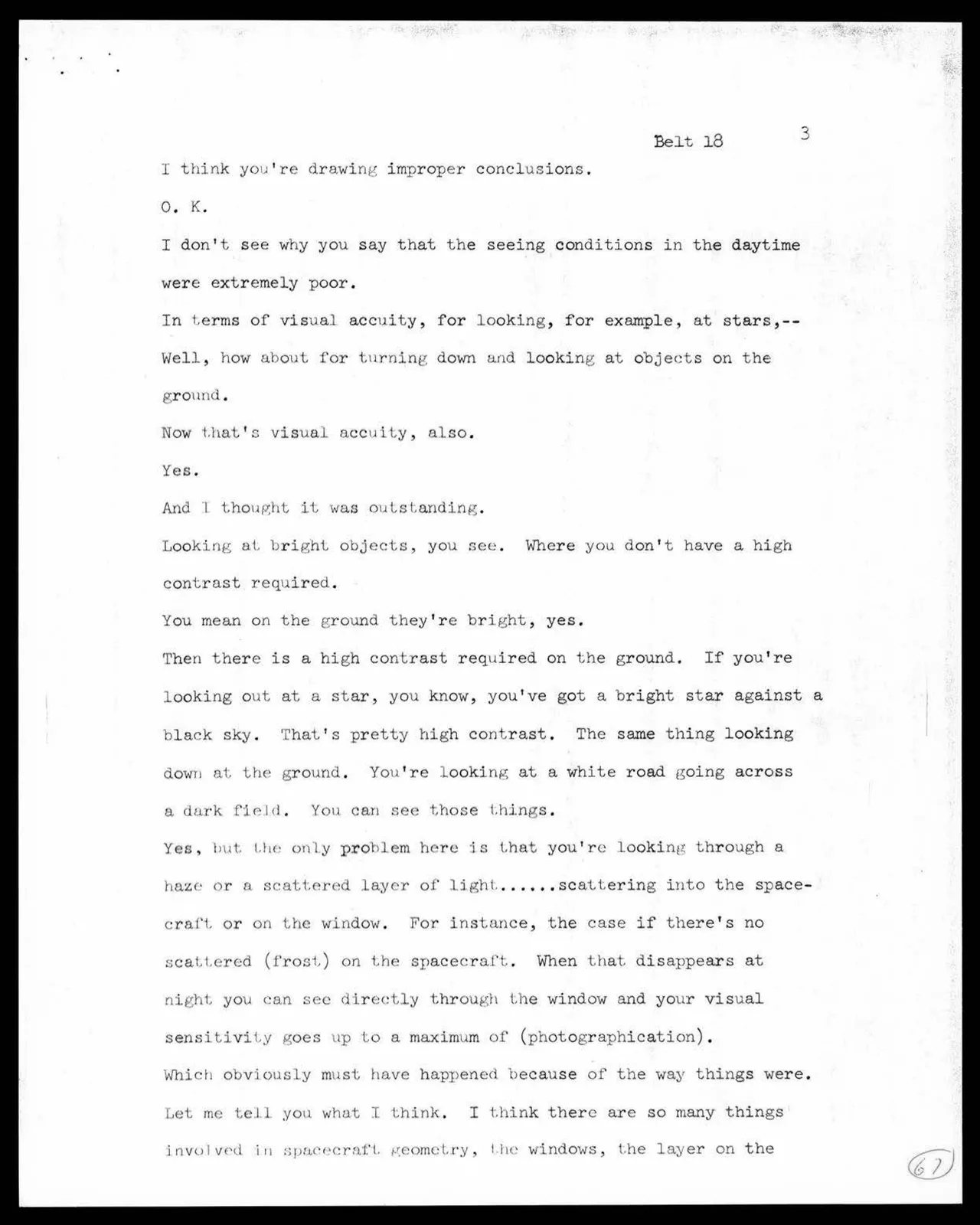
3 Belt 18 I think you ' r drawing improper conclusions . o. K. I don ' t see why you say that the seeing conditions i n the daytime were extr emely poor . In t erms of visual accuity, for looking, for example at stars, - Well , how about for tur ning down &nd looking at objects on the gronn .. Now that ' s visual acc11 ' Ly , also . Yes . And ·1 thoup;ht it was oulstanding . Looking a L br ight objects , you ::,ee . Where you don ' t have a high contrast required. You mean on the ground they ' r e br ight , yes . Then ther e is a high contrast required on the ground . If you ' re l ooking out at a star, you know, you 've got a bright star against a black sky . That ' s pr etty high contrast . The same thing l ooking down at the ground . You ' re . ooking at a white road going across a u:rk. fi0 Id . Yo1 can e those 1.hi.ne;s . Y s , lrnt. t,IH' only :prohlem h re •i Lhat you 're l ooking thro gh a ha:G • or n ·cattered lay r of ljght. ...... scattering illto the space crafi. or on Lhe window . For instance, the case if there's no scat.t. red (frost) on th spacec r a When tha disappears at nighL you can •·ec directly througl1 the window and yot r visual sensitivity goes up Lo a maxim m o:f (photogr aphication ) . Whict1 obvious y must have happened because o the way things were . Lei.. me t. 11 yoll what I think . I .link there are so many things .he layer on the