Gemini 4 Experiment Debriefing, 1967
NASA-UAP-D018 · page 11 of 224
Text
This text came with the file. It may have mistakes. When the text and the image disagree, the image is right.
Rtndczvous guidance
& recovery system ____
_,
11 Ft
8 Ft
Separation point
Oxidizer tank
•Equipment bay
27 Ft
Stage 11 engine
thrust chamber
108 Ft
10 Ft
Oxidizer
tank
Stage I engine
g1mbal point
•Equipment bay contains:
• Batteries·
• Malfunction detection system IMOSI units
• Range safety command control system
• Programmer
• Three-axis reference system !TARSI
• Radio guidance system IRGSI
• Autopilot
• Instrumentation and telemetry system
FIG.
5/24/65
M-913-65-04
GENERAL
Gemini Flight Number Four (GT-4) is the second
manned orbital flight in the Gemini Program and
the fourth flight in a series of twelve planned to
develop long-duration and rendezvous capability,
docking techniques, extra-vehicular activities,
and controlled reentry. The first three Gemini
flights demonstrated: orbital insertion capability;
spacecraft structural integrity; and spacecraft
systems performance and crew accommodation
qualities, respectively. This GT-4 mission is
intended to further demonstrate manned space
flight for a period of four days, the longest
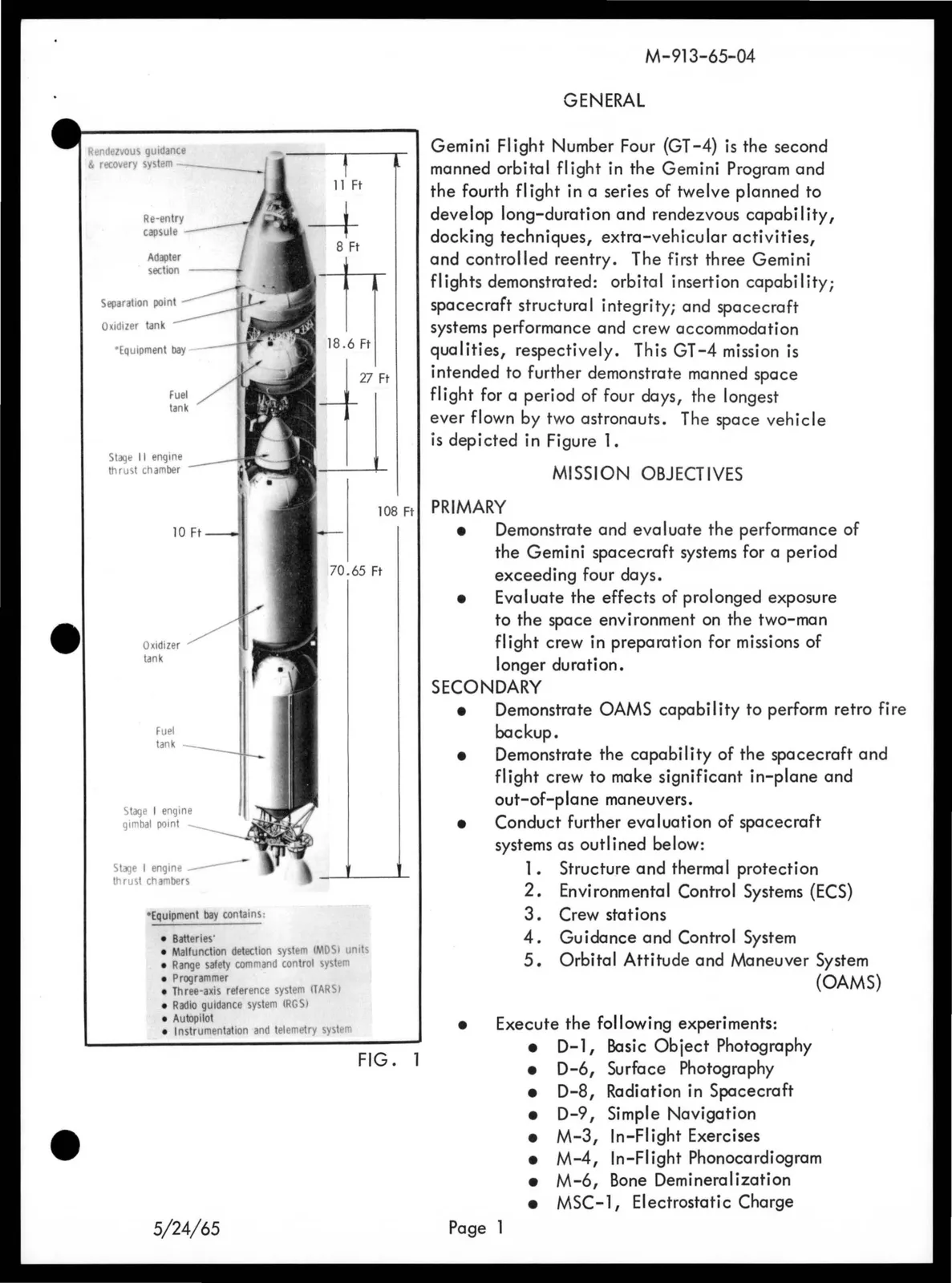
ever flown by two astronauts. The space vehicle
is depicted in Figure 1.
MISSION OBJECTIVES
PRIMARY
•
Demonstrate and evaluate the performance of
the Gemini spacecraft systems for a period
exceeding four days.
•
Evaluate the effects of prolonged exposure
to the space environment on the two-man
flight crew in preparation for missions of
longer duration.
SECONDARY
•
Demonstrate OAMS capability to perform retro fire
backup.
•
Demonstrate the capability of the spacecraft and
flight crew to make significant in-plane and
out-of-plane maneuvers.
•
Conduct further evaluation of spacecraft
systems as outlined below:
1.
Structure and thermo I protection
2. Environmental Control Systems (ECS)
3. Crew stations
4. Guidance and Control System
5. Orbital Attitude and Maneuver System
(OAMS)
•
Execute the fol I owing experiments:
•
D-1, Basic Object Photography
•
D-6, Surface Photography
•
D-8, Radiation in Spacecraft
•
D-9, Simple Navigation
•
M-3, In-Flight Exercises
•
M-4, In-Flight Phonocardiogram
•
M-6, Bone Demineralization
•
MSC-1, Electrostatic Charge
Page 1